Every good Himalayan book does to a reader what the mountains do to a body from the plains. It slows you down, and then it quietly takes something away. Ahmedabad sits at about fifty metres above sea level, so my first proper hill trip was mostly me discovering that stairs are a skill. That feeling of a place deciding how much of you it will allow runs through all thirteen books here, whether the writer is walking to a bazaar or dying near a summit.
So I have not ranked these by quality. I have ranked them by height. Number one is set in river valleys where the jeep still reaches, number thirteen is set in the zone where the human body starts shutting down on its own, and the list climbs steadily in between. Read it as a map. Pick the altitude you are in the mood for and the book follows.
The second thing marked on every entry is who is telling you the story: a writer who lives up there, or one who came, looked hard, and went home to write it. Both produce good books, they just notice different things, and saying which is which felt more useful than pretending all mountain writing comes from the same place. Five of these are novels and eight are nonfiction, labelled so you never open the wrong kind by accident.
Quick picks are right below if you want to be reading something within ten minutes. If you take one name off this page, take The Snow Leopard. If that sounds too slow for the week you are having, take Into Thin Air instead and lose a night of sleep.
How I picked these
- Altitude sets the order, not merit. Where two books sit at roughly the same height I put the gentler one first, and the quick picks tell you which ones are actually the best.
- The mountains had to be the story, not the wallpaper. Books that park a plot in a hill station when the same plot could happen in Pune got cut early.
- I kept the Himalayas to the Himalayas. The Living Mountain is Scotland, Touching the Void is the Andes, and the famous K2 books are Karakoram, so none of them are here even though every other list smuggles them in.
- One Ruskin Bond book only. He could fill this page by himself, he already has his own list on this site, so he gets the single title that is most about the hills themselves.
- Every book checked through Google Books and Open Library with a real cover, and the year shown is first publication, not the reprint edition sitting in your hand.
- Where the writer is Tibetan, Sherpa, Kashmiri, Adi or a lifelong hill resident, I say so. Where the writer is a visitor with a return ticket, I say that too.
The whole list at a glance
All 13 books, in order
| # | Book | Author | Year | Vibe | Best for |
|---|
| 1 | The Legends of Pensam | Mamang Dai | 2006 | quiet, oral, unhurried | readers tired of Uttarakhand |
| 2 | The Inheritance of Loss | Kiran Desai | 2006 | cold, sardonic, unsparing | readers who like literary novels |
| 3 | Man-Eaters of Kumaon | Jim Corbett | 1944 | patient, tense, plainspoken | reluctant readers and teenagers |
| 4 | The Folded Earth | Anuradha Roy | 2011 | melancholy, warm, watchful | readers starting with Indian fiction |
| 5 | Rain in the Mountains | Ruskin Bond | 1993 | gentle, domestic, rained-on | bedside reading |
| 6 | Curfewed Night | Basharat Peer | 2008 | plain, raw, personal | readers who want first-hand reportage |
| 7 | The Far Field | Madhuri Vijay | 2019 | cool, tense, guilty | readers who like difficult narrators |
| 8 | Seven Years in Tibet | Heinrich Harrer | 1952 | hardy, curious, evasive | readers who like survival travel |
| 9 | Cave in the Snow | Vicki Mackenzie | 1998 | cold, stubborn, practical | readers who like quiet extremes |
| 10 | We Measure the Earth with Our Bodies | Tsering Yangzom Lama | 2022 | tender, patient, displaced | readers who like family sagas |
| 11 | The Snow Leopard | Peter Matthiessen | 1978 | austere, searching, exact | readers who like slow books |
| 12 | Touching My Father's Soul | Jamling Tenzing Norgay | 2001 | reverent, personal, dutiful | readers who liked Into Thin Air |
| 13 | Into Thin Air | Jon Krakauer | 1997 | urgent, cold, haunted | people who say they hate reading |
The list
The books, ranked
1

Camp 1, Arunachal, she lives there
The Legends of Pensam
Mamang Dai2006about 210 pages
Linked stories from an Adi community on the Siang, told the way a family actually talks about its own dead.
Arunachal Pradesh is the stretch of the Himalayas most Indian readers cannot name a single town in, and Mamang Dai is from there. This is a book of connected stories about one Adi community along the Siang river, moving between a generation that remembers the British and the missionaries and a generation with government jobs and jeeps. A visiting journalist gives you a way in. Nothing is arranged as a plot: people appear, the river takes someone, an elder explains a death in terms you are not fully let into, a road arrives. The effect is less like reading a novel and more like sitting in a courtyard while a family talks past you.
Why it is at 1
First because it is the lowest ground on the list, and because it is the only book here from the eastern Himalayas, which the whole genre ignores in favour of Uttarakhand and Ladakh. It is also the clearest case of a writer who is not visiting. Dai is not explaining her people to an outside reader, so some of it stays closed to you, and that is the honest part.
Read it ifyou want the Himalayas that never show up in travel photography
Skip it ifyou need a plot with a spine and get restless when a book keeps changing whose story it is
quiet, oral, unhurriedBest for: readers tired of Uttarakhandfictionarunachalnortheastlinked stories
2
Camp 1, Kalimpong, half inside, half out
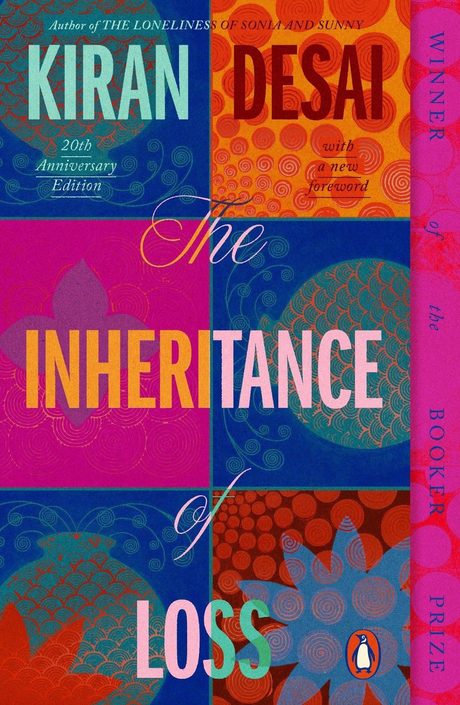
The Inheritance of Loss
Kiran Desai2006about 360 pages
A damp Kalimpong house, a retired judge who despises himself, and a cook's son washing dishes in New York.
Kalimpong in the 1980s, with the Gorkhaland agitation building in the town and Kanchenjunga sitting over everything. A retired judge lives in a rotting house with his teenaged granddaughter, his cook, and a dog he loves more than either of them. The cook's son is in New York, moving between basement kitchens and writing home about a life he does not have. Desai cuts between the hill town and the immigrant kitchens, and the link she draws is uncomfortable: the same colonial hangover that taught the judge to be ashamed of himself is what is pushing the boy out of the country. It won the Booker Prize.
Why it is at 2
Second on the ladder and the most famous book on it. I have placed it low because Kalimpong is a town with a market and a post office, and Desai's mountains are weather more than terrain. Fair warning, almost nobody in this book is treated gently, and readers who want warmth from an Indian novel come away cold. Read it for the wet, class-sick hill town nobody else bothers to write.
Read it ifyou want a hill town written with no nostalgia at all
Skip it ifyou want characters to be looked after by their author
cold, sardonic, unsparingBest for: readers who like literary novelsfictionkalimpongbookerdiaspora
Heads up: political violence in the background and an ending that offers very little comfort
3

Camp 1, Kumaon, he lived and hunted there
Man-Eaters of Kumaon
Jim Corbett1944about 244 pages
The book that taught generations of Indian readers how to read a forest, written by the man villagers sent for.
Corbett grew up in Kumaon and spent decades being called out by villages to kill tigers and leopards that had started hunting people. These are those accounts, told at the pace of the tracking rather than the shooting. What surprises first-time readers is how much of it is about walking: which ridge, which stream, how long the light will hold, what the langurs are saying about where the tiger is. He is also unusually clear that a man-eater is almost always an injured animal, and that the injury often came from a bad shot fired by somebody like him. The national park in Uttarakhand carries his name.
Why it is at 3
Third because the Kumaon hills are still low country by Himalayan standards, forest and terraced fields rather than snow. This is the oldest book on the list and the one most Indian readers meet at fourteen through a school extract. Corbett is a colonial officer writing in the 1940s and his assumptions about the people he walks among are of their time. Take him for the tracking and the fear.
Read it ifyou want the forest at ground level, at night, with something following you
Skip it ifhunting stories are not something you can read, however carefully told
patient, tense, plainspokenBest for: reluctant readers and teenagersnonfictionkumaonwildlifeclassic
Heads up: animals are hunted and killed, and people are killed by animals
4
Camp 1, Ranikhet, she lives there
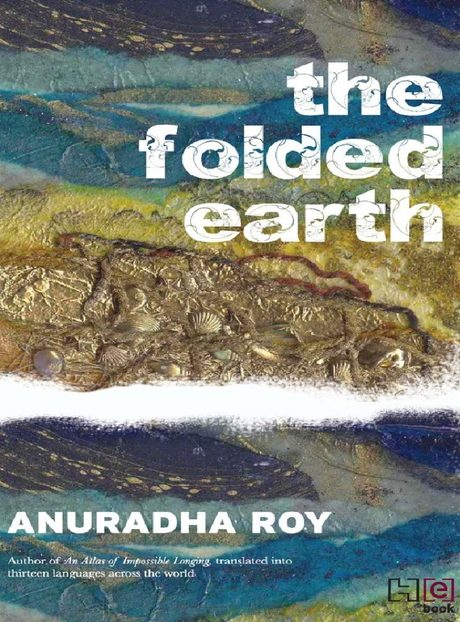
The Folded Earth
Anuradha Roy2011about 202 pages
A young widow moves to a Kumaon hill town to disappear, and the town decides how much of her it will keep.
Maya loses her husband in a climbing accident and leaves Hyderabad for a hill town in Kumaon, where she teaches at a mission school and rents rooms from an old man with a house full of paper. The novel is about what happens to an outsider who stays: the place absorbs her for a while, then reminds her she is not from here. Around the edges there is an election, an institution quietly buying up land, and a village girl whose life keeps narrowing while Maya watches. Roy lives in Ranikhet, and it shows in the small things, like what the light does to a deodar in November.
Why it is at 4
Fourth because Ranikhet sits a little higher than Kalimpong, and because this is the book on the list that is most honest about being a plains person in the hills. It is warmer than Desai and slower, and to its credit it never suggests that mountain air fixes grief. If you want one novel to start with and Kashmir feels like too much this week, start here instead.
Read it ifyou want a hill town novel with real people in the background, not extras
Skip it ifyou want plot, because this one drifts on purpose for two hundred pages
melancholy, warm, watchfulBest for: readers starting with Indian fictionfictionranikhetkumaongrief
Heads up: the book opens in bereavement and stays close to it
Pairs with: Man-Eaters of Kumaon, because Roy's Ranikhet is Corbett's country two generations later
5

Camp 1, Mussoorie, decades of residence
Rain in the Mountains
Ruskin Bond1993about 268 pages
Bond's hillside journal: the walk to the bazaar, the trees he knows by name, and a monsoon that refuses to leave.
Bond has lived above Mussoorie for most of his adult life and this is the book where he mostly writes about that. The walk down to the bazaar, the window he works at, the trees he knows individually, the way the monsoon arrives and then settles in like a relative. It mixes journal entries, short essays and a handful of poems, so you can open it anywhere and get a complete thing in two pages. He is not attempting anything grand. He tells you what the hillside did today, and after thirty pages you catch yourself noticing your own street differently on the way to work.
Why it is at 5
Fifth because Mussoorie is where the road ends for most Indian tourists, and because Bond is the reason so many of us picture the Himalayas as somewhere to sit rather than climb. He gets one slot although he could fill the page alone. Pick this over his fiction if you want the hills themselves, since here the mountain is the subject and not the backdrop to a boy's summer.
Read it ifyou want a book you can read four pages of before sleep and lose nothing
Skip it ifyou need narrative drive, because nothing in here is going anywhere
gentle, domestic, rained-onBest for: bedside readingnonfictionmussoorieessaysslow
6
Camp 2, Kashmir valley, he grew up there
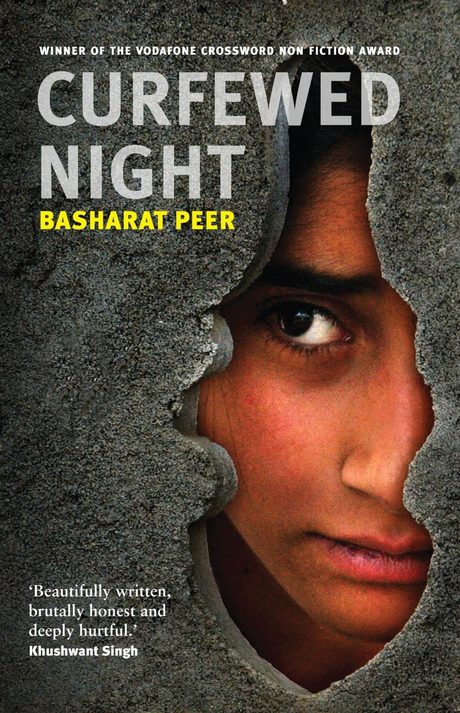
Curfewed Night
Basharat Peer2008about 198 pages
A Kashmiri journalist goes home to write down what the 1990s did to the people he grew up with.
Peer was a schoolboy in south Kashmir when the militancy began, and boys only a little older than him were crossing over for training while his family sent him away to study. Years later, working as a journalist in Delhi, he went back to record what the decade had done to people he knew by name. The book is built out of those visits: a village that lost most of its young men, an interrogation centre that has since gone back to being a building, a mother who keeps a room ready for a son who has not come home. He writes it plainly, which is the right call, because none of this material needs help.
Why it is at 6
Sixth because the Kashmir valley is where altitude stops being scenery on this list and starts being strategy, with every ridge holding a post. This is a memoir and it argues from one Kashmiri life, which is what it says on the cover. Read it beside The Far Field, which arrives at the same ground from outside and admits as much. Between the two you get more than either gives alone.
Read it ifyou want the 1990s in Kashmir at the scale of one family
Skip it ifyou are looking for a balanced political history rather than one man's account
plain, raw, personalBest for: readers who want first-hand reportagenonfictionkashmirmemoirreportage
Heads up: torture, disappearances and the killing of civilians, described directly
7
Camp 2, Kashmir, an outsider climbing in
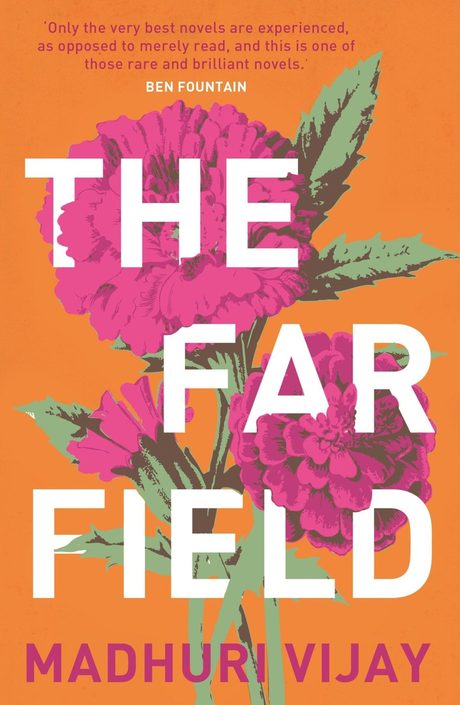
The Far Field
Madhuri Vijay2019about 429 pages
A rich, aimless Bangalore woman goes looking for a salesman in Kashmir and sets something in motion she cannot stop.
Shalini is thirty, from Bangalore, and stalled after her mother's death, which she has no language for. She goes looking for a Kashmiri salesman who used to visit their flat with bolts of cloth and make her mother laugh. The search takes her to Delhi, then to Kashmir, then up to a village where the army, the militants and the families are all part of one daily arithmetic. The novel is clear-eyed about what she is: a wealthy, bored, well-meaning person moving through somebody else's emergency, mistaking her own need for usefulness. What she sets off is the whole point of the book.
Why it is at 7
Seventh because Vijay keeps climbing, out of the valley and up to a village where the road gives up, and the higher the book goes the more damage her narrator does. I rate it the best novel here. It also does the thing most fiction about Kashmir avoids: it puts the outsider inside the frame rather than behind the camera, then declines to forgive her at the end.
Read it ifyou want a novel that makes you complicit and knows it
Skip it ifyou want a likeable narrator, because this one is not built to be liked
cool, tense, guiltyBest for: readers who like difficult narratorsfictionkashmirclassguilt
Heads up: conflict violence, a disappearance, and grief
8
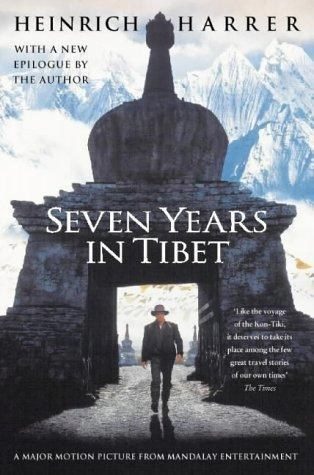
Camp 3, Lhasa, a fugitive who stayed
Seven Years in Tibet
Heinrich Harrer1952about 324 pages
An Austrian climber escapes a British internment camp, walks into Tibet, and ends up tutoring the young Dalai Lama.
Harrer was an Austrian climber caught in British India when the war began and interned near Dehradun. After several failed attempts he and Peter Aufschnaiter got out and walked north. What follows is close to two years of illegal travel across the Tibetan plateau on almost no money, then five years in Lhasa in the last decade before the Chinese army arrived. He learned the language, took work, and spent time with the teenaged Dalai Lama. The walking chapters are the best of it: cold, hunger, and one village after another deciding whether to feed two foreigners or report them.
Why it is at 8
Eighth because Lhasa sits at roughly 3,650 metres and the route to it crosses higher passes than that. One thing to know before you start. In 1997 the German magazine Stern published files showing Harrer had joined the Nazi party and the SS before the war, and he acknowledged it publicly. That does not make the Tibet he describes false, but it does explain a narrator who presents himself as a wanderer with no past.
Read it ifyou want pre-1950 Tibet from a witness who was actually there
Skip it ifyou cannot read a book apart from the politics of the man who wrote it, which is a fair position
hardy, curious, evasiveBest for: readers who like survival travelnonfictiontibettravel1950s
Heads up: the author was later confirmed as a Nazi party and SS member, discussed above
Pairs with: We Measure the Earth with Our Bodies, which gives you the Tibetan side of the same century
9
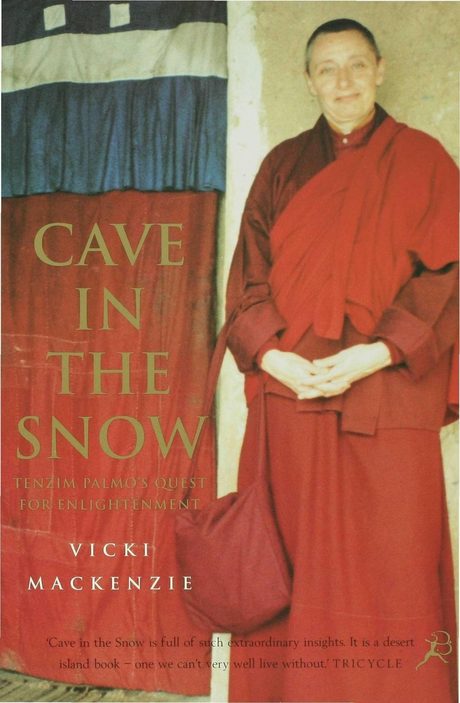
Camp 3, Lahaul, a cave at the snow line
Cave in the Snow
Vicki Mackenzie1998about 335 pages
A London girl becomes a Buddhist nun and spends twelve years alone in a Himachal cave, three of them in strict retreat.
Diane Perry grew up in London, read a book about Buddhism in her teens, and by her twenties was one of the first Western women ordained in the Tibetan tradition as Tenzin Palmo. When it became clear the monasteries had no real place for a woman who wanted to practise seriously, she went up into Lahaul in Himachal and lived alone in a cave for twelve years, three of them in strict retreat, at a height where the passes shut for months. Mackenzie writes it as biography rather than devotion, which is why it works for readers with no interest in Buddhism at all. Most of it is practical: heat, food, snow, stubbornness.
Why it is at 9
Ninth because that cave sits above the tree line, in the part of Himachal that tourists now drive through on the way to Ladakh without looking up. It is also the only book here where the mountain is neither subject nor setting but equipment. Mackenzie is a sympathetic biographer who largely takes her subject at her word, so read it as one life told from the inside rather than an investigation.
Read it ifyou want an extreme story told in an unexcited voice
Skip it ifspiritual biography puts you off even when it is told plainly
cold, stubborn, practicalBest for: readers who like quiet extremesnonfictionhimachalbiographybuddhism
10

Camp 3, Tibet to exile, a Tibetan writer
We Measure the Earth with Our Bodies
Tsering Yangzom Lama2022about 438 pages
Two sisters walk out of Tibet as children, and fifty years of exile follow them from a Nepal camp to a Toronto winter.
Two sisters leave their Tibetan village as children after it empties, and grow up in a refugee camp in Nepal where the food is aid and the future is a rumour that keeps getting revised. One stays in the Himalayas, one reaches Toronto through study, and the novel follows both across five decades, along with a small statue that keeps turning up wherever the family is. Lama is Tibetan, born in Nepal, raised partly in Canada, and she writes exile as an ordinary daily condition rather than a tragedy staged for outsiders. The Kathmandu chapters, where the family is neither at home nor gone, are the ones that stayed with me.
Why it is at 10
Tenth because it begins high, in a village and the passes leading out of it, and then keeps descending: to a camp, to a city, to a basement in Canada. Put it straight after Harrer. He describes Tibet in the 1940s as a guest with a secret of his own. Lama writes the century that followed from inside the family it happened to, and the two together are worth more than four separate books.
Read it ifyou want Tibet written by a Tibetan rather than by a visitor
Skip it ifyou want one continuous plot rather than several lives braided together
tender, patient, displacedBest for: readers who like family sagasfictiontibetnepalexile
Heads up: displacement, deaths in the family, and life in a refugee camp
11
Camp 3, Dolpo, a visitor with a reason
The Snow Leopard
Peter Matthiessen1978about 336 pages
A grieving man walks into Dolpo behind a zoologist, hoping to see one animal, and does not see it.
In 1973 Matthiessen walked into Dolpo in north-west Nepal with the zoologist George Schaller, who was going to study blue sheep near an old monastery close to the Tibetan border. Matthiessen went for reasons of his own. His wife had died the year before and he was a few years into Zen practice, and this is the book where those two facts collide at five thousand metres. It is a daily journal: the porters, the passes, the cold, the arguments he keeps having with himself. The animal in the title is the one thing the trip does not hand him, and he decides that absence is the answer.
Why it is at 11
Eleventh, and the best written book on this list by some distance. Schaller's science gives it a spine, so the Buddhism never floats off into vapour, and Matthiessen is hard enough on himself that the grief never turns into a performance. It is slow, and plenty of readers give up in the first hundred pages. Get past the approach march and the book opens right up.
Read it ifyou want a walking book that is really about loss and attention
Skip it ifyou have no patience for a man thinking about himself for three hundred pages
austere, searching, exactBest for: readers who like slow booksnonfictionnepaldolpogrief
Heads up: bereavement runs through the whole book
12
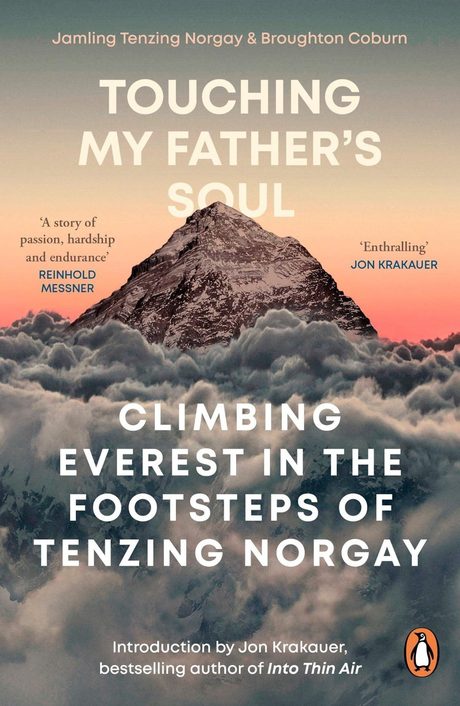
Camp 4, Everest, a Sherpa on his father's mountain
Touching My Father's Soul
Jamling Tenzing Norgay2001about 338 pages
Tenzing Norgay's son climbs Everest in 1996 and writes the version of that mountain the famous books leave out.
Jamling Tenzing Norgay is the son of the man who stood on the summit with Edmund Hillary in 1953, which is a heavy thing to carry uphill. He climbed Everest himself in 1996, in the same season as the disaster Krakauer wrote about, and this book is both that climb and a long argument with his father, who did not want his children on the mountain. Written with Broughton Coburn, it gives you the part of Everest the bestsellers skip: the pujas before a departure, the goddess the Sherpa families understand to live up there, and what those families actually think of the clients who arrive every spring.
Why it is at 12
Twelfth because it reaches the summit, and it comes before Krakauer because it is written by somebody the mountain belongs to. It is not as well made a book. The prose is plainer and the structure wanders in the middle. It answers the question Into Thin Air cannot even ask, which is what the people doing the real work up there believe they are doing.
Read it ifyou want Everest from the side that carries the loads
Skip it ifyou want pure mountaineering action with the religion left out
reverent, personal, dutifulBest for: readers who liked Into Thin Airnonfictioneverestsherpamemoir
Heads up: deaths on the mountain, described from close range
Pairs with: Into Thin Air, read in this order so the Sherpa account lands first
13
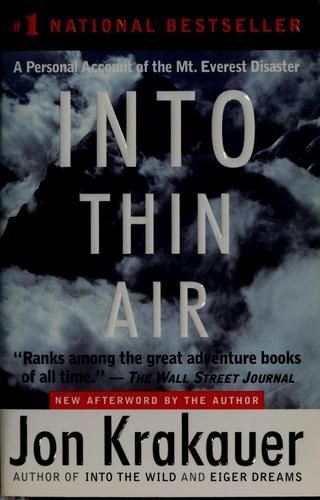
Camp 4, the death zone, a journalist who came down
Into Thin Air
Jon Krakauer1997about 378 pages
A magazine assignment about commercial Everest guiding turns into the deadliest day the mountain had seen.
Krakauer went to Everest in 1996 on an assignment about the commercial guiding business, joined a client expedition, reached the summit, and came down into a storm that turned the descent into one of the deadliest days the mountain had known. He wrote the book fast, while it was still raw, and you can feel that on the page. It remains the clearest account anybody has written of what altitude does to judgement: how a decision that would be obvious at sea level becomes impossible at eight thousand metres, and how experienced people watch each other make fatal choices without finding the words to stop them.
Why it is at 13
Last because it is the highest, and because everything below it is about living in these mountains while this one is about dying in them. It is also the most readable thing here. Two cautions. Krakauer is writing about people he watched die, weeks after it happened, and other survivors, Anatoli Boukreev especially, disputed his version in print. Treat it as one participant's account rather than the record.
Read it ifyou want a true story that moves faster than most thrillers
Skip it ifyou are about to fly somewhere and would rather not think about dying outdoors
urgent, cold, hauntedBest for: people who say they hate readingnonfictioneverestdisasterreportage
Heads up: detailed accounts of deaths, bodies and severe injury
Pairs with: The Climb by Anatoli Boukreev, if you want the version that argues back
Worth knowing
How the altitude ladder works
Camp 1 is the country where the road still goes: river valleys in Arunachal, hill towns like Kalimpong, Ranikhet and Mussoorie, forest and terraced fields and a bazaar with a chemist in it. Camp 2 is the Kashmir valley and the villages above it, where height is measured in army posts rather than metres. Camp 3 is above the tree line, the Tibetan plateau, a Himachal cave at the snow line, the Dolpo passes. Camp 4 is Everest, where the air holds about a third of the oxygen your body expects.
One honest wrinkle. The Kashmir valley floor is around 1,600 metres, which is lower than Mussoorie, so Camp 2 is not a strict step up from Camp 1. I have kept it there because both Kashmir books climb hard out of the valley and the climbing is what they are about. Inside each camp I ordered by what I would hand a reader first, not by a survey number.
One more thing this ordering means: rank one is not the best book here. It is the lowest. The quick picks at the top carry my actual verdicts, and the best book on the page sits at eleven.
Worth knowing
Who is telling you the story
Roughly half of these were written by people who live in the mountains and half by people who arrived with a notebook. Residents notice maintenance: what breaks in winter, who fixes the water line, which family has stopped speaking to which. Visitors notice thresholds, the first pass, the first prayer flag, the first night they cannot sleep for the thinness of the air. You need both, but you should know which one you are holding, because a visitor writing about belonging is describing something they watched rather than something they did.
The place this matters most is Kashmir and Tibet, where outsider accounts have shaped what the rest of the world thinks it knows. That is why Basharat Peer sits next to Madhuri Vijay, and Tsering Yangzom Lama sits next to Heinrich Harrer. Read the pairs and the gap between them tells you something neither book says on its own.
Worth knowing
Books that land on Himalaya lists and should not
Nan Shepherd's The Living Mountain is a wonderful book about the Cairngorms in Scotland, and it turns up on Himalayan lists constantly because of the word mountain. Joe Simpson's Touching the Void happens in the Peruvian Andes. Most of the celebrated K2 books, including the ones about the 2008 season, are set in the Karakoram, which is a separate range on the other side of the Indus, and lumping it in here would let me pad the list with easy drama.
Kipling's Kim is a genuine Indian classic but it spends most of its length on the plains and the Grand Trunk Road, reaching the hills only late. Shantaram is Bombay with a short trip elsewhere. Anything set in Dehradun city, which sits in a valley below the range, did not qualify either, which is why Ruskin Bond is represented by his Mussoorie book and not by Rusty.
People also ask
Questions, answered
Which is the best book set in the Himalayas?
The Snow Leopard by Peter Matthiessen, if you can take a slow book. It is a walk into Dolpo in Nepal with a zoologist, and underneath it is a man dealing with his wife's death, so the mountains do actual work rather than sitting there being scenic. If slow is not your week, Into Thin Air is the most readable book on this list, and The Far Field is the best novel.
What is the best novel set in the Himalayas?
The Far Field by Madhuri Vijay. A woman from Bangalore goes to Kashmir chasing a memory of her dead mother and causes harm she is not equipped to understand. It is the rare novel about the mountains that admits the narrator is a tourist in somebody else's crisis. The Inheritance of Loss is the more famous choice and The Folded Earth is the gentler one.
Are there good Himalayan books by Indian writers?
Most of this list, actually. Mamang Dai writes Arunachal from inside an Adi community, Basharat Peer writes Kashmir as a Kashmiri, Anuradha Roy writes Kumaon from her house in Ranikhet, Ruskin Bond has lived above Mussoorie for decades, and Kiran Desai and Madhuri Vijay write the hills from an Indian outsider's angle. The foreign writers here are the Everest and Tibet books, where they were the ones on the ground.
Do I need to be into trekking or mountaineering to enjoy these?
No. Only two of the thirteen are climbing books, and both sit at the very top of the list. The rest are novels, memoirs and essays where the mountains shape ordinary life: school teaching, funerals, elections, a monsoon that will not end. If you want zero rope and crampons, start at rank one and stop reading at rank eleven.
Which Himalayan book should I read on a trip to the mountains?
Match the book to the region and it doubles in value. Rain in the Mountains for Mussoorie and Landour, The Folded Earth or Man-Eaters of Kumaon for Nainital and Ranikhet, Cave in the Snow for Himachal and the road to Ladakh, The Snow Leopard for anything in Nepal. Save the Kashmir books for home, since reading them on a Srinagar houseboat is a heavier experience than most holidays want.
Are these books hard to find in India?
Almost all of them are in print here in Indian editions and easy to get online or in any decent bookshop. Bond, Corbett, Desai, Roy, Vijay and Peer are stocked everywhere. Matthiessen, Krakauer and Harrer come in imported or Indian paperback and are commonly available. Jamling Tenzing Norgay's book is the one you may have to order rather than find on a shelf.
Before you go
What to read tonight
If you have one evening and no appetite for effort, open Rain in the Mountains at any page and let Bond describe the weather at you for forty minutes. If you have a week, read The Far Field, and then read Curfewed Night straight after so the same ground gets told twice from two very different distances. If you want the one that will still be in your head next year, it is The Snow Leopard, and the trick with it is to stop treating the pages as pages and let the walking rhythm take over.
After that, the natural next step is downhill and outward. Corbett will send you to nature writing, Krakauer will send you to disaster reporting, Lama and Peer will send you looking for more writing from places India argues about rather than reads. Pick your altitude, and remember that the best mountain books are usually the ones where nobody reaches a summit.
Keep going
Lists that pair with this one
Authors
The 13 Best Ruskin Bond Books, Ranked (Where to Start at Any Age)
Thirteen distinct books, ranked by what they give a first-time reader, with an age label on every one.
Nonfiction
15 Best Travel Books About India, Even If You Live Here
Ranked by what each one gives a reader who already knows what a railway platform smells like at four in the morning.
Indian Fiction
20 Best Books by Indian Women Authors, From 1905 to 2025
Ranked by how hard I would push each one at a stranger, with a door on every book so you know how much patience it asks for.
Mood & Life
16 Best Books for Long Flights and Train Journeys, by Hours
Every book here is timed: roughly how many hours it fills, and how well it survives being put down for the meal trolley.
Mood & Life
15 Best Books to Read in Monsoon, Matched to Your Rain Day
Ordered the way the season actually moves, from the dry wait before the first burst to the rain that outlasts everybody, with the exact kind of wet day each book suits.