The first travel book about India I ever finished was written by a Scotsman, and it told me things about Delhi that no Indian had ever bothered to tell me. That irritated me for about a week. Then I understood the trick: he was looking, and I had stopped looking somewhere around class seven. That is what this genre is good for if you already live here, not information, which we have plenty of, but attention.
So I have not ranked these by prose quality. I have ranked them by what they give a reader who already knows what a railway platform smells like at four in the morning. A book that patiently explains chai to Americans scores low here even when the sentences are lovely. A book that makes you see your own city sideways scores high even if the author got half the names wrong.
Every entry carries a tag for where the writer was standing: outsider, returnee, or insider. Outsider is not an insult on this list. Some of the sharpest books here were written by people who arrived with no context at all, and their whole advantage is that nothing was normal to them. But I say where it shows, including two famous books that are worth your time and are also, in places, quite unpleasant about the country they are describing.
How I picked these
- The test was one question: after reading it, did I look at something familiar differently. Books that only work as an introduction for foreigners got cut.
- Travel and reportage blur here and I let them blur. Maximum City is technically reportage and it is still number one, because a man walking his own city for two years is travel writing by any definition worth having.
- Every book checked through Google Books and Open Library, so every cover and edition here is a real one you can buy or borrow.
- Land of the Seven Rivers gets filed under travel constantly and I left it out, because it is a history of Indian geography rather than a book about going somewhere.
- Two books sit here with warnings rather than recommendations, and the warnings are inside their entries where you will actually read them, not buried in a footnote.
The whole list at a glance
All 15 books, in order
| # | Book | Author | Year | Vibe | Best for |
|---|
| 1 | Maximum City | Suketu Mehta | 2004 | immersive, restless, unsparing | anyone living in an Indian city |
| 2 | City of Djinns | William Dalrymple | 1993 | funny, curious, layered | anyone in or near Delhi |
| 3 | The Epic City | Kushanava Choudhury | 2017 | warm, melancholy, ordinary | readers who left a city and wonder |
| 4 | Chasing the Monsoon | Alexander Frater | 1990 | joyful, driven, atmospheric | reading during an actual monsoon |
| 5 | Nine Lives | William Dalrymple | 2009 | quiet, specific, respectful | readers tired of generalisations |
| 6 | Following Fish | Samanth Subramanian | 2010 | light, curious, precise | a short trip or a long flight |
| 7 | Butter Chicken in Ludhiana | Pankaj Mishra | 1995 | sharp, snobbish, prescient | understanding small-town India |
| 8 | India: A Million Mutinies Now | V. S. Naipaul | 1990 | patient, argued, cold | readers who want the 1980s explained |
| 9 | Karma Cola | Gita Mehta | 1979 | dry, savage, brief | one sitting, one long train ride |
| 10 | No Full Stops in India | Mark Tully | 1991 | measured, reported, argumentative | readers who like essays |
| 11 | An Area of Darkness | V. S. Naipaul | 1964 | brilliant, contemptuous, wounded | readers who can argue back |
| 12 | Around India in 80 Trains | Monisha Rajesh | 2012 | friendly, chatty, light | an actual long train journey |
| 13 | Chai, Chai | Bishwanath Ghosh | 2009 | slow, unhurried, small-town | readers who like nothing happening |
| 14 | The Great Railway Bazaar | Paul Theroux | 1975 | witty, sour, restless | readers who like the genre itself |
| 15 | Holy Cow | Sarah Macdonald | 2002 | breezy, jokey, shallow | a beach, not a bookshelf |
The list
The books, ranked
1
Returnee, two years walking his own city
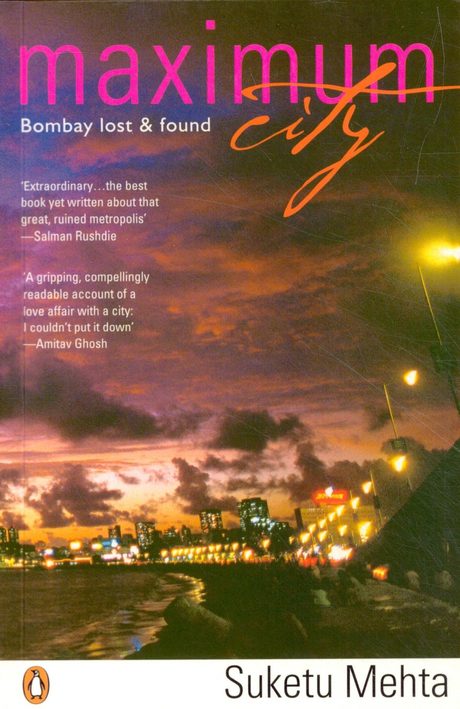
Maximum City
Suketu Mehta2004about 542 pages
Two years inside Bombay's extremes, reported until the people being reported on forgot to keep performing.
Mehta grew up in Bombay, left for New York at fourteen, and came back in his thirties with a family and a notebook. What he produced is a portrait of the city from inside its extremes: Shiv Sena rioters, a bar dancer's household accounts, an encounter cop who has shot dozens of men, a diamond family walking away from all of it to become monks. He does not visit these people, he stays until they get bored of performing for him. The book is thick and it never once slackens.
Why it is at 1
First because nothing else here gets so far inside, and because the standpoint is the interesting one: he has enough distance to see the city and enough belonging to be let in. If you live in an Indian city, this is the book that will make you notice yours again. It is also the least comfortable thing on the list, and it earns every page of that discomfort.
Read it ifyou want a city taken apart from the inside
Skip it ifyou want a warm portrait of Bombay, because this is not one
immersive, restless, unsparingBest for: anyone living in an Indian citymumbaireportagereturnee
Heads up: riot violence, police killings and sex work described in close detail
2

Outsider, one year digging under Delhi
City of Djinns
William Dalrymple1993about 480 pages
A year in Delhi spent digging back through Partition, the British, 1857 and the Sultanate, laughing most of the way.
Dalrymple spent a year in Delhi in his twenties with a formidable landlady, a taxi driver named Balvinder Singh, and an obsession with how many times the city has been destroyed and rebuilt. He digs backwards: Partition refugees, then the British, then 1857, then the Sultanate, then the ruins under the golf course. Half the book is archive work and the other half is comedy about trying to live in Delhi with a broken geyser and no functioning phone. The combination has no business working as well as it does.
Why it is at 2
Second because it is the most enjoyable book here and because it does the thing this list rewards, which is turning a city you think you know into six cities stacked on top of each other. The outsider position shows in the small stuff, and some of the amused writing about servants and landladies has aged into something faintly colonial. The history has not aged at all.
Read it ifyou want Delhi's layers and you like your history funny
Skip it ifthe amused foreigner tone will irritate you, because it is definitely present
funny, curious, layeredBest for: anyone in or near Delhidelhihistoryoutsider
3

Returnee, who chose Calcutta on purpose
The Epic City
Kushanava Choudhury2017about 273 pages
A Princeton graduate moves back to Calcutta for a newspaper job, and writes the truest book here about staying put.
Choudhury grew up between New Jersey and Calcutta, took a Princeton degree, then moved back to Calcutta to work at a newspaper for a salary that made sense to nobody. The book is his account of the years after that: the para, the addas, the College Street bookshops, the dead industry, the ageing leftists, the people who stayed when everyone with options left. It is the least dramatic book on this list and one of the truest, because he is describing ordinary life instead of hunting for extremes.
Why it is at 3
Third because it answers a question most travel writing avoids, which is what it feels like to live somewhere everybody agrees is finished. Anybody who has watched a hometown empty out will recognise every page of it. Quieter than Maximum City and less ambitious, and it earns its place by refusing the cheap shots at Calcutta that outsiders reliably take.
Read it ifyou want Calcutta from somebody who chose it
Skip it ifyou want incident and drama, because this is deliberately ordinary
warm, melancholy, ordinaryBest for: readers who left a city and wonderkolkatareturneeessay
4
Outsider, chasing the rain up the map
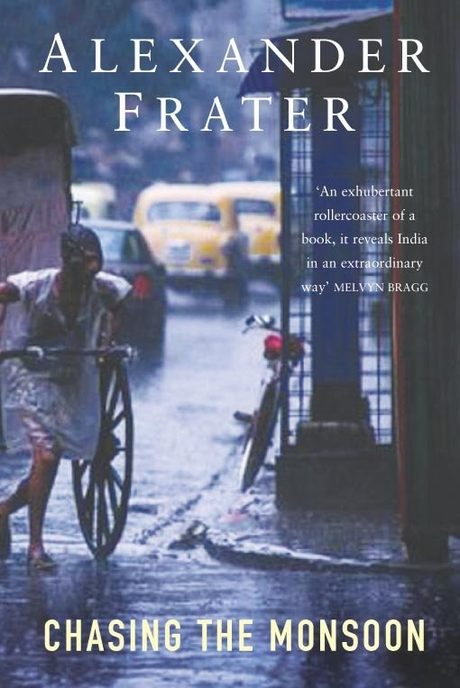
Chasing the Monsoon
Alexander Frater1990about 292 pages
A man follows the monsoon from Kerala to Cherrapunji, which gives this one something rare in travel books: a clock.
Frater grew up in the New Hebrides listening to his father talk about the Indian monsoon, and as an adult he decided to follow it. He lands at Kovalam for the first burst at the end of May, then moves north with the rain through Goa, Bombay, Delhi and finally Cherrapunji, trying to arrive with it each time. The result is a travel book with a deadline and a plot, which is rarer than it sounds. Half of it is meteorologists and the other half is what happens to a whole country when the rain runs late.
Why it is at 4
Fourth because it found a structure nobody else here has, and because it treats the single most important annual event in Indian life as the subject rather than as scenery. He is an outsider and it shows mostly in his delight, which is not a flaw. If you have ever stood outside for the first proper rain in June, you already understand what this book is doing.
Read it ifyou want a journey with an actual clock running through it
Skip it ifyou dislike weather writing, because there is a great deal of it
joyful, driven, atmosphericBest for: reading during an actual monsoonmonsoonjourneyoutsider
5
Outsider, nine people and their gods
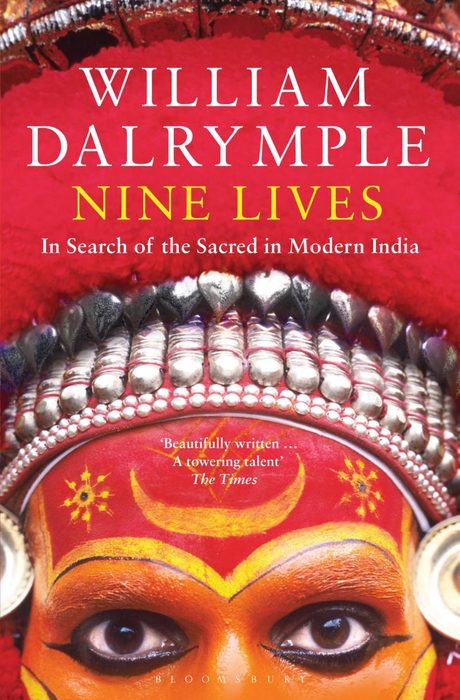
Nine Lives
William Dalrymple2009about 305 pages
Nine people who gave their lives to religion, talking at length while the author keeps unusually quiet.
Nine people who have given their lives to some form of religious practice: a Jain nun preparing to fast to death, a Theyyam dancer who digs wells for ten months and is a god for two, a devadasi, a Sufi, a maker of bronze idols whose son would rather write software. Dalrymple mostly gets out of the way and lets each of them talk. What comes through is how strange and specific Indian religious life actually is once you stop treating it as one single thing with one single name.
Why it is at 5
Fifth because it is the best correction available to the flattened idea of Indian spirituality that foreigners and urban Indians both carry around. It is also the least self-indulgent book Dalrymple has written, since he keeps his own voice small throughout. It sits below City of Djinns only because a collection of portraits loses the momentum that a single journey gives you.
Read it ifyou want Indian religious life in specific human detail
Skip it ifyou want the author's own story, because he steps back here
quiet, specific, respectfulBest for: readers tired of generalisationsreligionprofilesoutsider
6
Insider, the whole coastline with fish as the excuse
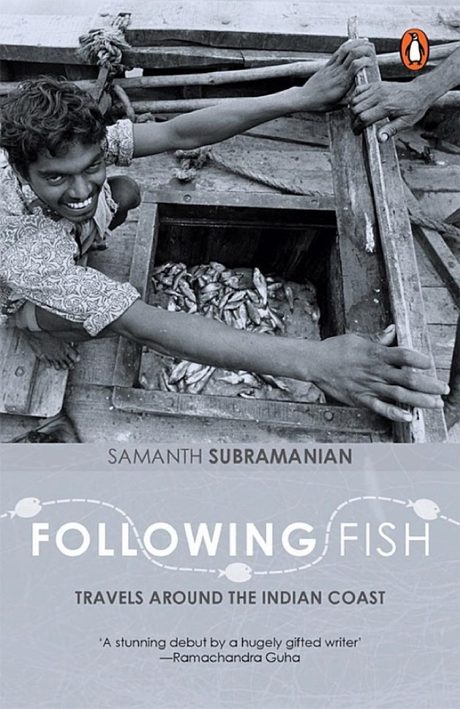
Following Fish
Samanth Subramanian2010about 197 pages
The Indian coastline with fish as the excuse: asthma medicine, toddy shops, hilsa arguments and shark boats.
Subramanian goes around the Indian coast with fish as his pretext: the Hyderabad fish medicine given out for asthma, toddy shops in Kerala, a boat out of Mangalore, Bengali cooks arguing over hilsa, the shark fishery in Tamil Nadu. Each chapter is short and carries a real question inside it, usually about who is making a living and how that living is changing. Because he is a reporter first it never becomes a food-writing swoon, and because he is funny it never becomes a fisheries report either.
Why it is at 6
Sixth because it is the most Indian-eyed book here and the one that best rewards a reader who already knows the country. Nothing is being introduced to you; a coastline you assumed was one thing turns out to be nine separate economies. It is shorter and lighter than the books above it, which is why it sits at six rather than at three.
Read it ifyou want the coast, the food, and the economics behind both
Skip it ifyou are vegetarian and squeamish about the details
light, curious, preciseBest for: a short trip or a long flightcoastfoodinsider
7
Insider, small towns at the moment they changed
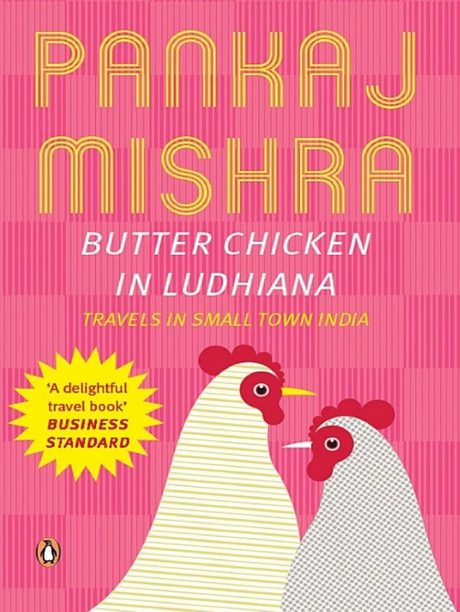
Butter Chicken in Ludhiana
Pankaj Mishra1995about 312 pages
Small-town India in 1995, caught the exact year liberalisation arrived there, by a writer who was often unkind and usually right.
In the early nineties Mishra travelled through small-town India just as liberalisation started reaching it, and wrote down what he found: new money, video parlours, brand-name aspiration, cable television, and a great many young men with nothing to do. He is frequently unkind about the people he meets and the book was attacked for exactly that when it appeared. What holds up is the accuracy. Almost everything he describes as a fresh symptom in 1995 is now simply the default condition of urban India.
Why it is at 7
Seventh because it works as a time capsule that turned out to be a prediction, and because small-town India is where most of this country lives and hardly anybody writes about it. The problem is the tone: Mishra is looking down more often than across, and you will feel that. Read it as a document rather than as company on a journey.
Read it ifyou want the exact moment India started changing
Skip it ifcondescension in a narrator ruins a book for you
sharp, snobbish, prescientBest for: understanding small-town Indiasmall towns1990sinsider
8
Ancestral visitor, and listening this time
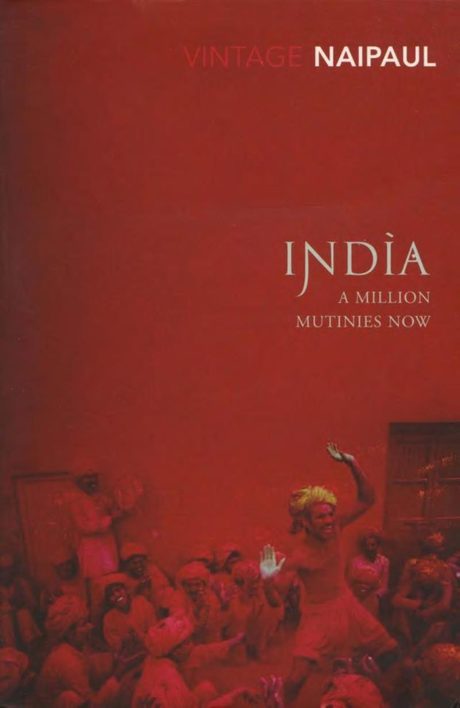
India: A Million Mutinies Now
V. S. Naipaul1990about 626 pages
Naipaul's third India book and the one where he finally listens, built out of long interviews across the 1980s.
Naipaul's third book about India, and the one where he mostly stops lecturing and starts listening. It is built out of long interviews: a Shiv Sena man, a Dalit writer, a Sikh in the aftermath of 1984, a Brahmin who has lost his old position, a stockbroker. He lets each account run at length, and the argument that surfaces is that all the anger boiling around him is not the country breaking down but a sign of people finally claiming a voice they were never given.
Why it is at 8
Eighth because it is the best of his India books by a distance, and because that title turned out to be the most accurate description anyone has given of the last forty years here. The listening is real in a way it simply is not in An Area of Darkness. He is still an outsider hunting for a thesis, and the thesis still sometimes arrives ahead of the evidence.
Read it ifyou want India explained through long, patient interviews
Skip it ifyou want the writer to stay out of it, because he never does
patient, argued, coldBest for: readers who want the 1980s explainedinterviews1980soutsider
9
Insider, watching the guru trade up close
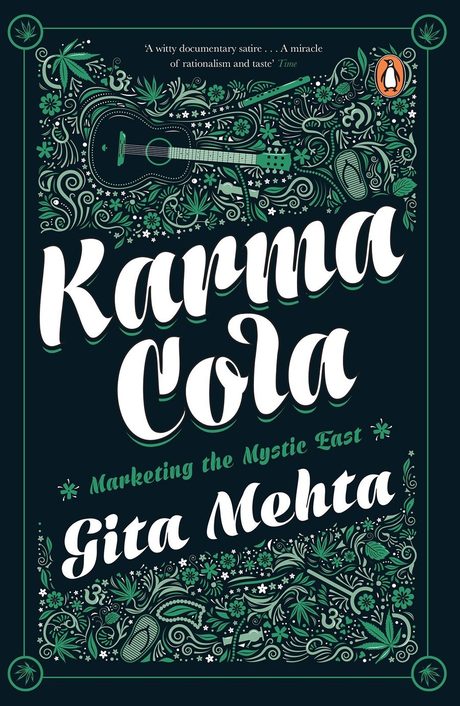
Karma Cola
Gita Mehta1979about 219 pages
A short, savage book about the seventies guru boom, written by an insider laughing at both sides of the transaction.
In the seventies, Western seekers arrived in India in enormous numbers looking for enlightenment, and Mehta watched the entire transaction with a very dry eye. This is a short and brutal and funny book about what happens when a spiritual marketplace meets customers who cannot read the price tag: the gurus who happily obliged, the seekers who lost their minds in Benares, the families who came looking for them afterwards. It moves like a stand-up set with an unusually high body count, and it is short enough for one sitting.
Why it is at 9
Ninth because it is the antidote to every book by a foreigner who came to India to find themselves, and reading it next to Holy Cow is genuinely funny. Mehta is an insider with a Cambridge education laughing at both sides at once, which is the most useful vantage point on this list. It sits at nine only because it is a set of sketches rather than a sustained journey.
Read it ifyou want the seventies guru boom demolished, briefly
Skip it ifyou find sustained sarcasm tiring across a whole book
dry, savage, briefBest for: one sitting, one long train ride1970ssatireinsider
Heads up: drug deaths and psychiatric breakdowns recounted bluntly
10
Outsider who stayed more than twenty years
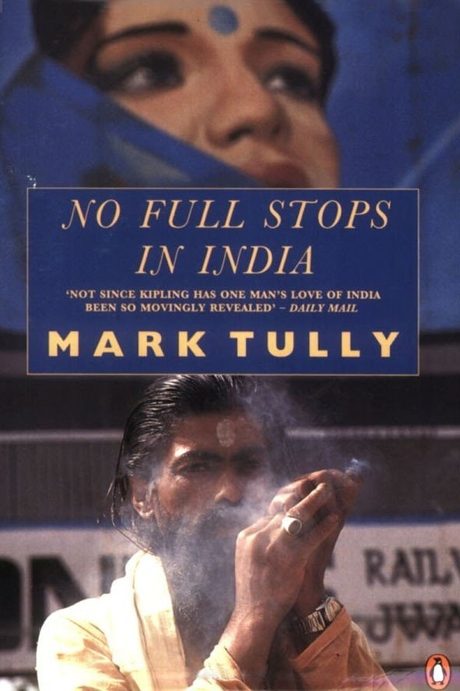
No Full Stops in India
Mark Tully1991about 380 pages
Two decades of BBC reporting turned into essays, arguing that India's elites imported a frame that never quite fitted.
Tully ran the BBC's Delhi bureau for more than twenty years, and this is the set of essays that came out of the end of that stretch: a Kumbh Mela, a Bihar village and its caste arithmetic, Calcutta communism, communal riots, and the news business itself. His argument, made repeatedly, is that Indian elites imported a Western frame that does not fit the country, and that villages are not sitting around waiting to be modernised into something else. You can disagree with all of it and still find the reporting excellent.
Why it is at 10
Tenth because he is the outsider who stayed longest, and it shows in his access rather than in his opinions. He gets into rooms no visiting writer would ever find. The book is over thirty years old now and reads that way in places, and his romanticism about village India is precisely the thing Ambedkar spent a lifetime attacking. Worth reading with that argument in your pocket.
Read it ifyou want long-form reporting from somebody who stayed
Skip it ifyou distrust foreigners defending Indian tradition
measured, reported, argumentativeBest for: readers who like essaysessays1990soutsider
11
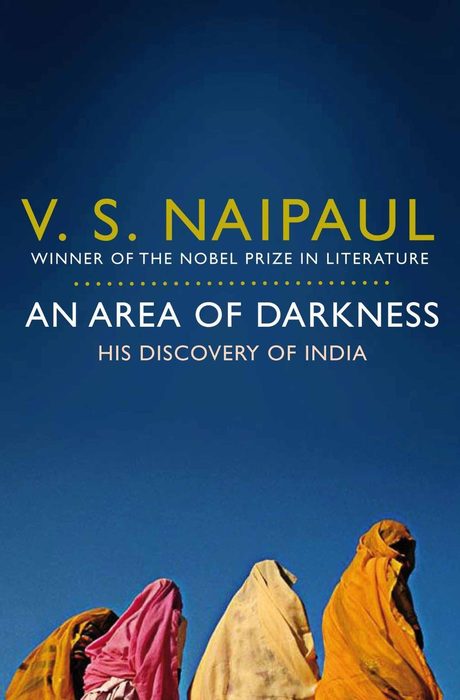
Ancestral visitor, and appalled by everything
An Area of Darkness
V. S. Naipaul1964about 304 pages
The famous, beautiful, contemptuous one: a diaspora homecoming that curdled, and a document of the writer more than the country.
Naipaul arrived in India in 1962 as a Trinidadian of Indian descent expecting some version of a homecoming, and spent a year appalled instead: by the poverty, by the sanitation, by what he read as a national refusal to see itself. He also visited his ancestral village and could not make any connection with it. The prose is superb and the disgust is relentless, and the two are hard to separate. The book was banned in India after publication, which tells you accurately enough how it landed here.
Why it is at 11
Eleventh, with a real warning attached. This is a superbly written book about one man's revulsion, and if you read it as a description of India you will walk away with a badly distorted picture. Read it instead as a record of what happens when a diaspora returns carrying an inherited idea and meets an actual country. Then read A Million Mutinies Now and watch him grow up.
Read it ifyou want the most famous outsider account, author included
Skip it ifyou do not want to spend a whole book being sneered at
brilliant, contemptuous, woundedBest for: readers who can argue back1960sdiasporacontested
Heads up: sustained disgust about poverty and sanitation
12
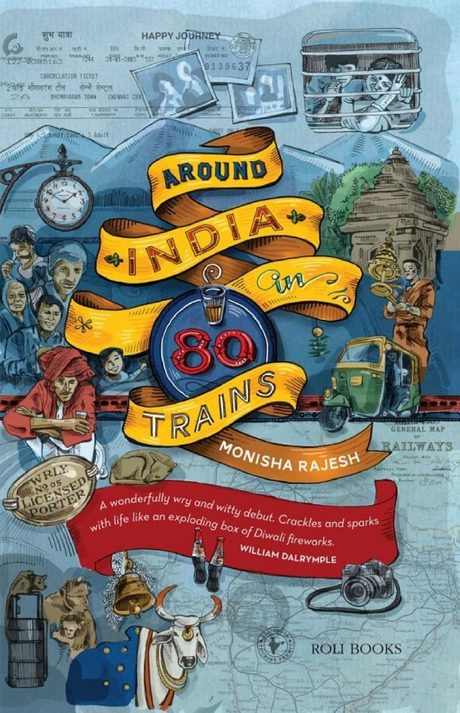
Diaspora, eighty trains in four months
Around India in 80 Trains
Monisha Rajesh2012about 341 pages
Forty thousand kilometres on eighty trains, friendly and light, and more about the compartment than about the country.
Rajesh, born in Britain to Indian parents, spent four months covering forty thousand kilometres on eighty Indian trains, from the Himalayan toy trains to the Lifeline Express hospital train to the ordinary sleeper class most of the country actually travels in. It is companionable stuff, far more about the people in the compartment than about the destinations. Her position is the diaspora one: Indian enough that people speak to her freely, foreign enough that the whole system still strikes her as remarkable.
Why it is at 12
Twelfth because the railways are the best possible frame for a book about India and she uses them well, but the observations stay at the level of a very good travel column. Set against the books above it, this one notices more than it explains. For a reader who already lives here it is pleasant company rather than a book that changes anything.
Read it ifyou love trains and want light, friendly company
Skip it ifyou want depth, because this stays close to the surface
friendly, chatty, lightBest for: an actual long train journeyrailwaysjourneydiaspora
13
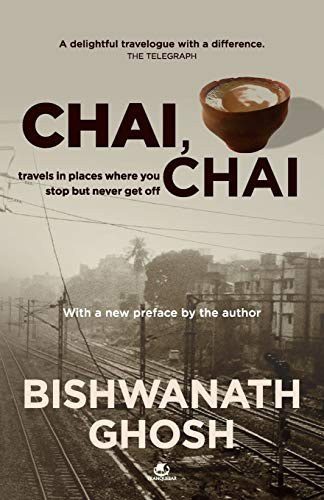
Insider, getting off at the junctions
Chai, Chai
Bishwanath Ghosh2009
Getting off at the junctions everyone changes trains at, and finding towns that exist only because two lines crossed.
Ghosh had one very good idea: get off at the junctions where everybody changes trains and nobody ever leaves the platform. Mughalsarai, Itarsi, Jhansi, Arakkonam, Guntakal, Shoranur. He spends a few days in each, drinking tea and talking to hotel managers, rickshaw drivers and men in bars, and finds towns that exist for no reason except that a railway line crossed another one there. Not much happens, which is the point. These are places most Indians have technically been to and never once seen.
Why it is at 13
Thirteenth because the idea is the best one on this list and the execution is only good rather than great. Ghosh is a pleasant, unhurried companion and he never tries to make the towns more interesting than they are. It is also the most purely Indian premise here, because nobody who has not spent a night on a junction platform would have thought of it.
Read it ifyou like small places and slow, aimless travel
Skip it ifyou need a strong narrative, because there is none
slow, unhurried, small-townBest for: readers who like nothing happeningrailwayssmall townsinsider
14
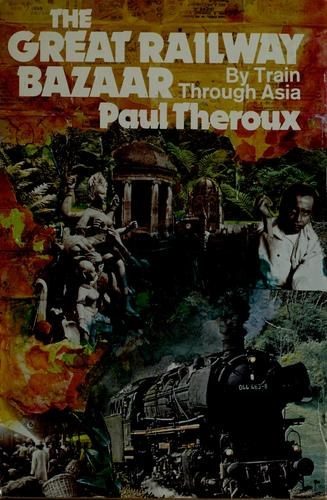
Outsider, passing through on his way east
The Great Railway Bazaar
Paul Theroux1975
The book that invented the grumpy modern travelogue, with India as one long, thin section in the middle of it.
Theroux took trains from London to Tokyo and back in 1973 and produced the book that more or less invented the modern grumpy travel memoir. India is a long stretch in the middle: the Frontier Mail, the Grand Trunk Express, Madras, Simla. He is quick, funny and frequently unpleasant about the people he meets, and he is far more interested in what is happening inside the compartment than in the country outside the window. It is a book about travelling rather than a book about anywhere in particular.
Why it is at 14
Fourteenth because only a section of it is about India, and the India section is thin. He passes through, collects eccentrics, and keeps moving. It stays on the list because the railway writing itself is genuinely good and because it explains the tone of half the travel books written since. Read the Indian chapters and skip the rest with a clear conscience.
Read it ifyou want the classic railway travelogue, India included
Skip it ifyou want a book actually about India, because this is not one
witty, sour, restlessBest for: readers who like the genre itselfrailways1970soutsider
15
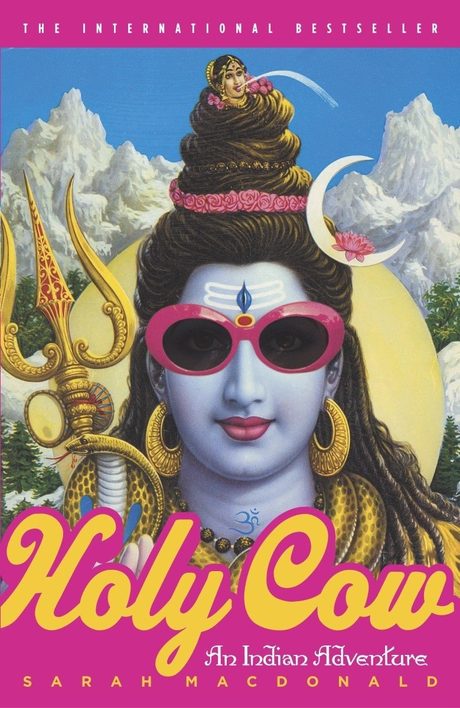
Outsider, two years and a lot of religions
Holy Cow
Sarah Macdonald2002about 306 pages
An Australian samples Indian religions for two years, brightly and shallowly, and it is the weakest book on this list.
Macdonald, an Australian radio journalist, followed her partner to Delhi and spent two years sampling religions: a vipassana course, Sikhism, Judaism, Parsi rituals, an ashram or two, and a serious illness in the middle of it all. It is written in a bright, joke-heavy style aimed squarely at readers who want India as an adventure with a spiritual souvenir at the end. She is honest about her own ignorance, which is easily the best thing in the book and the reason it is readable at all.
Why it is at 15
Fifteenth and last, and I have kept it here to be useful rather than kind. It keeps turning up on lists like this one, which is why I have included it, and it is the shallowest thing on mine: religions get sampled like items at a buffet and the country works mainly as a backdrop for one woman's year. If you want this territory done properly, read Karma Cola, which got there twenty-three years earlier and was funnier about it.
Read it ifyou want light, funny and undemanding travel company
Skip it ifyou live in India, because very little in it will be new to you
breezy, jokey, shallowBest for: a beach, not a bookshelfreligionmemoiroutsider
Worth knowing
What the standpoint tags mean
Outsider means the writer came from elsewhere with no family claim on the place: Dalrymple, Frater, Tully, Theroux, Macdonald. Returnee means they grew up partly here, left, and came back on purpose, which covers Suketu Mehta and Kushanava Choudhury. Insider means they were writing about a country they had never stopped living in, so Subramanian, Mishra, Ghosh and Gita Mehta. Naipaul gets his own category, an ancestral visitor who arrived expecting recognition and received none.
Where the outsider position shows is usually in what the writer finds remarkable. Frater is thrilled by the monsoon in a way no Indian ever would be, and that is a gift rather than a defect, because he actually looks hard at something the rest of us simply walk through. It shows badly when a writer treats ordinary Indians as comic material, which happens constantly in Theroux, occasionally in early Dalrymple, and in Naipaul as a settled position. The insiders have the opposite problem: familiarity makes them skip the explaining, so Ghosh and Subramanian assume things a first-time visitor would need spelled out.
Worth knowing
The two difficult ones
An Area of Darkness and Butter Chicken in Ludhiana are both here, and both spend a lot of their pages looking down at people. I have not removed them, because contempt is not the same thing as inaccuracy and both writers see things the kinder books miss entirely. Mishra called the shape of small-town aspiration in 1995 and he was right about nearly all of it. Naipaul saw a country refusing to look at itself and he was partly right, and he was also a man who could not forgive India for failing to be the place his grandparents had described to him.
The honest way to read them is to argue back as you go. If a book is making you angry and you can say precisely why, you are getting more out of it than you ever get from a book you nod along with. Take Naipaul's own descriptions as evidence about Naipaul, and take the interviews in A Million Mutinies Now as evidence about India.
People also ask
Questions, answered
What is the best travel book about India?
Maximum City by Suketu Mehta, if you want depth. It is a returnee's portrait of Bombay built out of two years of reporting, and nothing else on this list gets so far inside its subject. If you want pleasure rather than depth, City of Djinns by William Dalrymple is the most enjoyable book here, and if you want a journey with a clock ticking through it, take Chasing the Monsoon by Alexander Frater instead.
Are travel books about India worth reading if you already live in India?
Yes, but be selective, because roughly half of this genre exists to explain India to people who have never been. The ones worth your time either go somewhere you have not, like the coastline in Following Fish or the junction towns in Chai, Chai, or they take a place you know well and show you the layers sitting underneath it, which is what City of Djinns does to Delhi.
Which travel books about India are written by Indians?
On this list: Maximum City by Suketu Mehta, The Epic City by Kushanava Choudhury, Following Fish by Samanth Subramanian, Butter Chicken in Ludhiana by Pankaj Mishra, Karma Cola by Gita Mehta, and Chai, Chai by Bishwanath Ghosh. Monisha Rajesh writes from a British Indian position, somewhere between the two. The genre has historically been dominated by foreign writers, which is changing slowly, and it is one reason the Indian entries here matter.
Is An Area of Darkness worth reading?
Yes, with your guard up. Naipaul writes superbly and he is describing his own revulsion at least as much as he is describing India, so it fails as a portrait of the country and succeeds as a document of a diaspora homecoming that went wrong. Read A Million Mutinies Now afterwards, written twenty-six years later, where he finally sits down and listens to people rather than judging them from across a room.
Which travel book should I take on an actual trip?
Match the book to the transport. Long train journey: Chai, Chai or Around India in 80 Trains, both of which read well in short bursts between stations. Coastal trip: Following Fish, obviously. Delhi: City of Djinns, ideally read in the places it describes. Travelling anywhere during the rains: Chasing the Monsoon. Avoid Maximum City on a holiday, because it is heavy going and it will not leave you alone at night.
Before you go
What to read tonight
If you are starting tonight, take City of Djinns, because it is the one that most reliably converts people who are certain they do not like travel writing. If you already read the genre, go to The Epic City instead, which is quieter and will sit with you far longer.
Then do the thing these books are actually good for. Pick your own city, the one you stopped seeing years ago, and spend one Sunday walking a part of it you have only ever driven through. Every writer here did exactly that, and the only real difference between them and you is that they wrote it down afterwards. Frater needed an entire monsoon to do it and Mehta needed two years. You need one afternoon and a phone left at home.
Keep going
Lists that pair with this one
Indian Fiction
16 Best Books to Understand India, Ranked by What They Explain
Sixteen books, ten doors into the same country: history, caste, the mega city, the village, money, and where to start tonight.
Nonfiction
16 Best Books on Indian History for Beginners, in Order
Not a ranking but a route: one or two books per era, from the Indus valley to the news you read this morning.
Indian Fiction
16 Best Novels Set in Mumbai, Mapped Neighbourhood by Neighbourhood
Sixteen Bombay novels ranked by how much of the city you carry out with you, from a Worli chawl to a tower in Vakola.
Indian Fiction
14 Novels Set in Kolkata, From Colonial Calcutta to Now
Ranked by how much of the real city ends up in your head, and labelled with the era each one drops you into.
Nonfiction
The 13 Best Indian Food Books, Ranked Like a Meal
Not recipe collections. Thirteen books about why Indian food tastes the way it does, served in the order I would hand them to you.