Chetan Bhagat Books Ranked: All 13, From Worst to Best
Ten novels and three non-fiction books, judged on whether they still work when you read them today rather than on how big they were in 2009.
By Bhavik SarkhediUpdated August 2026Covers and data: Google Books, Open Library
The 3 Mistakes of My Life is set about twenty minutes from where I grew up, in the part of Ahmedabad where the cricket shop in that book could plausibly still be open. I read it at nineteen, in one sitting, and then argued about it with my hostel floor for a week. That is the part people who sneer at Chetan Bhagat keep missing. He is the reason a whole generation of Indians who had never finished a novel finished one.
The sneering is not wrong either. The prose is plain to the point of bare, and several of these books have endings that arrived before the idea did. My position, stated up front so you can decide how much to trust the rest of this page: two of his novels are genuinely good, four are perfectly fine as a train read, and three are bad in ways worth naming out loud.
So this runs worst to best. Number 1 is the one I would take off your shelf, and number 10 is the one I would defend in a room full of literature graduates. After the novels, entries 11 to 13 are the non-fiction, kept outside the countdown because ranking a column collection against a campus novel is a category error rather than a judgement.
Two questions per book: does it still work if you pick it up today with no nostalgia in the room, and did it matter when it came out. The order on this page answers the first question only, and where the two answers disagree I say so inside the entry.
Every title verified through Google Books and Open Library with a real cover, and the year shown is first publication, not the reprint date on the copy you will find at a railway stall.
His newest novel, 12 Years, came out in late 2025 and is not ranked here. I have not read it, neither database carries a cover image for it yet, and I am not ranking a book from its blurb.
The three non-fiction books sit in their own tier at the bottom. That is a different shelf, not a demotion, and they are ranked against each other instead.
Nostalgia earns nothing. Two of these mattered enormously to me at nineteen and still sit in the bottom half.
An investment banker narrates her own life while the author narrates over her, and you can hear him doing it.
Radhika Mehta is a high-earning investment banker sitting through her own wedding in Goa, mentally replaying two relationships and one career that all wanted a smaller version of her. The premise is decent. A novel about a woman who out-earns every man she dates, written for readers who have never been asked to root for one, could have been sharp and useful. What arrives instead is a first-person voice that keeps pausing to explain feminism to you, and an inner monologue that reads like a man's guess at what a woman thinks when nobody is in the room.
Why it is at 1
Bottom of the list because the failure is structural rather than cosmetic. Every other book here is at least the book it was trying to be. This one spends three hundred pages arguing with its own narrator, and the argument belongs to the author instead of her. Half Girlfriend above it is thinner, but it is honest about being thin.
Read it ifyou are completing the set and want to watch an ambitious swing miss
Skip it ifyou have ever been irritated by a man explaining your own life back to you
well meant, badly aimedBest for: completists onlycontemporaryfinancefeminism
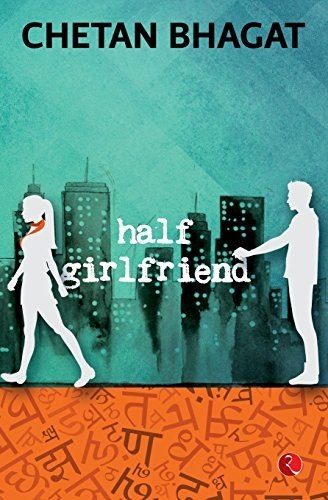
A Bihari basketball player and a rich Delhi girl invent a relationship status so they never have to name what they are.
Madhav Jha comes from a crumbling royal family in Bihar, gets into a Delhi college on a sports quota, and falls for Riya Somani, who is fluent in the English he cannot speak. She will not be his girlfriend and will not quite say no, so he settles for calling her his half girlfriend. The class and language gap at the centre is real, and Bhagat is one of very few Indian novelists in English who treats that humiliation as a subject rather than a joke. Then the plot needs somewhere to go, and it goes to a diary, a hunt across two continents, and a resolution delivered by coincidence.
Why it is at 2
Second from the bottom because the first half is better than its reputation and the second half is worse than you remember. Rural English and the shame around it is a subject almost nobody writes about, and he gets the burning-ears part exactly right. Then the book drops the subject to chase a plot. One Night at the Call Center above it is sillier, but it commits to its silliness.
Read it ifyou want the language and class humiliation, which is the real subject here
Skip it ifcoincidence-driven second halves make you close a book for good
sincere, then sillyBest for: an argument about class and Englishcampusclassbihar
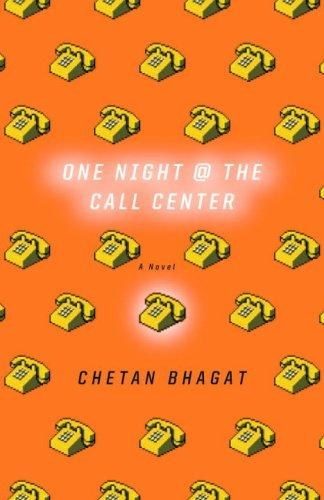
Six call centre employees have the worst night of their lives, and then God rings the office phone.
It is 2004 in a Gurgaon call centre and six people on the night shift are each about to lose something: a job, a marriage, a boyfriend, a grip. Bhagat is very good on the specific indignity of that work, the American aliases, the training on how to soothe a customer who thinks you are sitting in Illinois. Then, at the lowest point of the night, the phone rings and it is God, and the novel turns into a motivational seminar with a plot wrapped around it. Everything before that call is his sharpest social writing of the decade. Everything after it is a pamphlet.
Why it is at 3
Third from the bottom, and it hurts to put it here, because the first two hundred pages are excellent. The divine phone call is not a small flaw you can read past. It converts a novel about powerlessness into a lecture about attitude, which is the opposite of what the book had spent its first half saying. 400 Days above it is a much smaller book that at least keeps its shape.
Read it ifyou want the best portrait of early outsourcing India that fiction has managed
Skip it ifa literal divine intervention will make you put a book down
sharp, then preachyBest for: nostalgia for 2004 Gurgaonworkplacegurgaon2000s
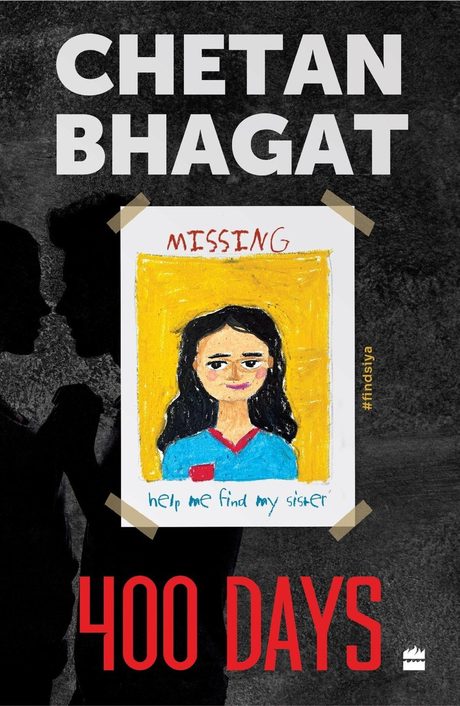
The third Keshav and Saurabh case: a twelve-year-old vanishes from a locked flat and the police stopped looking a year ago.
A mother walks into the detective duo's makeshift office with a case Delhi police closed more than a year earlier. Her daughter disappeared from inside the house, and everyone involved has quietly decided she ran away. Bhagat is comfortable in this format by now: short chapters, a live investigation, Keshav sulking about his love life while Saurabh eats. As a procedural it is competent, and the missing-child material is handled with more restraint than I expected from him. What it lacks is a reason to exist beyond series momentum, and the romance subplot is running on fumes by this point.
Why it is at 4
In the middle because it is the definition of fine. Nothing in it is embarrassing, which is more than the three below it can claim, and nothing in it will stay with you past Sunday. The Girl in Room 105 above it is messier but has a genuine subject underneath. This one is a capable third instalment of a series that peaked at its second.
Read it ifyou have read the first two and want the trio finished
Skip it ifyou need a book to leave some kind of mark
brisk, forgettableBest for: an airport queuemysterydelhiseries
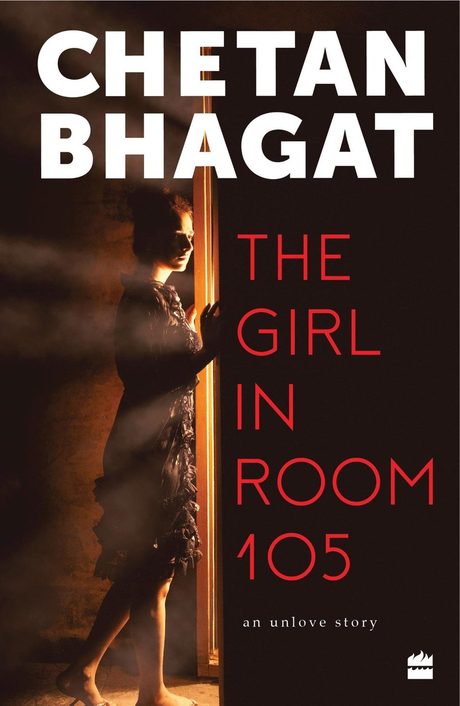
A broke IIT graduate climbs into his ex-girlfriend's hostel room on New Year's Eve and finds her dead.
Keshav Rajpurohit teaches at a coaching institute, drinks more than he should, and has never got over Zara, the classmate his family made impossible because she is Muslim. She messages him on New Year's Eve. He climbs in through her window and finds her body, and because the police prefer the easy answer, he starts investigating with his flatmate Saurabh. The mystery itself is ordinary and the culprit is guessable well before the reveal. What is not ordinary is how directly a mass-market thriller puts interfaith family pressure at its centre, and how good the two men are together on the page.
Why it is at 5
Above 400 Days because it has a real subject under the whodunit, and below Revolution 2020 because the whodunit part is thin. This is the book where he changed lanes from campus romance to crime, and you can watch him learning the form as it goes. The jokes land more reliably than the clues do.
Read it ifyou want a fast mystery with a genuine Indian pressure point inside it
Skip it ifyou solve mysteries early and resent being made to wait
pacy, unevenBest for: a first crime novelmysterydelhiinterfaith
Two friends from Varanasi want the same woman and take opposite routes up: one builds a fake college, one starts a newspaper.
Gopal fails the engineering entrance and ends up running a private college assembled from bribes, borrowed land and political cover. Raghav clears the exam, becomes a journalist, and decides to expose exactly that kind of college. Aarti, who has known them both since school, is the third point of the triangle. The romance is the weakest thread by a distance. The education racket around it is the strongest reporting Bhagat has ever folded into fiction, because he clearly knows how those colleges get financed and who has to be paid. Varanasi gets more care here than any city in his other books.
Why it is at 6
Sixth because the material deserved a better novel and still shows through the one it got. The corruption plot has a specificity you rarely find in commercial Indian fiction, and it is dragged down every time the love triangle takes the wheel, which is often. One Arranged Murder above it is a much smaller book that does exactly what it sets out to do.
Read it ifyou want fiction about how the private education business actually runs
Skip it iflove triangles where nobody behaves well wear you out
ambitious, lopsidedBest for: readers who like a scam plotvaranasicorruptionlove triangle
A woman dies at her own family's Karva Chauth party, and the detective on the case is engaged to her sister.
Saurabh is about to marry Prerna. At the family gathering for Karva Chauth, Prerna's sister falls from the balcony, and what everyone wants to call an accident refuses to stay one. This time Saurabh is inside the case rather than beside it, which changes the temperature of the whole book: he cannot be the comic relief about his own in-laws, and Keshav has to hold the friendship together while suspecting people they have eaten dinner with. The mechanics here are the tidiest Bhagat has managed, and a joint family does the job a locked room usually does.
Why it is at 7
Seventh, and the best of the three thrillers, because for once the emotional stakes and the puzzle point in the same direction. Room 105 has the braver subject; this one has the better book built around it. It is also the funniest he has been since 2 States, largely because Saurabh gets to be a person here instead of a punchline.
Read it ifyou want a domestic mystery where every suspect is a relative
Skip it ifwhodunits that never leave one household feel small to you
warm, twistyBest for: a two-day readmysteryfamilydelhi
Three friends open a cricket shop in Ahmedabad, and then 2001 and 2002 happen to their city.
Govind wants a business, Ish wants to coach a boy with a real cricketing gift, and Omi's family runs the temple next door that gives them their first premises. The shop opens in Ahmedabad, and the city they are building it in goes through an earthquake, a religious flashpoint and a riot. I grew up near these streets and the geography is right, which is not something I can say about most novels set in my city. The last hundred pages ask you to watch a friendship survive something a lot of friendships in Gujarat did not survive that year.
Why it is at 8
Eighth because it takes the biggest risk of anything here and mostly earns it. He is writing about 2002 in Gujarat for an audience that buys books at railway stalls, and he does not sand down the ending to keep them comfortable. Revolution 2020 has similar ambition and less nerve. The cricket half is thin, and that is what keeps it out of the top two.
Read it ifyou want his most serious novel and can take a hard ending
Skip it ifcommunal violence in fiction is not what you need right now
warm, then brutalBest for: readers who want stakesahmedabadcricketfriendship
Heads up: communal violence, an earthquake, and a violent death late in the book
Three friends at IIT Delhi decide the grading system is the enemy, and for a long while the grading system wins.
Hari, Ryan and Alok arrive at IIT Delhi as the smartest boys their towns ever produced and settle at the bottom of the class. Ryan wants to prove the system is broken, Alok needs marks because his family needs money, and Hari is stuck between them, narrating. Almost nothing in the plot is unusual: a professor's daughter, a stolen question paper, a terrace. What was unusual in 2004 was the register. Here was an Indian novel in English that sounded the way boys in a hostel actually sounded, with no glossary, no footnotes and no apology to a foreign reader.
Why it is at 9
One below the top, and the most important book of the thirteen by a distance. It opened the lane that every commercial Indian writer under him now works in, including me. Read today, the first two thirds hold up completely and the friendship is real, and then the third act goes melodramatic in a way 2 States never does. That gap is the entire reason it sits here and not at the top.
Read it ifyou want the book that made Indian publishing take ordinary English seriously
Skip it ifyou need a third act as steady as the first two
funny, then heavyBest for: anyone who survived an engineering degreeiitfriendshipdebut
Heads up: a suicide attempt
Pairs with: Watch 3 Idiots after, not before, so you can see what the film added and what it quietly threw away.
A Punjabi boy and a Tamil girl fall in love at IIM Ahmedabad, then spend two years trying to make four parents like each other.
Krish and Ananya meet in the mess queue at IIM Ahmedabad, and the falling-in-love takes about forty pages. The rest of the novel is the actual problem: two families who are courteous to each other's faces and merciless in private, and a couple who refuse to solve it by eloping. So Krish moves to Chennai to win over her parents, Ananya works on his, and the comedy comes from how precise the sabotage gets, right down to who gets served what at dinner. It is the only book of his where the funny scenes and the sad scenes come out of the same source.
Why it is at 10
Top of the list because it is the best made thing he has written. The structure is clean, the joke rate is the highest in his catalogue, and the mother and son relationship underneath it is the one piece of genuine emotional writing across thirteen books. Five Point Someone matters more to Indian publishing. This is the one I would hand a stranger if I wanted them to come back for a second.
Read it ifyou have ever had to sell a partner to your own parents
Skip it ifyou want a romance where the couple is the hard part
funny, warm, sneaky sadBest for: anyone deep in rishta seasonromcomfamilyiim
Pairs with: The Zoya Factor by Anuja Chauhan, if you want this same comic register with three times the language.
What Young India Wants: Selected Essays and Columns
Chetan Bhagat2012
The newspaper columns that turned a novelist into a man who gets invited onto television panels.
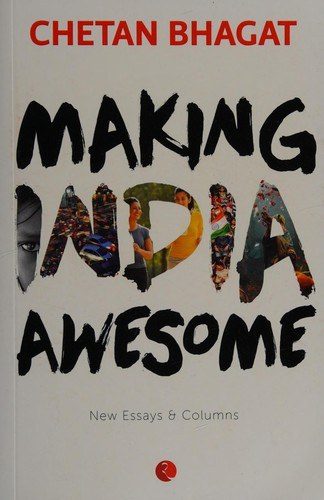
The first collection of his opinion writing: short pieces on corruption, the education system, reservations, and the way young Indians keep being asked to be patient by people who were never patient themselves. The essays are brief, argumentative and pitched at somebody with ten minutes on a commute. Read as journalism they are thin, because a column that assumes no prior knowledge cannot go very deep. Read as a record of what a mass audience was being told to think in 2012, in the wash of the anti-corruption protests, the book is more interesting than its own sentences.
Why it is at 11
Outside the countdown with the other two, because measuring a column collection against a campus novel makes no sense. Of the three non-fiction books, this one has the clearest reason to exist. The heat of 2011 and 2012 is genuinely in it, which the later collections cannot claim, since by then he was writing to an audience he already owned rather than to a moment.
Read it ifyou want a snapshot of the middle-class mood in 2012
Skip it ifyou would rather have reporting than opinion
More columns, three years on, with the solutions set out in numbered lists.
The second essay collection, sorted into sections on the economy, society, politics and women. The format repeats the first book: a problem stated plainly, a few paragraphs of argument, a fix proposed as a list. Some of the economic pieces are sensible, and some of the social ones have aged into a shape their author probably did not plan. The prose is at its plainest here, which is a deliberate choice, since the stated aim is to be read by people who do not read. It works better as a set of conversation starters than as a book you sit down with.
Why it is at 12
Below What Young India Wants because it is the same product with less occasion behind it. These columns were written into a calmer stretch of years and you can feel it: less at stake, more general advice, fewer sentences that had to be brave. If you read only one of the two essay collections, take the earlier one.
Read it ifyou liked the first collection and want another dose
Skip it ifpolicy advice in bullet form bores you quickly
plain, prescriptiveBest for: dipping in and outessayspolicycolumns
The self-help turn, from the man who has been advising young India on television for a decade.
This is the pivot from columns to coaching. Eleven rules, each carrying stories, exercises and a summary, aimed squarely at a twenty-two-year-old who feels behind everybody on Instagram. The territory is the familiar self-improvement package: money habits, skills, discipline, the cost of caring what a crowd thinks of you. What he brings to it is the Indian specificity that imported self-help never has, with examples built on an Indian salary, an Indian family and an Indian job market. What he does not bring is a single idea you could not get from a straight-talking uncle across one long evening.
Why it is at 13
Last of the thirteen, and last for a reason: it is the least necessary book he has published. The rules are sensible, the delivery is friendly, and none of it needed to be a book. It matters as a marker though, because this is the point where he stopped being a novelist who wrote columns and became a coach who used to write novels.
Read it ifyou are twenty-two, anxious about money, and want it in Indian terms
Skip it ifyou have read any modern self-improvement book at all
friendly, familiarBest for: a nervous first-jobberself-helpmoneycareer
Every book got two questions. Does it still work if you read it today with no nostalgia in the room, and did it matter at the time it appeared. The order on this page answers the first question only, which is why a few placements will annoy people. Where the two answers split, I say so inside the entry, and Five Point Someone is the clearest case: the most important book of the thirteen sits one place below the best one.
The three non-fiction titles sit outside the countdown at 11, 12 and 13. Two collections of newspaper columns and one self-improvement book cannot be measured against a campus novel on the same scale, so I have ranked them against each other and left them where they can be judged fairly.
Worth knowing
The films, and where 12 Years went
Five of these became movies, and the adaptations are a large part of why the books still sell. Five Point Someone became 3 Idiots in 2009, with a credit row that ran in the papers for weeks afterwards. One Night at the Call Center became Hello in 2008. The 3 Mistakes of My Life became Kai Po Che in 2013, the rare case of a film improving on its source. 2 States and Half Girlfriend were filmed under their own names in 2014 and 2017. If you have only seen the films, the two worth reading afterwards are 2 States and The 3 Mistakes of My Life, in that order.
His newest novel, 12 Years, arrived in late 2025 and is not ranked on this page. I have not read it, and neither Google Books nor Open Library carries a cover image for it yet, which is the bar every other book here had to clear. When I have read it, it goes into the countdown wherever it deserves to sit, and this section is where I will say so rather than quietly reshuffling the page and pretending it was always there.
People also ask
Questions, answered
What is the best Chetan Bhagat book?
2 States, and for me it is not close. It has the tightest structure, the highest joke rate, and the only genuinely moving relationship in his whole catalogue, which is the one between Krish and his mother rather than the one on the cover. Five Point Someone is the more important book and the one that changed Indian publishing, so if you want the historically significant answer, take that instead. If you want the book you will enjoy most this weekend, take 2 States.
Which Chetan Bhagat book should I read first?
Five Point Someone if you want to start where everybody else started, 2 States if you simply want the best one, and The Girl in Room 105 if you would rather read a mystery than a romance. Do not start with One Indian Girl or Half Girlfriend, because if either is your first taste you will never pick up a third. Every novel stands alone except the Keshav and Saurabh books, which run in sequence.
How many books has Chetan Bhagat written?
Ten novels are ranked on this page, plus three non-fiction books, and a new novel called 12 Years arrived in late 2025 that I have not ranked yet. He has also published essay collections that overlap heavily with his newspaper columns, so the total you see quoted online shifts depending on whether those get counted separately. Counting novels only, eleven is the honest answer as of 2026.
Which Chetan Bhagat books were made into movies?
Five of them. Five Point Someone became 3 Idiots, One Night at the Call Center became Hello, The 3 Mistakes of My Life became Kai Po Che, and both 2 States and Half Girlfriend were filmed under their own titles. Kai Po Che is the adaptation that improves on its source material. 3 Idiots is the most famous and the furthest from the book, which is a fair part of why the argument over its credits got so loud.
Is Chetan Bhagat actually worth reading, or is the criticism fair?
Both are true at once. The prose is plain, the endings are frequently rushed, and the later books read like product rather than novels. He is also the writer who convinced a generation of Indians who had never finished a book that reading was for them, in language they actually spoke. Read the two at the top of this page and judge from there rather than from a headline. If you finish 2 States and feel nothing, you have your answer and it cost you a weekend.
What order should I read the Keshav and Saurabh books in?
The Girl in Room 105 first, then One Arranged Murder, then 400 Days. Each case is self-contained, but the friendship and Keshav's love life carry forward, and the second book lands considerably harder once you have watched those two men become a double act in the first. If you only want one of the three, make it One Arranged Murder, which is the best built of them.
Before you go
What to read tonight
If you want to start something tonight, open 2 States, and accept that you will finish it by tomorrow evening whether or not that was the plan. If you are choosing between the two at the top, the tiebreak is what you want from the evening: Five Point Someone if you want to feel nineteen and slightly angry about it, 2 States if you want to laugh and then call your mother.
And if you read three of these and find that the plainness of the sentences bothers you more than the plots do, that is a genuinely useful thing to learn about yourself. It means you are ready for Anuja Chauhan, who writes this same Indian comedy with three times the language in it, or for the translated fiction shelf, where the sentences are the entire point. Bhagat is a doorway. Nobody, including him, has ever claimed he is the room.