Most science reading lists start where science departments start, with physics, which is exactly where most people stopped. So this one starts with a rusty nail going into your thumb and what your body does about it over the next four days. The rule for getting on the list was simple. If a book cannot hold somebody whose last contact with science was a class ten exam they did not enjoy, it is out, however famous the author is.
The order is a route rather than a ranking. We begin inside your own body, move outward to the living things around you, stop once for the book that covers all of it at once, and finish off the planet with the stars. Five books in, you have a working model of yourself. Fifteen books in, you have a rough idea of where you are sitting in the universe. You can jump in anywhere, and the quick picks below will tell you where to start if you are only ever going to read one.
Two other things you will find here. Every entry says how much maths is in the book, because that fear stops more readers than anything else, and the honest answer is almost always none at all. And where a famous book has been challenged since it came out, the challenge sits in its own entry instead of a footnote nobody reads. Two of these are argued about by working scientists. Both are still worth your evening, with the argument in your pocket.
How I picked these
- No background assumed anywhere. If a book expects you to remember what a mole is, it did not make the list.
- Ordered by distance from your own skin, because attention works better when it starts with you and moves out.
- Maths counted honestly in every entry, since that is the fear that keeps people out of this section of the bookshop.
- Fame protected nobody: two books here have taken serious criticism since publication and both criticisms are on the page.
- Every edition checked through Google Books and Open Library, with the first publication year rather than whichever reprint turned up.
The whole list at a glance
All 15 books, in order
| # | Book | Author | Year | Vibe | Best for |
|---|
| 1 | Immune | Philipp Dettmer | 2021 | friendly, visual, oddly thrilling | nervous first time science readers |
| 2 | Gut | Giulia Enders | 2014 | cheerful, frank, funny | anyone with a temperamental stomach |
| 3 | Why We Sleep | Matthew Walker | 2017 | urgent, persuasive, contested | chronic late night scrollers |
| 4 | The Immortal Life of Henrietta Lacks | Rebecca Skloot | 2010 | intimate, angry, humane | readers who love narrative nonfiction |
| 5 | The Emperor of All Maladies | Siddhartha Mukherjee | 2010 | sweeping, clinical, compassionate | readers who finish six hundred pages |
| 6 | The Selfish Gene | Richard Dawkins | 1976 | cold, brilliant, argumentative | readers who like one big idea |
| 7 | Entangled Life | Merlin Sheldrake | 2020 | curious, lyrical, precise | walkers, gardeners, cooks |
| 8 | The Hidden Life of Trees | Peter Wohlleben | 2015 | warm, romantic, disputed | walkers and weekend gardeners |
| 9 | Silent Spring | Rachel Carson | 1962 | patient, damning, exact | readers who like a founding text |
| 10 | The Sixth Extinction | Elizabeth Kolbert | 2014 | calm, reported, devastating | readers ready for hard facts |
| 11 | A Short History of Nearly Everything | Bill Bryson | 2003 | funny, curious, generous | absolutely everyone, including gifts |
| 12 | Packing for Mars | Mary Roach | 2010 | funny, filthy, rigorous | teenagers who say science is boring |
| 13 | Astrophysics for People in a Hurry | Neil deGrasse Tyson | 2017 | brisk, clear, quotable | commuters and impatient readers |
| 14 | Seven Brief Lessons on Physics | Carlo Rovelli | 2014 | brief, beautiful, humane | readers with one free evening |
| 15 | Cosmos | Carl Sagan | 1980 | grand, humane, hopeful | anyone who has lost their curiosity |
The list
The books, ranked
1
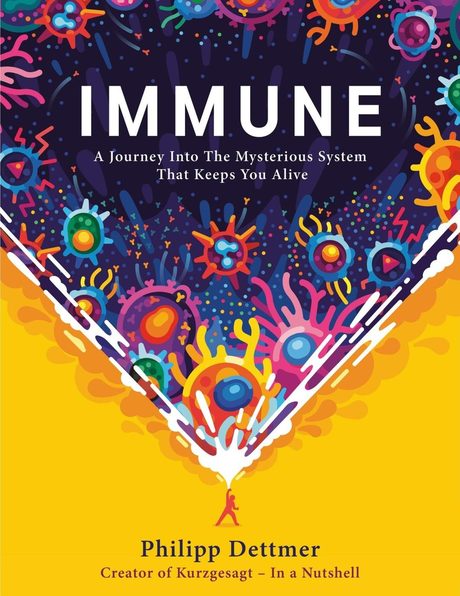
Zoom 1, inside your own body: no maths
Immune
Philipp Dettmer2021about 457 pages
The clearest account of your immune system ever written for people who last studied biology before their board exams.
Dettmer built the animation channel Kurzgesagt and this book works the same way he does. It opens with a rusty nail going into your thumb and follows what happens hour by hour, from the cells that arrive first and start screaming chemically, through the ones that carry samples back to your lymph nodes, to the antibodies that turn up days later carrying instructions written during an infection you had years ago. There are drawings, jokes, and footnotes where he admits which parts he has simplified and why. By the end you are carrying a working model of the most complicated system in your body, and every news story about a vaccine reads differently.
Why it is at 1
First stop, because the quickest way to make a nervous reader care about science is to explain something that is happening inside them right now. It is also the friendliest book here for anyone who has decided they are bad at this subject. Read it, enjoy it, and the rest of the route is within reach.
Read it ifyou want to understand your own body before anything else
Skip it ifyou dislike cartoon diagrams and jokes in your nonfiction
friendly, visual, oddly thrillingBest for: nervous first time science readersbiologyimmunologyillustrated
Pairs with: Gut at two, since a large share of your immune system lives down there
2

Zoom 1, inside your own body: no maths
Gut
Giulia Enderstranslated by David Shaw2014about 280 pages
A young doctor makes your digestive system funny, then makes you realise you knew nothing about a third of yourself.
Enders wrote this as a medical researcher in her twenties and it has the energy of somebody who cannot believe nobody told her any of this. She covers the mechanics of digestion, why the appendix is not the useless leftover you were taught it was, the gut's own nervous system and why people call it a second brain, what the bacteria living inside you are doing all day, and how to sit on a toilet properly. It is cheerfully rude about bodily functions, which is the point, because squeamishness is why most people know less about their gut than about their phone.
Why it is at 2
Second stop because the gut is the part of yourself you are most embarrassed about and least likely to understand. One caution: microbiome research has moved quickly since this came out, so read it for the anatomy and the pleasure rather than as a set of health rules. The original German edition landed in 2014 and the English translation followed in 2015.
Read it ifyou want the body's least discussed system explained without embarrassment
Skip it ifyou would rather not read about digestion over dinner
cheerful, frank, funnyBest for: anyone with a temperamental stomachbiologymicrobiometranslated
3
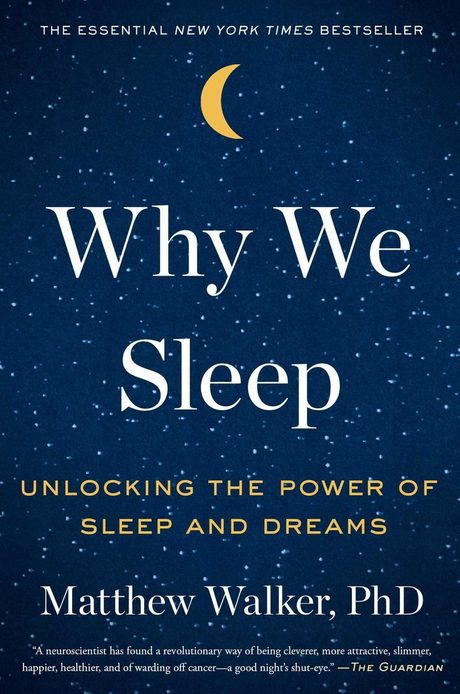
Zoom 1, inside your own body: no maths, some contested numbers
Why We Sleep
Matthew Walker2017about 368 pages
The book that made a generation take sleep seriously, carrying warnings that several researchers say run past the evidence.
Walker is a sleep scientist and his case is straightforward: sleep is not downtime, it is when a great deal of the work of the brain and body actually happens, and most of us run a deficit we have decided is normal. He goes through what happens across a night, what dreaming appears to do for memory and for processing feelings, why teenagers genuinely cannot fall asleep early, and what caffeine and alcohol do to the shape of a night's rest. The chapters on shift work and on school start times are the ones that stay with you afterwards.
Why it is at 3
Third stop and the one entry that ships with a warning label. In 2019 a long public critique catalogued errors and overstated claims in the book, and the argument about how hard its scarier conclusions should be pushed has never fully settled. What it recommends, more sleep and a regular schedule, is not controversial at all. The frightening statistics are the part to hold loosely.
Read it ifyou treat sleep as the thing you cut when you are busy
Skip it ifyou are an anxious sleeper who will spend a month counting hours
urgent, persuasive, contestedBest for: chronic late night scrollerssleepneurosciencecontested
Heads up: anxious sleepers often find this one makes things worse for a week or two
4
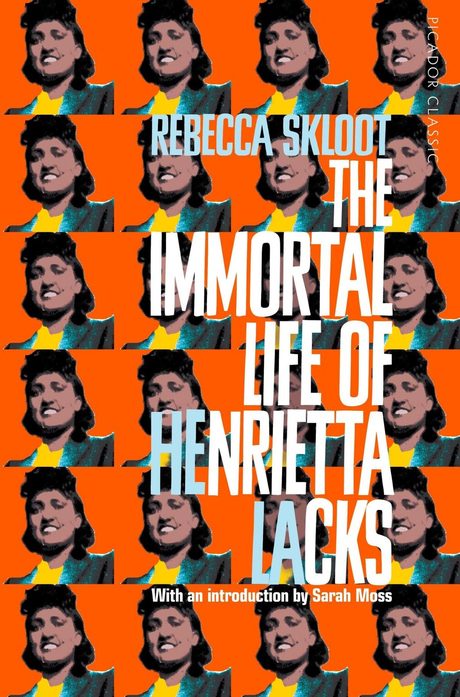
Zoom 1, inside your own body: no maths
The Immortal Life of Henrietta Lacks
Rebecca Skloot2010about 435 pages
The cells that changed modern medicine were taken from a poor Black woman in 1951, and nobody asked her first.
Henrietta Lacks died of cervical cancer at thirty one. A sample of her tumour, taken without her knowledge, became the first human cell line that would keep growing indefinitely in a laboratory, and those cells went on to be used in polio vaccine research, in cancer work, and in labs on every continent since. Skloot tells two stories at once. There is what the cells did for medicine, and there is what happened to a family who found out decades later that their mother was alive in freezers around the world while they could not afford a doctor themselves.
Why it is at 4
Fourth stop because cells are the last layer inside the body before we head outward, and because this is the book for anyone who thinks science writing is cold. It is also the clearest introduction to research ethics you will read without opening a policy document. The chapters with the family are what lift it past being a science book.
Read it ifyou come to nonfiction for people rather than for mechanisms
Skip it ifyou want the science kept separate from the politics around it
intimate, angry, humaneBest for: readers who love narrative nonfictionmedicineethicsbiography
Heads up: medical racism, poverty and a family's grief run through the whole book
5
Zoom 1, inside your own body: no maths
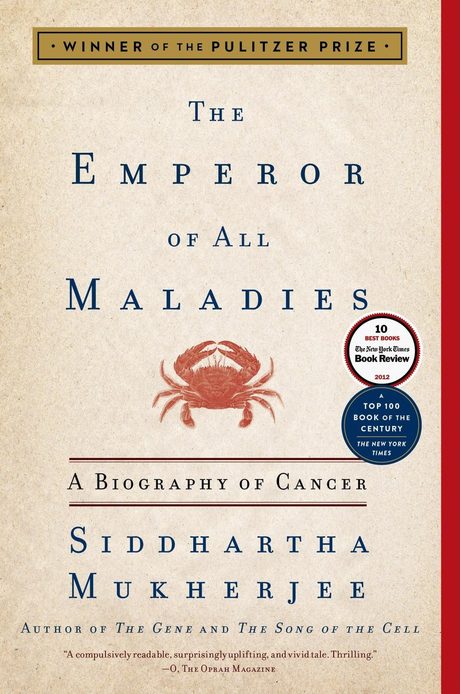
The Emperor of All Maladies
Siddhartha Mukherjee2010about 624 pages
A biography of cancer, from ancient surgeons to the drug trials running while the author was writing it.
Mukherjee is an oncologist, and he structures four thousand years of cancer as though the disease were a character with a life story. Early surgeons cut further and further without understanding why it kept failing. The first chemotherapies were built out of poisons and tried on children. A war on cancer was declared in Washington with a confidence nobody had earned. Then came the slow arrival of drugs that actually understood the machinery of a cell. His own patients run through all of it, named and followed across chapters, which stops a very long book from ever turning abstract.
Why it is at 5
Fifth stop and the last one inside the body, because cancer is your own cells doing what cells do with the brakes cut. It is the longest book in this zone and it earns the length. If Henrietta Lacks gave you the ethics of the laboratory, this gives you the medicine that came out of it, written by somebody who was standing at the bedside that morning.
Read it ifyou want the history of medicine told through real patients
Skip it ifsomeone close to you is in treatment right now
sweeping, clinical, compassionateBest for: readers who finish six hundred pagesmedicinehistorycancer
Heads up: illness, chemotherapy and patient deaths are described closely
6
Zoom 2, the living world around you: a little arithmetic in one chapter
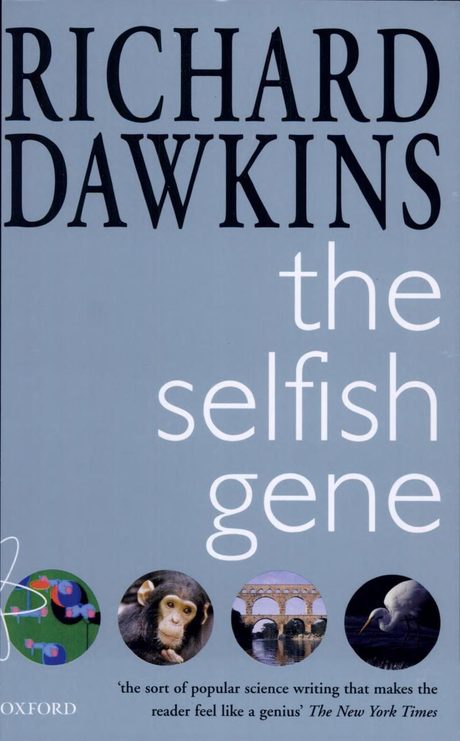
The Selfish Gene
Richard Dawkins1976about 372 pages
The book that flipped biology: evolution makes far more sense from the gene's point of view than from the animal's.
Dawkins argues that the unit natural selection really works on is the gene, and that bodies are temporary vehicles that genes build to carry themselves into the next round. That one change of viewpoint explains things which had puzzled people for a century, including why an animal will die for its siblings, why parents and offspring fight, and why cooperation shows up among creatures with no morals at all. The chapter on hawks and doves brings in a little game theory arithmetic, the only real sums in the book. He also coined the word meme in the last chapter, for something rather different from what the internet did with it.
Why it is at 6
Sixth stop and the first one outside your own skin, because it changes how you look at every living thing including yourself. Almost fifty years on the framework is standard biology, while the title has caused decades of arguments with people who never read past the cover. Selfish is describing the gene, never the person, and Dawkins says so on roughly every third page.
Read it ifyou want the single idea that organises all of biology
Skip it ifyou want warmth, because this one argues before it charms
cold, brilliant, argumentativeBest for: readers who like one big ideaevolutionbiologyclassic
7
Zoom 2, the living world around you: no maths
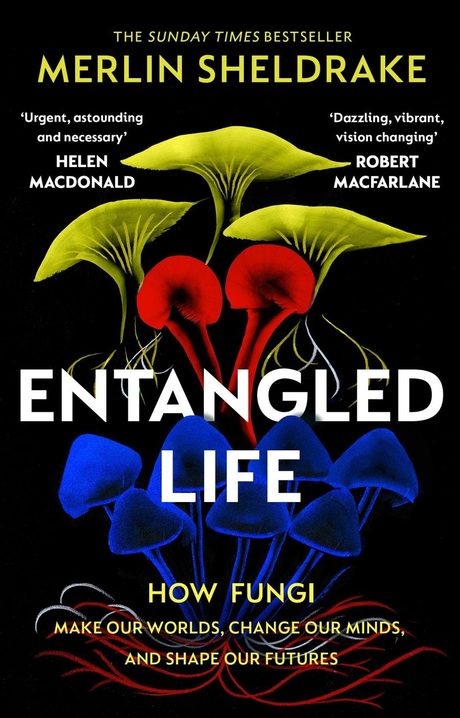
Entangled Life
Merlin Sheldrake2020about 267 pages
Fungi are neither plant nor animal, they are running underneath everything, and this is the book that makes you notice.
Sheldrake is a biologist who works on underground fungal networks and he writes about them like somebody slightly in love. The book takes in truffle hunters and their dogs, the yeasts that make bread and alcohol, lichens that are two organisms living as one thing, psilocybin and what it does to a brain, and the fungal threads that connect tree roots across a forest. He is careful about how much remains unknown and clear about which parts are his own speculation, which is rarer in nature writing than it ought to be.
Why it is at 7
Seventh stop because fungi sit between the body zone and the forest zone, living inside you and around you at the same time. It is the newest book on this list and the one I have given away most often. Read it before The Hidden Life of Trees, because Sheldrake hands you the actual evidence for those underground networks and Wohlleben hands you the poetry.
Read it ifyou want a living world you have walked past your whole life
Skip it ifyou need a clear practical use for what you are reading
curious, lyrical, preciseBest for: walkers, gardeners, cooksbiologyfunginature
8
Zoom 2, the living world around you: no maths, disputed claims
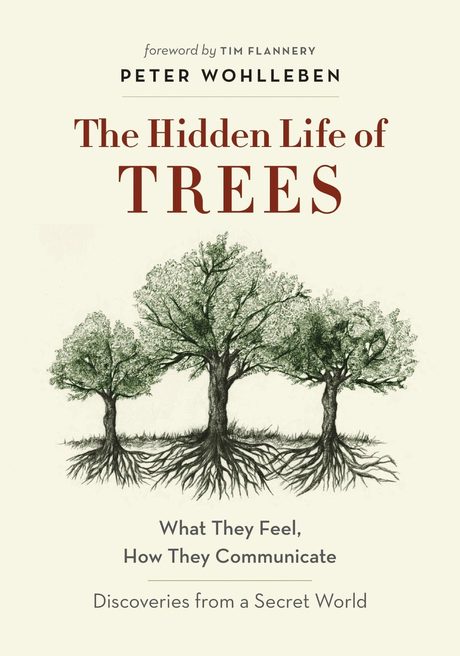
The Hidden Life of Trees
Peter Wohllebentranslated by Jane Billinghurst2015about 289 pages
A German forester argues that trees warn each other, feed their neighbours and raise their young, and forest science argues back.
Wohlleben managed a beech forest for decades and writes about trees as though they were very slow animals. Trees sending chemical alarms when deer begin eating them. Older trees feeding the stumps of felled neighbours through root connections. A forest holding its own climate steady. Saplings waiting years in the shade for a gap in the canopy above them. The language is warm and openly emotional about trees having friendships and families, which is either the charm of the book or its central flaw, depending on which forester you ask.
Why it is at 8
Eighth stop, and here the caveat matters. Since it came out, a group of forest ecologists has argued in public that the evidence for the underground helping network is much weaker than the popular telling suggests, and that the family metaphor is carried well past what data can support. Read it after Sheldrake so you can feel where observation ends and affection begins. It will still change how a walk through trees feels.
Read it ifyou want to see a forest as a system rather than scenery
Skip it ifloose use of words like friendship in science writing irritates you
warm, romantic, disputedBest for: walkers and weekend gardenersnatureforeststranslatedcontested
9
Zoom 2, the living world around you: no maths
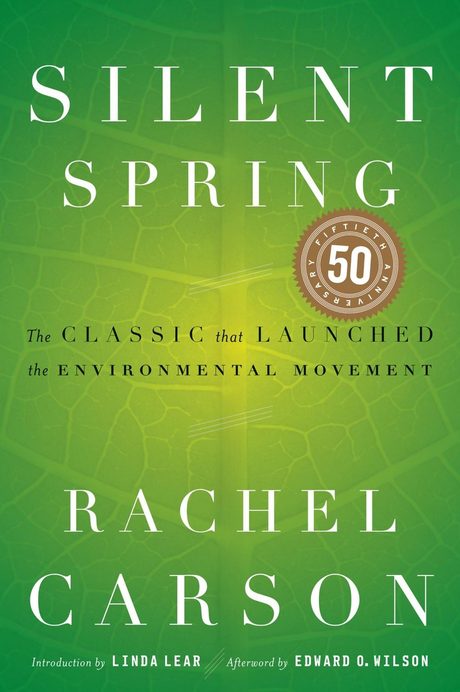
Silent Spring
Rachel Carson1962about 404 pages
The 1962 book that started the environmental movement, by a marine biologist who knew the chemical industry would come for her.
Carson's subject was pesticides, DDT above all, and what happens when something designed to kill insects travels up the food chain into birds, fish and eventually people. She assembled the evidence with enormous care because she knew precisely what would be thrown back at her, and it duly was, through industry campaigns calling her hysterical and unscientific. The prose is unhurried and exact, and the opening chapter, a fable about a town that has gone quiet, is one of the best openings in nonfiction. The book led to real regulation, which almost nothing else on this list can claim.
Why it is at 9
Ninth stop because this is where the route moves from single organisms to whole systems, and because every environmental book written since is descended from it. Some specifics are dated after sixty years, and there are honest arguments about what pesticide restrictions later meant for malaria control. The method, following a poison patiently through a food chain, is the part to take with you.
Read it ifyou want the book that changed environmental law
Skip it ifyou want current climate science rather than the origin story
patient, damning, exactBest for: readers who like a founding textenvironmentclassicchemistry
10
Zoom 2, the living world around you: no maths
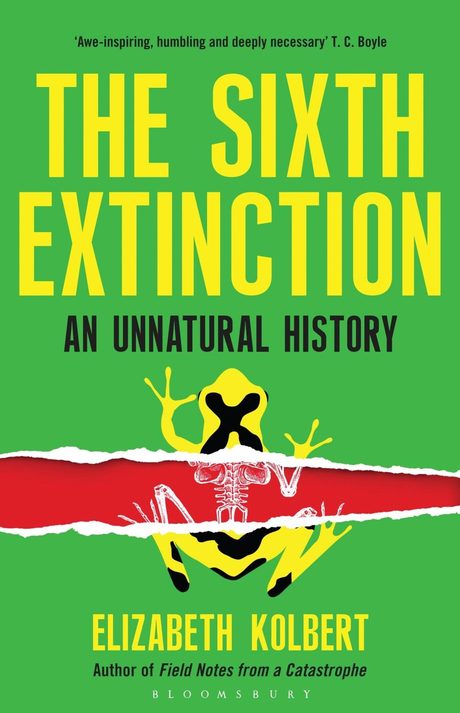
The Sixth Extinction
Elizabeth Kolbert2014about 297 pages
Five times life on earth has nearly ended. Kolbert reports from the sixth, which is under way and is our doing.
Kolbert travels to the places where extinction is being measured rather than argued about. A Panamanian laboratory keeping frogs alive because a fungus has cleared them out of the wild. An island where the last great auks were clubbed to death. Acidifying water off the Italian coast. A patch of Amazon cut into fragments for an experiment that has run for decades. Each chapter takes one species or one place and uses it to explain a mechanism, whether that is ocean chemistry, habitat fragmentation, or invasive species arriving in shipping containers. She reports instead of sermonising, and the accumulation is harder to shrug off than an argument would be.
Why it is at 10
Tenth stop and the end of the living world zone, because it is where every book before it meets. Genes, fungi, forests, oceans, and one species rearranging the lot inside two centuries. It is calmly written and quietly devastating, which is a harder trick than outrage. Read it when you have some emotional room, not in a week that is already bad.
Read it ifyou want the science of what is being lost, reported and not preached
Skip it ifecological grief is sitting close to the surface for you
calm, reported, devastatingBest for: readers ready for hard factsenvironmentextinctionreportage
Heads up: sustained accounts of species loss and animal deaths
11

Zoom 3, all of it at once: no maths
A Short History of Nearly Everything
Bill Bryson2003about 672 pages
A travel writer realised he understood nothing about the universe, spent three years fixing it, and wrote the best beginner's science book there is.
Bryson works through the large questions in order. How the universe began, how the earth formed, how anybody worked out its age, what atoms are, how life started, how species change, what is going on under our feet with tectonic plates and over our heads with weather. It works because he is a beginner too, so he asks the questions you would ask and never assumes you remember a thing. He is also fascinated by the scientists themselves, which fills the book with feuds, wrong turns, and men hiding dinosaur bones from each other out of spite.
Why it is at 11
Eleventh stop and my pick for the best single book here. It is the one to buy if you are only buying one, the one to give at a birthday, and the only entry that covers the whole route by itself. Bryson is not a scientist, and that is exactly why it works, because everything arrives explained by somebody who needed it explained to him first.
Read it ifyou want one book that covers most of science and makes you laugh
Skip it ifyou want the latest research rather than a grand tour
funny, curious, generousBest for: absolutely everyone, including giftsgeneral sciencehistoryhumour
12
Zoom 4, off the planet: no maths
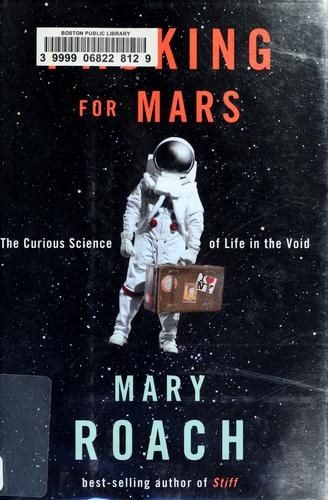
Packing for Mars
Mary Roach2010about 334 pages
Everything the space agencies leave out of the brochure: vomit, toilets, smell, boredom and what a body does without gravity.
Roach's method is to ask the questions everybody actually wonders about and then find the researchers who study them for a living. How do you use a toilet in zero gravity, and what happens when the system fails. What does a crew smell like after weeks sealed in a capsule. Why did agencies test crash survival using human cadavers. How do you eat, wash, or get five minutes of privacy up there. The comedy is real and so is the science, because each silly question opens straight into serious engineering and physiology. She is very good on the psychology of being locked in a tin with other people.
Why it is at 12
Twelfth stop and the book I would hand a bored fifteen year old without a second thought. It gets you off the planet through the body rather than through physics, which is the right door for most people. Read it before the astronomy books, because after this the vacuum feels like a place human beings actually go rather than a diagram.
Read it ifyou want space through the body and the plumbing
Skip it ifyou want the physics of spaceflight rather than the indignities
funny, filthy, rigorousBest for: teenagers who say science is boringspacehumourreportage
Heads up: frank about bodily functions and includes research carried out on human cadavers
13

Zoom 4, off the planet: no maths you have to do
Astrophysics for People in a Hurry
Neil deGrasse Tyson2017about 140 pages
The universe in about a hundred and forty pages, written by a man who knows you have a commute and a phone.
Tyson takes the big items, the first few minutes after the big bang, dark matter, dark energy, the periodic table as a record of dead stars, and gives each one a short chapter you can finish standing in a metro. He does not pretend any of it is simple, but he keeps the technical detail to what a curious person can hold in their head between stations. The final chapter, on what a cosmic perspective does to human arguments, is the part people quote at each other. This is a starter rather than a full meal and it knows that about itself.
Why it is at 13
Thirteenth stop, and the placement is about length rather than quality. If Cosmos at fifteen is a nine course dinner, this is the plate you eat standing up in the kitchen. Read it when you want to know what dark matter actually means before a conversation, and read Sagan when you want to feel something about it.
Read it ifyou want the vocabulary of modern astronomy in a week
Skip it ifyou want depth rather than a fast briefing
brisk, clear, quotableBest for: commuters and impatient readersspaceastronomyshort
14
Zoom 4, off the planet: one equation, shown not solved
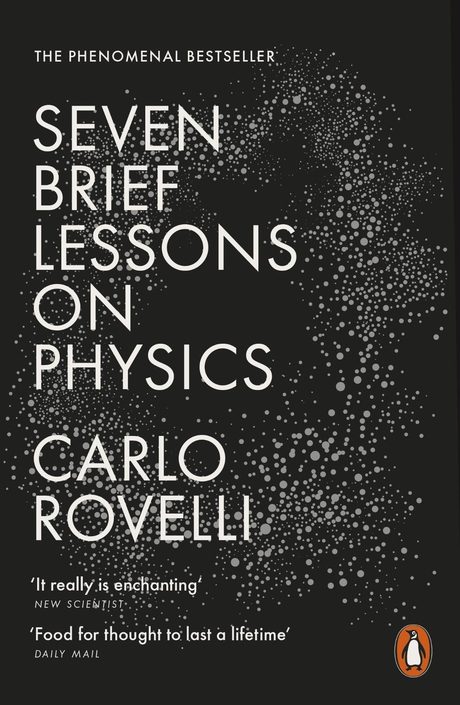
Seven Brief Lessons on Physics
Carlo Rovellitranslated by Simon Carnell and Erica Segre2014about 63 pages
Modern physics in seven short chapters, written like poetry by a physicist who works on quantum gravity.
Rovelli wrote these as newspaper columns and they read like it in the best possible way: seven short pieces on general relativity, quantum mechanics, the structure of the cosmos, particles, the grains of space that his own field works on, probability and heat, and finally what any of it means for us. The first lesson puts Einstein's equation on the page as something to admire rather than something to solve. The whole book takes about ninety minutes to read and considerably longer to stop thinking about, which is a good exchange rate.
Why it is at 14
Fourteenth stop because it is the shortest possible route to feeling what modern physics is about, with no problem sets anywhere. It will not leave you understanding quantum mechanics, and Rovelli would tell you nobody does. Read it in one sitting on a Sunday, then read the last chapter again, because that one is about us rather than about physics.
Read it ifyou want beauty and brevity rather than a full explanation
Skip it ifyou want to actually understand relativity by the end
brief, beautiful, humaneBest for: readers with one free eveningphysicsshorttranslated
15
Zoom 4, off the planet: no maths
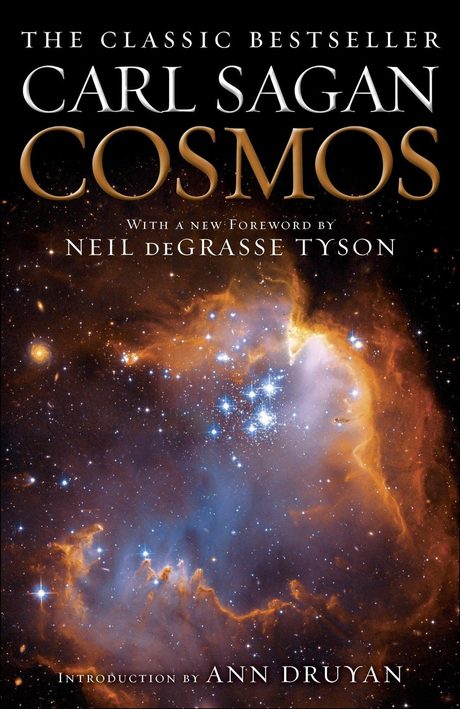
Cosmos
Carl Sagan1980about 450 pages
The book that made a whole generation look up, and it has aged far better than the haircuts in the television series.
Sagan wrote this alongside the television series in 1980 and it moves between the history of astronomy, how life may have started, the chances of other civilisations, and what our species has done with its short window of existence. You get the library of Alexandria, Kepler grinding out the shape of orbits, the chemistry of stars, and the arithmetic of interstellar distance, all in a voice that treats the reader as an adult who deserves the real thing rather than a simplified version of it. Some pages on nuclear war belong firmly to the Cold War. The wonder has not dated at all.
Why it is at 15
Fifteenth stop, the end of the route, and the one to save for last for the same reason you save the best sweet. Everything else here is a way of paying attention, and Sagan makes the argument for why that is worth spending a life on. It reads like a letter written to somebody's grandchildren, which is not the usual register for astronomy.
Read it ifyou want awe rather than information
Skip it ifyou want current astronomy with the newest telescope data
grand, humane, hopefulBest for: anyone who has lost their curiosityspaceclassicastronomy
Worth knowing
How the route works
The list runs in four zones. Books one to five stay inside your own body, from the immune system and the gut out to cells and cancer. Books six to ten cover the living world immediately around you: genes, fungi, forests, pesticides and extinction. Book eleven is the one that covers the whole thing at once. Books twelve to fifteen leave the planet, starting with what happens to a human body in space and ending with the universe itself.
This is not a ranking by quality, and I have said in each entry where a book sits on merit rather than position. Number fifteen is one of the finest books here. The order exists because attention is easier to hold when you start with the reader's own thumb and move outward, and because most beginners quit science reading at the physics shelf. By the time you reach physics on this route, you have four zones of momentum behind you.
Worth knowing
How much maths is actually in here
Almost none, which is the honest answer nobody prints on the cover. Fourteen of these fifteen books contain no maths you are expected to do. Dawkins runs a little game theory arithmetic in his chapter on hawks and doves, and you can follow the argument even if you skip the numbers. Rovelli puts one equation on the page in his first lesson and then tells you to look at it rather than solve it, the way you would look at a painting.
What these books ask for instead is patience with a picture in your head. Immune asks you to hold a system with a dozen cell types moving at once. Emperor of All Maladies asks you to keep a century of research in view while a patient in chapter three is still waiting for results. That is a reading skill, not a science skill, and it improves quickly.
Worth knowing
Which one to hand a teenager
Packing for Mars, without hesitation, especially for a teenager who has decided science is boring. It is funny about bodies in the way fifteen year olds find funny, and the engineering arrives while they are laughing. If they are already curious, give them Immune, because the drawings carry the difficult parts and the subject is their own body during exam season. For a teenager who reads seriously and wants to feel something large, Cosmos still does what it did in 1980. I would not start any of them with the physics books, which is the mistake every school syllabus makes.
People also ask
Questions, answered
What is the best science book for someone with no science background?
A Short History of Nearly Everything by Bill Bryson. He wrote it as a curious outsider who realised he could not explain anything about the world, so every chapter is pitched exactly at somebody starting from nothing. It covers cosmology, geology, chemistry, evolution and the people who worked it all out, with no equations anywhere. If you want something shorter to test yourself first, try Immune or Seven Brief Lessons on Physics.
Do I need maths to read popular science books?
No. Fourteen of the fifteen books here contain no maths you have to do, and the one equation that appears, in Rovelli's first lesson, is printed to be admired rather than solved. What these books do ask for is patience while a picture builds in your head across a few chapters. That is a reading habit rather than a mathematical one, and it gets easier by about book three.
Which science book should I give a teenager?
Packing for Mars by Mary Roach for a reluctant one, because it answers the questions teenagers actually have about space, most of which involve toilets and vomit, while smuggling in real engineering. Immune works well for a curious teenager since the drawings carry the hard parts. Cosmos suits a serious reader who wants to feel something enormous. Avoid starting anyone on physics, which is where school already lost them.
Is Why We Sleep accurate?
Partly, and the argument is worth knowing before you read it. A detailed public critique in 2019 documented errors and overstated claims in the book, particularly around some of the more alarming health statistics, and specialists still disagree about how hard those conclusions should be pushed. The central advice, that adults need more sleep than they take and benefit from a regular schedule, is not in dispute. Read it for the behaviour change, not for the scare figures.
Is The Selfish Gene still worth reading?
Yes. The gene centred view of evolution it popularised is standard biology now, and no later book explains it as cleanly. The parts that have aged are the tone, which is combative, and the last chapter on memes, which the internet has taken somewhere Dawkins never intended. Ignore the arguments about the title. Selfish is describing what a gene does, not a recommendation for how people should live.
What should I read after Sapiens?
If you liked the sweep of it, A Short History of Nearly Everything covers the physical universe the way Sapiens covered human history. If you liked the biology, The Selfish Gene gives you the engine underneath and Behave gives you human behaviour layer by layer. If you liked the uncomfortable questions about what our species has done, The Sixth Extinction is the reported version with the evidence attached.
Before you go
What to read tonight
If you want to start tonight, start with your own body. Immune if you like being shown how a machine works, Henrietta Lacks if you would rather follow people, and either one will tell you within forty pages whether this kind of reading is for you. If you would rather skip the route and take one book only, it is Bryson at eleven, and it has been the right answer for twenty years.
Then keep going outward when you feel like it. The reason this list ends with Sagan is that everything before it teaches you to notice something specific, a cell, a fungus, a bird missing from a spring morning, and Cosmos is the book that tells you why noticing is worth a life. Read it last, on a night with no plans, ideally somewhere you can actually see a few stars.
Keep going
Lists that pair with this one
Books Like
15 Books Like Sapiens: Big Arguments You Can Actually Finish
Every one is real, verified and ranked by how much of the Sapiens feeling comes back, including the book that argues Harari is wrong.
Nonfiction
15 Best Psychology Books for Beginners, Shaky Claims Marked
Every book here names the one claim it put into circulation, and I tell you where that claim stands after a decade of re-testing.
Mood & Life
18 Best Books for Teenagers in India, Sorted by Age
Three age bands, from twelve to eighteen, ranked by the odds that a teenager who does not read finishes it and asks for the next one.
Genre
16 Sci Fi Books for Beginners, Ordered by Difficulty
Ranked one to sixteen by how much each book asks of you, easiest first, with a bail point on every entry.
Nonfiction
14 Philosophy Books for Beginners, Ordered So You Finish One
Each book is labelled with the question it actually answers, ranked from the easiest doorway to the one that will hurt if you start there.