I finished Sapiens on a Volvo bus somewhere short of Udaipur and spent the next hour staring out of the window feeling like a slightly upgraded monkey. That is the feeling people are chasing when they type books like Sapiens into Google at midnight. It is not really about history. It is about the camera pulling back until your own life looks like one frame in a very long film.
So this list is built around that camera. Every book carries a zoom level in its label, from 13.8 billion years down to a single second of thought, and a shelf: the human story, the mind, money and power, or India. The order, one to fifteen, is mine, by how much of the Sapiens feeling comes back per hour of effort you put in, with extra credit for books that argue with Harari rather than agree with him.
Which brings up the part most of these lists skip. Sapiens is a wonderful book and a contested one. Specialists have spent a decade pointing out where the neat story flattens messy evidence, and the book at number one is five hundred pages of exactly that objection. Read it and Sapiens gets more interesting, not less.
This is for anyone who read one big-idea book and wants the next one to be as good. Four Indian books are in here, because the Sapiens zoom works beautifully on ground you already stand on. Quick picks below if you have ten seconds.
How I picked these
- One big argument each. A book that is only a bag of interesting facts with no thesis did not make it, however good the facts were.
- Readable by a person with a job. Sapolsky and Smil are the two hard ones here and I say so in their entries instead of pretending otherwise.
- Every title checked through Google Books and Open Library with a real cover on file, so there are no ghost editions or invented titles on this page.
- I cut 21 Lessons for the 21st Century. It is Harari at his most op-ed, and if you want a second helping of that voice, Homo Deus is the better one.
- India is not an afterthought. Four of the fifteen are about the subcontinent, because Guha and Dalrymple do the same zoom on streets you have walked.
- No self-help wearing a history jacket. Anything that ended with a numbered list of habits got cut.
The whole list at a glance
All 15 books, in order
| # | Book | Author | Year | Vibe | Best for |
|---|
| 1 | The Dawn of Everything | David Graeber and David Wengrow | 2021 | restless, argumentative, generous | readers who want the counterargument |
| 2 | Guns, Germs, and Steel | Jared Diamond | 1997 | patient, systematic, sweeping | readers who want the original |
| 3 | A Short History of Nearly Everything | Bill Bryson | 2003 | curious, funny, warm | people new to reading nonfiction |
| 4 | Behave | Robert M. Sapolsky | 2017 | dense, funny, humane | readers who want the real mechanism |
| 5 | India After Gandhi | Ramachandra Guha | 2007 | generous, sceptical, readable | Indians who skipped history class |
| 6 | The Anarchy | William Dalrymple | 2019 | cinematic, angry, meticulous | readers who want history that moves |
| 7 | Thinking, Fast and Slow | Daniel Kahneman | 2011 | slow, exacting, humbling | anyone who makes decisions for money |
| 8 | The Selfish Gene | Richard Dawkins | 1976 | cold, clear, thrilling | readers who like first principles |
| 9 | The Emperor of All Maladies | Siddhartha Mukherjee | 2010 | grave, precise, moving | readers who like science with stakes |
| 10 | Debt: The First 5,000 Years | David Graeber | 2011 | sprawling, provocative, humane | readers who distrust economics textbooks |
| 11 | Why Nations Fail | Daron Acemoglu and James A. Robinson | 2012 | argumentative, systematic, dry | readers who like economics with history |
| 12 | Energy and Civilization: A History | Vaclav Smil | 2017 | unsentimental, exact, demanding | engineers and number people |
| 13 | Homo Deus | Yuval Noah Harari | 2016 | fluent, speculative, uneven | Sapiens fans wanting the sequel |
| 14 | Factfulness | Hans Rosling | 2018 | brisk, cheerful, corrective | people who read too much news |
| 15 | Land of the Seven Rivers | Sanjeev Sanyal | 2012 | brisk, curious, opinionated | a first Indian history book |
The list
The books, ranked
1
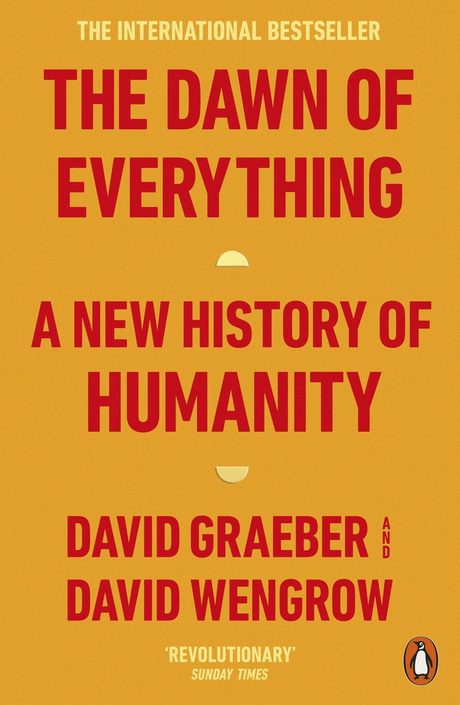
Human story, zoom: 30,000 years
The Dawn of Everything
David Graeber and David Wengrow2021about 483 pages
The book that taps the Sapiens version of prehistory on the shoulder and says none of that is what the digging actually found.
An anthropologist and an archaeologist go through three decades of new excavation work and come back with an awkward finding: early humans did not march in one line from small foraging bands to farms to kings. They built cities with no sign of rulers, switched between hierarchy and equality by season, and clearly argued among themselves about how to live. The book is long and it circles, because the authors are taking a story apart rather than telling a tidy one. What you get in exchange is the sense that the way we organise ourselves now was a choice, and choices can be made again.
Why it is at 1
Number one because it gives you the Sapiens zoom and then removes the comfort of the Sapiens straight line. Read it soon after Harari, while his version is still fresh, and you get an argument between two books instead of one book's opinion. It is the hardest read here, and the only one where the effort changes what you think.
Read it ifyou want the newest evidence and enjoy watching a big story get taken apart
Skip it ifyou want a tidy narrative, because this one keeps refusing to hand you one
restless, argumentative, generousBest for: readers who want the counterargumentbig historyanthropologyarchaeology
Pairs with: Sapiens itself, read back to back so the disagreement stays loud.
2
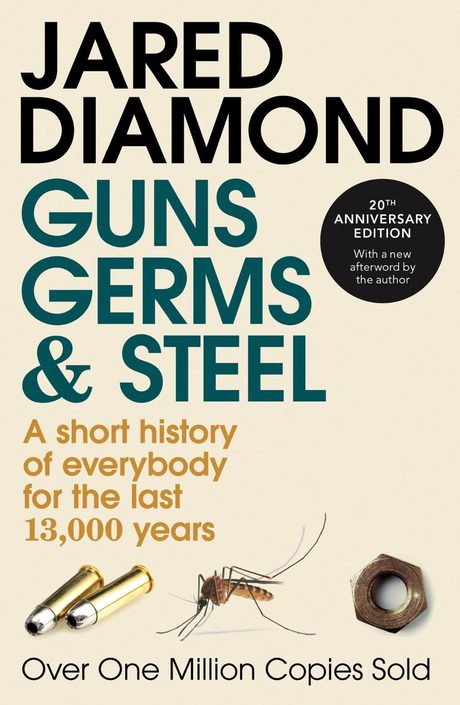
Human story, zoom: 13,000 years
Guns, Germs, and Steel
Jared Diamond1997about 419 pages
Why did Europe end up with the ships and the guns instead of the other way round? Diamond answers with geography, seeds and cattle.
Diamond opens with a question a New Guinean politician once asked him: why do your people have so much cargo and mine so little. His answer is that the winners of history got lucky with their continents. Eurasia runs east to west, so crops and animals could travel along the same latitude, which meant surplus food, dense cities, writing, and the diseases dense cities breed. Those diseases did more colonising than the muskets ever did. This is the book that taught a generation to look for the boring structural reason sitting under a dramatic outcome.
Why it is at 2
This is the direct ancestor of Sapiens and Harari's debt to it is obvious once you read them together. It ranks second rather than first because the geography argument has been chipped at for twenty five years for leaving out politics and human choice. It is still the cleanest single-idea history book on the list.
Read it ifyou like one strong idea followed all the way through
Skip it ifyou want culture and politics taken seriously as causes
patient, systematic, sweepingBest for: readers who want the originalbig historygeographycivilisation
3

Everything, zoom: 13.8 billion years
A Short History of Nearly Everything
Bill Bryson2003
A travel writer decides he wants to know how the universe works, and the science comes back funnier than any textbook managed.
Bryson admits at the start that he grew up bored by science, so he went and asked the scientists to explain it again, slowly, to a man who was not embarrassed to look stupid. What comes back is the whole thing: the Big Bang, plate tectonics, the age of the Earth, DNA, the odds against you existing at all. The pleasure is in the people. Half the book is about the strange, competitive, occasionally deranged humans who worked this out, including the ones who got it right and were ignored for fifty years.
Why it is at 3
Third, and first if you bounced off Sapiens. It has the same widescreen feeling and almost none of the difficulty, because Bryson's job is to be the confused person in the room asking the obvious question. It ranks below the top two only because it is a tour rather than an argument. Nobody finishes it and changes their mind, they just come out delighted.
Read it ifyou want the zoom-out with no homework attached
Skip it ifyou need a thesis, because this book is a guided tour
curious, funny, warmBest for: people new to reading nonfictionsciencepopular sciencehistory of ideas
4
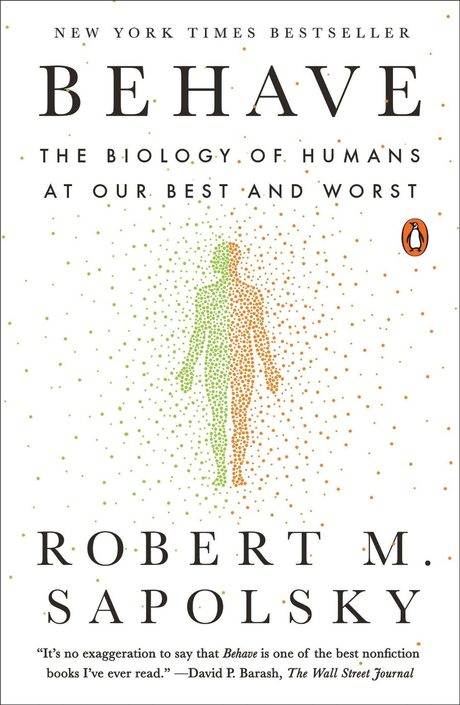
The mind, zoom: one second to one million years
Behave
Robert M. Sapolsky2017about 801 pages
Sapolsky takes a single human action and rewinds it: one second before, one hour before, one childhood, one evolutionary history.
A person does something, kind or terrible. Sapolsky asks what happened in the brain one second earlier, then the hormones that morning, then the adolescence, the womb, the genes, the culture, and the ecology that shaped the culture. Each chapter pulls back one notch. By the end you have a full biology of behaviour without ever losing sight of the person who acted. He writes like a very funny professor who knows his students are tired, so the footnotes crack jokes and every hard idea gets a second run at it. Eight hundred pages, and it earns them.
Why it is at 4
Fourth because it is the mind shelf's version of Sapiens: one framing device applied at enormous scale, leaving you seeing ordinary behaviour differently. It asks more of you than anything above it except The Dawn of Everything. If Sapiens made you wonder why humans are like this, this is the actual answer with the neuroscience left in.
Read it ifyou want the biology behind human cruelty and human kindness
Skip it iflong science books put you to sleep, since this one runs to eight hundred pages
dense, funny, humaneBest for: readers who want the real mechanismneurosciencepsychologybiology
5
India, zoom: 1947 to now
India After Gandhi
Ramachandra Guha2007about 960 pages
How a country nobody expected to survive held itself together, told without the flag-waving and without the sneering.
Guha starts at the moment the country is handed to itself: broke, split, and full of people who have just watched their neighbours kill each other. Then he follows what happened, the states redrawn by language, the wars, the Emergency, the movements, the elections nobody believed would keep happening. He writes about politicians as people making decisions with incomplete information, which is rarer in Indian history writing than it should be. The revised edition carries the story further forward. It runs to nearly a thousand pages and it moves, because Guha is a storyteller who happens to have the archives.
Why it is at 5
Fifth, and the highest Indian entry, because it does the Sapiens thing on ground you live on. Harari pulls back until you feel small. Guha pushes in until the country stops being an abstraction and becomes a set of arguments that particular people had in particular rooms. If you read one book here about your own country, this is it.
Read it ifyou want Indian history as a live argument, not a syllabus
Skip it ifyou want something short, because this is a thousand pages
generous, sceptical, readableBest for: Indians who skipped history classindiahistorypolitics
6

India, zoom: 1599 to 1803
The Anarchy
William Dalrymple2019about 577 pages
A company with shareholders and a London office conquered most of India. Dalrymple tells it as the corporate takeover it actually was.
The East India Company began as a set of investors chasing pepper and ended up running a subcontinent with a private army. Dalrymple works from Company records alongside Mughal and Persian sources, so Indian rulers get to be strategists rather than scenery, and the collapse looks like what it was: slow, ugly and contingent, full of bad decisions on every side and one famine on a scale that is hard to hold in your head. He writes battle scenes better than most novelists working today. You finish it angry, which is the correct response.
Why it is at 6
Sixth because it does what Sapiens does best, taking something you were taught as a fact of nature and showing it was a decision made by identifiable men with balance sheets. It sits below Guha only because the window is narrower. As a pure reading experience it may be the most enjoyable book on this page.
Read it ifyou like history that reads like a thriller and still cites its sources
Skip it iflong battle narratives tire you out
cinematic, angry, meticulousBest for: readers who want history that movesindiacolonialismnarrative history
7
The mind, zoom: one decision
Thinking, Fast and Slow
Daniel Kahneman2011about 611 pages
Two systems run your head, the fast one that guesses and the slow one that checks, and the fast one is driving more than you think.
Kahneman spent a career, much of it with Amos Tversky, finding the places where human judgement bends in predictable directions. Anchoring, loss aversion, the way a vivid story beats a boring statistic, the way we remember an experience by its peak and its ending rather than its length. The book is a slow tour of those findings with small tests you can fail as you read, and failing them is the entire point. It is not a self-help book and it will not tell you how to fix yourself. It tells you what you are working with.
Why it is at 7
Seventh, and I moved it down deliberately. It is a landmark on how judgement works, but parts of it did not survive psychology's replication crisis, and in 2017 Kahneman himself said he had placed too much faith in the underpowered priming studies behind one chapter. Read it knowing that and it is still the best book here on why intelligent people decide badly.
Read it ifyou want to watch your own thinking from the outside
Skip it ifyou want practical fixes, because this book only diagnoses
slow, exacting, humblingBest for: anyone who makes decisions for moneypsychologydecisionsbehavioural economics
8
The mind, zoom: 3.8 billion years
The Selfish Gene
Richard Dawkins1976about 372 pages
You are a survival machine built by genes to carry them forward. Fifty years on, the idea still rearranges your head.
Dawkins flips the camera around. Instead of asking what is good for the animal, he asks what is good for the gene riding inside it, and a lot of biology that looked like altruism turns out to be arithmetic. Why a bird warns the flock, why a mother defends her young harder than her cousins, why cooperation shows up at all inside a system built on competition. This is also the book that gave the world the word meme, in its original sense of an idea that copies itself. The title has caused fifty years of confusion, so read the preface first.
Why it is at 8
Eighth because it is the intellectual grandparent of this entire shelf, Sapiens included. Harari on shared fictions holding strangers together is downstream of Dawkins on replicators. It sits here rather than higher because the science has moved on in places and the prose is drier than Bryson or Dalrymple. The central idea has aged remarkably well.
Read it ifyou want the single idea that reorganised modern biology
Skip it ifyou dislike being described as a machine for four hundred pages
cold, clear, thrillingBest for: readers who like first principlesevolutionbiologyideas
9
Human story, zoom: 4,000 years
The Emperor of All Maladies
Siddhartha Mukherjee2010about 624 pages
A biography of cancer, from an Egyptian papyrus to a modern ward, written by an oncologist who turned out to be a real writer.
Mukherjee treats a disease as a character with a life story: first sightings in ancient texts, centuries of helplessness, surgeons who cut wider and wider in the belief that more was better, chemotherapy pioneers who poisoned patients almost to death because the alternative was certain death, and the slow arrival of molecular biology. Between the science he keeps returning to his own patients, so the abstraction never floats free of a person in a bed. He is unusually honest about medicine's dead ends and its vanity.
Why it is at 9
Ninth because it proves the Sapiens format works on a single subject: pick one thing, follow it across all of recorded history, and the thing turns into a lens on everything around it. It is heavier going emotionally than anything else here. It is also, sentence for sentence, the best written book on the list.
Read it ifyou want science writing with actual people in it
Skip it ifillness in your family is recent, because this one lands hard
grave, precise, movingBest for: readers who like science with stakesmedicinesciencehistory
Heads up: sustained detail about cancer treatment, dying patients and clinical trials
10

Money and power, zoom: 5,000 years
Debt: The First 5,000 Years
David Graeber2011about 709 pages
Everything you were taught about barter turning into money is wrong, and Graeber has the anthropology to show where money really came from.
Economics textbooks open with a village where people swap chickens for shoes until somebody invents coins. Graeber, an anthropologist, points out that no such village has ever been found anywhere on Earth. Credit came first, debt is older than currency, and the vocabulary we use for morality, what we owe, what we deserve, settling scores, came straight out of accounting. He then runs that argument across five thousand years, through empires, slavery, religion and the 2008 crash. It sprawls and it repeats itself. It also permanently changes how you hear the phrase paying your debts.
Why it is at 10
Tenth because it is the money shelf's Sapiens: one enormous claim, evidence dragged in from everywhere, an author perfectly happy to annoy a whole discipline. It is looser and more polemical than Harari, so read it with your guard up. The central point about barter has held up better than several of the digressions around it.
Read it ifyou want an anthropologist's version of economic history
Skip it ifyou need a tight argument with few digressions
sprawling, provocative, humaneBest for: readers who distrust economics textbooksmoneyanthropologyeconomics
11
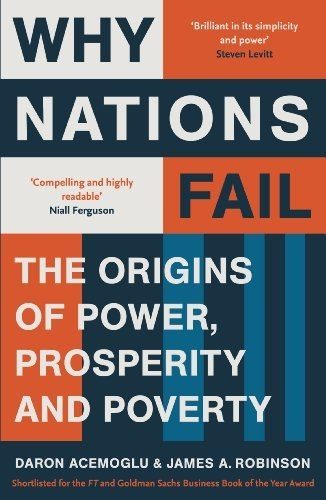
Money and power, zoom: 500 years
Why Nations Fail
Daron Acemoglu and James A. Robinson2012about 529 pages
Two economists argue that countries are rich or poor because of their institutions, and that geography and culture are mostly excuses.
The book opens on the border town of Nogales, half in Arizona and half in Mexico, same people and same weather, wildly different incomes. From there the argument is that the difference comes down to institutions: whether the rules let ordinary people keep what they build and take part in power, or funnel everything to a small group at the top. The examples run from Venice to Botswana to the Soviet Union, and the pattern the authors keep finding is that extractive rules can produce a growth spurt but never a durable prosperous country.
Why it is at 11
Eleventh because it is the direct rival to Diamond at number two, and reading them against each other teaches you more than either does alone. Diamond says the map dealt the cards. These two say people wrote the rules. The book is far more persuasive on the diagnosis than on what any particular country should now do about it.
Read it ifyou want a theory of why some countries stay poor
Skip it ifcase study after case study feels repetitive to you
argumentative, systematic, dryBest for: readers who like economics with historyeconomicsinstitutionspolitics
12
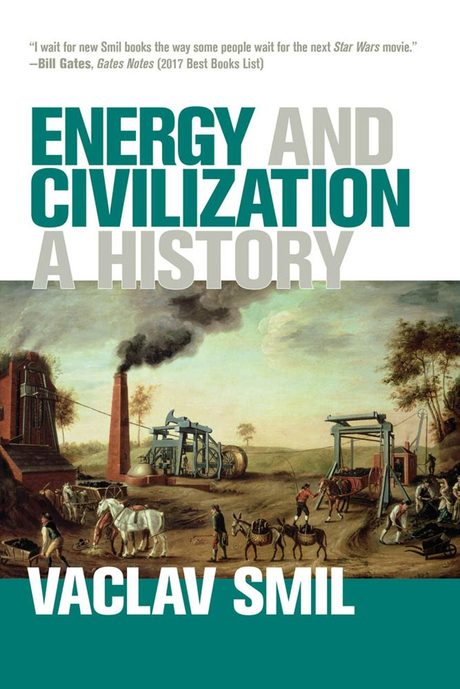
Money and power, zoom: 10,000 years
Energy and Civilization: A History
Vaclav Smil2017about 564 pages
Every civilisation is a way of capturing energy, and Smil counts the joules from the ox and the plough to the gas turbine.
Smil's claim is that if you want to understand any society, count how much energy it can put to work and how efficiently it does so. He starts with muscle, human and animal, moves through water, wind, coal, oil and electricity, and shows what each new source made possible: how many people one field could feed, how tall a building could go, how fast an army could move. There are tables. There are a great many numbers. In exchange you get the least sentimental big history you will ever read.
Why it is at 12
Twelfth because it is the hardest book here to love and one of the most useful. It ranks low only because reading it feels like work, and this list is ranked partly on pleasure per hour. Nobody else does the arithmetic properly, so if you want the numbers sitting underneath every other book on this page, they are in here.
Read it ifyou want the physical numbers under human history
Skip it iftables and unit conversions make you close a book
unsentimental, exact, demandingBest for: engineers and number peopleenergyhistorynumbers
13

Human story, zoom: the next century
Homo Deus
Yuval Noah Harari2016about 528 pages
Harari's sequel: having beaten famine, plague and war down to manageable size, what does a species do with itself next?
The setup is that humanity's three ancient enemies have become problems rather than fates. Harari asks what replaces them as the project, and his answer is upgrading ourselves: longer life, engineered contentment, and handing our decisions to algorithms that know us better than we know ourselves. The middle section, on how humanism quietly became the religion of the modern world, is the best writing he has done anywhere. The predictions in the last third are the weakest part, as predictions usually are, and they were written before the current AI wave, so some pages read oddly now.
Why it is at 13
Thirteenth, which will annoy people, and I will defend it. If you loved Sapiens you will enjoy this, but it repeats a lot of the first book's setup and its forecasting is the softest thing Harari has published. Read it if you want more of that voice. Read The Dawn of Everything first if you want your mind changed.
Read it ifyou want more Harari and you liked the voice
Skip it ifyou want evidence rather than forecasting
fluent, speculative, unevenBest for: Sapiens fans wanting the sequelfuturetechnologybig history
14
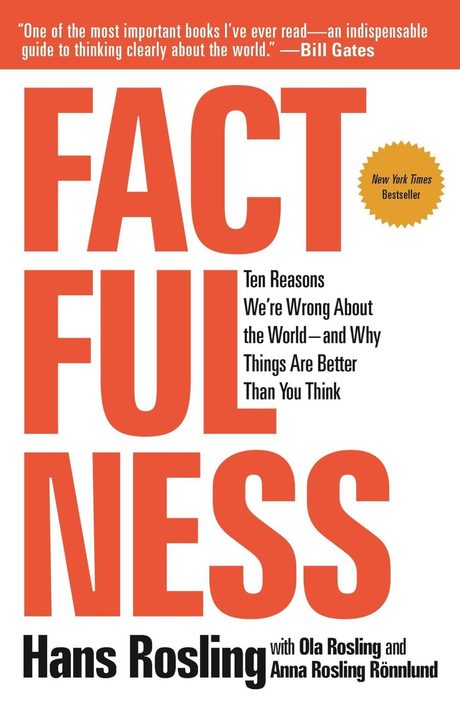
Human story, zoom: the last 200 years
Factfulness
Hans Rosling2018about 353 pages
A Swedish doctor with a bag of statistics shows that the world is in better shape than you believe, and explains why you got it wrong.
Rosling spent years asking educated audiences simple questions about global poverty, child deaths and girls in school, then watching them score worse than random guessing. This book is his explanation of why: ten habits of mind, from assuming everything is getting worse to splitting humanity into us and them, that make us reliably wrong about how the species is doing. He replaces the rich world and poor world split with four income levels, which is a genuinely better way to think. His son and daughter-in-law finished the book after his death.
Why it is at 14
Fourteenth because it is the most useful weekend of reading here and the least ambitious. It has no theory of history, only a correction to yours, and the correction is worth having. It runs against the mood of the internet, which is why some readers call it glib. Rosling is not saying things are good. He is saying they are better and still bad.
Read it ifyou want your picture of the world checked against data
Skip it ifoptimism about global trends irritates you
brisk, cheerful, correctiveBest for: people who read too much newsdataglobal developmentstatistics
15
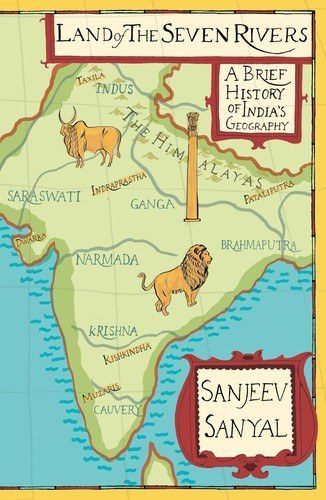
India, zoom: geological time to Gurgaon
Land of the Seven Rivers
Sanjeev Sanyal2012
Indian history told through its rivers, coasts and shifting landforms, from a dried-up Saraswati to a suburb full of glass towers.
Sanyal's angle is geography: what the subcontinent's rivers, mountains and coastlines did to the people who settled along them. He tracks the drying of the Saraswati, the reasons the Gangetic plain became the political centre, how trade routes and ports migrated, and why cities rose and emptied where they did. It ends in modern Gurgaon, which he treats as the latest chapter of the same story rather than a break from it. He writes lightly and moves fast, and he is upfront that parts of the deep past rest on evidence still being argued over.
Why it is at 15
Fifteenth, and it is here as the gateway rather than the authority. Of the four Indian books on this list it is the shortest and the easiest, and it is the one that most resembles Harari's method, taking a single lens and running it across everything. Guha and Dalrymple are the more careful historians. Sanyal is the better first step.
Read it ifyou want Indian history with the map in front of you
Skip it ifyou want a historian who flags every disputed claim
brisk, curious, opinionatedBest for: a first Indian history bookindiageographyhistory
Worth knowing
How to read the labels
Every book carries two things above its title: which shelf it sits on and how far it zooms out. The shelves are the human story, the mind, money and power, and India, which are the four directions readers go after Sapiens. The zoom is the span the book actually covers, from 13.8 billion years in Bryson down to one second of thinking in Kahneman.
The reason to care is that the Sapiens feeling comes from the zoom and not from the subject. Mukherjee gets it out of a single disease and Kahneman gets it out of a single decision, because both keep pulling the camera back until you can see the shape of the whole thing. Pick your next book by the zoom you want rather than by the shelf.
Worth knowing
Where Sapiens gets argued with
Sapiens is a great read and a contested one, and any list that hides that is selling you something. The main charge from archaeologists and historians is that it moves quickly over evidence that is thin or still disputed, especially about how foragers lived and what happened when farming arrived, and that one confident storyline conceals how much of the past is genuinely unsettled.
The most substantial reply is the book at number one. Graeber and Wengrow spend five hundred pages showing that the sequence Harari leans on, small bands to farming to inequality to the state, is not what the last thirty years of digging turned up. There were large settlements with no sign of rulers and societies that switched their politics with the seasons. Their reading of the evidence has been questioned in turn, which is how this is supposed to work. My honest position: Sapiens is the best written introduction to the subject and a poor final word on it, and the two books together are far more interesting than either alone.
People also ask
Questions, answered
What should I read after Sapiens?
The Dawn of Everything by David Graeber and David Wengrow, if you want the conversation to continue. It covers the same ground with newer archaeology and disagrees with Harari about most of it, which makes both books better. If you want the pleasure of Sapiens without the difficulty, read Bill Bryson's A Short History of Nearly Everything instead. And if you simply want more of Harari's voice, Homo Deus is the sequel, and it is good rather than great.
Is Sapiens historically accurate?
It is accurate in outline and loose in the detail. Archaeologists and historians have objected to how fast it travels over contested evidence, particularly about foraging life and the arrival of farming, and to the confidence of a single storyline. None of that makes it a bad book. Treat it as a brilliant argument by one historian rather than a settled account, and read The Dawn of Everything for the strongest reply to it.
Which book like Sapiens is the easiest to read?
A Short History of Nearly Everything. Bryson wrote it as a man who found science boring at school, so every explanation assumes you know nothing and no question is treated as stupid. Factfulness is the next easiest and the shortest. Do not start with Behave or Energy and Civilization, since both are long and both expect you to keep numbers and mechanisms in your head while you read.
Are there Indian books like Sapiens?
Four on this list. India After Gandhi by Ramachandra Guha is the essential one, nearly a thousand pages on how the republic survived itself. The Anarchy by William Dalrymple tells the East India Company story as the corporate takeover it was. Land of the Seven Rivers by Sanjeev Sanyal is the shortest and the closest to Harari's method. The Emperor of All Maladies is by an Indian author, though its subject is cancer rather than India.
Do I need a science background for these?
No. Bryson, Factfulness and Land of the Seven Rivers assume nothing whatsoever. The Selfish Gene and Behave get technical in patches, but both authors define every term before they lean on it, and skipping a paragraph you cannot follow costs you almost nothing. Energy and Civilization is the single book here where being comfortable with numbers genuinely changes how much you get out of it.
Is Homo Deus worth reading or is it just more Sapiens?
Both, honestly. The middle section on how humanism quietly replaced religion as the story modern people live by is the strongest writing Harari has done. The forecasts about algorithms and upgraded humans that fill the last third are much looser, and they were written before the current wave of AI, so some pages read strangely now. Read it if you liked the voice enough to want another round of it.
Before you go
What to read tonight
If you have one evening and no patience, start Bryson tonight. It works in twenty-page sittings and you can leave it for a week without losing the thread. If you still have the appetite you had when you first opened Sapiens, go straight to The Dawn of Everything and read it as the other half of an argument, while Harari's version is fresh. And if what you actually want is the ground shifting under a country you thought you knew, Guha and Dalrymple will do more for you than any global history, because you already know the streets they are standing on.
One warning from experience. Do not queue three of these back to back. Big-idea nonfiction blurs together when you binge it, and the fifth theory of everything in a month stops landing. Put a novel in between.
Keep going
Lists that pair with this one
Indian Fiction
16 Best Books to Understand India, Ranked by What They Explain
Sixteen books, ten doors into the same country: history, caste, the mega city, the village, money, and where to start tonight.
Mood & Life
14 Best Money Books for Indians, First Salary to First Crore
Sorted by where you are and by how much of each book you have to translate into Indian conditions before it is any use.
Mood & Life
20 Best Books to Read in Your 20s, Grouped by the Problem
Four problems run this decade, work, love, money and meaning, so the list is sorted that way instead of pretending one book fixes all four.
Mood & Life
16 Best Books for Long Flights and Train Journeys, by Hours
Every book here is timed: roughly how many hours it fills, and how well it survives being put down for the meal trolley.
Books Like
13 Books Like The Kite Runner, Sorted by How Much Hope They Give You
The Kite Runner wounds you and then offers a way to make it right, so I have marked every book here with whether it offers the same way out.