At a wedding in Ahmedabad, a Dutch colleague of the groom asked me what he should read to understand India. I said India After Gandhi, felt clever for about four seconds, and then spent the drive home realising that one book cannot carry a country where the language changes every few hundred kilometres and the century you are living in depends on your postcode.
So this is the answer I should have given him. Sixteen books, arranged as ten doors into different parts of the same building: history, caste, the mega city, the village, money, the colonial takeover, prehistory, cricket, satire, and one primary source written by the man who ran the place first. Non fiction dominates. The two novels are labelled as novels, because a good novel gives you the temperature of an event and a good history gives you its shape.
The ranking runs on one axis: how much of the country a book explains for the hours it asks of you. That is why a speech from 1936 that was never delivered sits at number two, and why a beloved classic sits at sixteen with a caveat attached. If you are Indian, expect at least three of these to argue with something your family taught you. If you are not, expect to stop using the word India as though it names one thing.
Quick picks are right below if you want to leave in ten seconds with one title.
How I picked these
- I judged each book on explanatory value per hour, not on prestige. A short book that changes how you read the news beats a famous one that decorates a shelf.
- Fiction and non fiction both, each entry labelled, because a novel and a reported book teach different things about the same event.
- Coverage over consensus: the list has to hold history, caste, cities, villages, money, colonial origins, prehistory and one primary source, instead of ten books about Delhi politics.
- I cut Freedom at Midnight. It reads wonderfully and it is a dramatised account that leans hard on Mountbatten's version, and historians have been arguing with its sourcing for decades. It is a story about 1947 rather than a history of it.
- I cut the novels where India is the background rather than the subject, Midnight's Children included, because they deserve their own list and this one has a different job.
- Every title was checked through Google Books and Open Library, so the covers and editions here are real ones you can actually buy or borrow.
The whole list at a glance
All 16 books, in order
| # | Book | Author | Year | Vibe | Best for |
|---|
| 1 | India After Gandhi | Ramachandra Guha | 2007 | patient, humane, argumentative | the one book you keep |
| 2 | Annihilation of Caste | B. R. Ambedkar | 1936 | cold, precise, furious | one sitting, then a week of thinking |
| 3 | Maximum City | Suketu Mehta | 2004 | immersive, unsparing, alive | anyone who lives in a big city |
| 4 | Behind the Beautiful Forevers | Katherine Boo | 2012 | quiet, forensic, devastating | readers who distrust statistics |
| 5 | Everybody Loves a Good Drought | P. Sainath | 1996 | dry, angry, concrete | winning dinner table policy arguments |
| 6 | Ants Among Elephants | Sujatha Gidla | 2017 | flat, unsparing, unforgettable | reading straight after Ambedkar |
| 7 | The Idea of India | Sunil Khilnani | 1997 | elegant, compact, argued | one weekend of thinking |
| 8 | India Unbound | Gurcharan Das | 2000 | optimistic, personal, pro market | understanding pre 1991 India |
| 9 | The Billionaire Raj | James Crabtree | 2018 | sharp, reported, readable | anyone who follows business news |
| 10 | The Anarchy | William Dalrymple | 2019 | fast, cinematic, grim | history readers who want narrative |
| 11 | Train to Pakistan | Khushwant Singh | 1956 | spare, tense, unforgiving | one evening, cover to cover |
| 12 | The Argumentative Indian | Amartya Sen | 2005 | learned, generous, repetitive | readers who enjoy ideas |
| 13 | A Corner of a Foreign Field | Ramachandra Guha | 2002 | warm, curious, scholarly | cricket fans who read |
| 14 | The Great Indian Novel | Shashi Tharoor | 1989 | clever, playful, showy | readers who like literary jokes |
| 15 | Early Indians | Tony Joseph | 2018 | clear, patient, careful | settling family WhatsApp arguments |
| 16 | The Discovery of India | Jawaharlal Nehru | 1946 | grand, dated, revealing | reading after the modern histories |
The list
The books, ranked
1
Door 1: How we got here (non fiction)
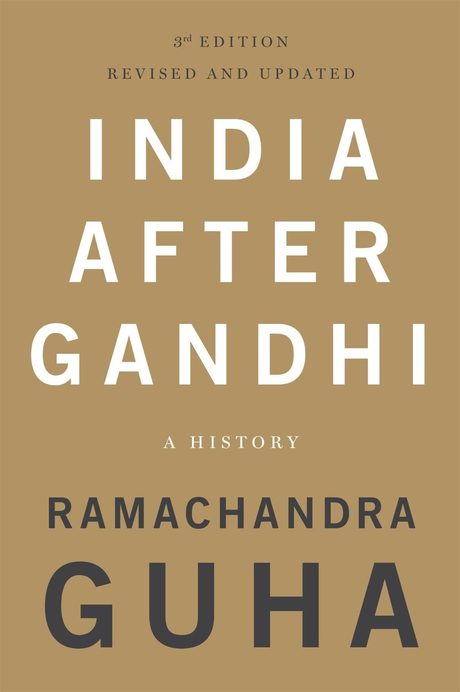
India After Gandhi
Ramachandra Guha2007about 898 pages
Nine hundred pages on how a country nobody expected to survive kept holding elections anyway.
Guha starts where most school textbooks give up, at midnight on 15 August 1947, and then keeps going for six decades. The accession of Kashmir, the merging of hundreds of princely states, the redrawing of state borders along language lines, the wars, the Emergency, the insurgencies in the northeast, the 1991 reforms. He writes history through people rather than dates, which is the only reason a book this heavy moves at all. Reading it feels like watching a plane get built while it is already flying, and finally understanding why the wings are that shape.
Why it is at 1
Number one because it does the most work per hour you put in. Nearly every argument you will ever have about India, on reservations, on Kashmir, on language, on which states subsidise which, has a chapter here explaining how that fight began. The caveat is honest: it is long, and the chapters thin out as they approach the present, where history turns into journalism.
Read it ifyou want one book that explains the country you live in
Skip it ifyou bounce off long books and would rather start with two hundred pages
patient, humane, argumentativeBest for: the one book you keephistorypost-1947politics
Pairs with: The Anarchy, which covers the two centuries just before this book opens.
2
Door 2: Caste, unfiltered (non fiction)
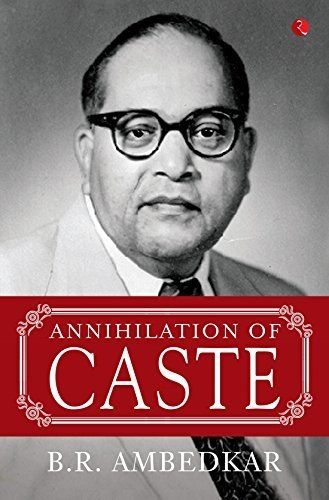
Annihilation of Caste
B. R. Ambedkar1936about 160 pages
The speech a Hindu reform group invited Ambedkar to give, then cancelled once they read what he had written.
Ambedkar wrote this in 1936 for a conference in Lahore. The organisers asked him to soften parts of it, he refused, they called the event off, and he printed the speech himself. It is short, cold and furious. His argument is that caste is not a division of labour but a division of labourers, and that no amount of kindness, reform or inter dining fixes it while the religious sanction underneath stays intact. Gandhi replied in print, Ambedkar replied to the reply, and most editions carry the whole exchange. It still reads like it was written this morning about somebody in your extended family.
Why it is at 2
Second because caste explains more of ordinary Indian life than any other single thing, and this is the clearest statement of the case, written by the man who lived it and later chaired the drafting of the Constitution. Guha tells you what happened to India. Ambedkar tells you what is still happening in your building's lift and your cousin's rishta search.
Read it ifyou want the argument at its source instead of somebody's summary
Skip it ifyou were hoping for a neutral survey of caste rather than one man's case
cold, precise, furiousBest for: one sitting, then a week of thinkingcasteessayambedkar
Pairs with: Ants Among Elephants at number six, which is the same argument lived out in one family.
3
Door 3: The city as the country (non fiction)
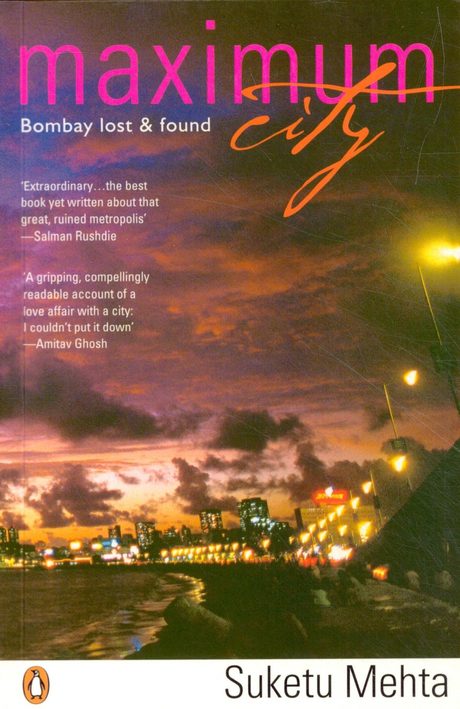
Maximum City
Suketu Mehta2004about 542 pages
A writer moves his family back to Bombay after two decades away and reports it like a foreign country he happens to love.
Mehta grew up in Bombay, left as a teenager for New York, and came back in his thirties with a wife, two small children and a notebook. What follows is not travel writing. He spends months with a Shiv Sena man who describes what he did during the riots, with a hit man who cannot sleep, with bar dancers, with a family of diamond merchants preparing to renounce everything they own. The city hands over its cruelty and its tenderness inside the same chapter. I do not know a better book on how ordinary people build a life in an impossible place.
Why it is at 3
Third because a country this size only becomes real at street level, and no reporter has got closer than this. It is thicker and messier than Katherine Boo's book just below, and far more personal. Fair warning: Mehta is inside every scene, and some readers find that exhausting by page four hundred.
Read it ifyou learn through people and scenes rather than through arguments
Skip it ifyou want tidy chapters, because this one sprawls on purpose
immersive, unsparing, aliveBest for: anyone who lives in a big citymumbaireportagecities
Heads up: riot violence and killings described in first person detail
4
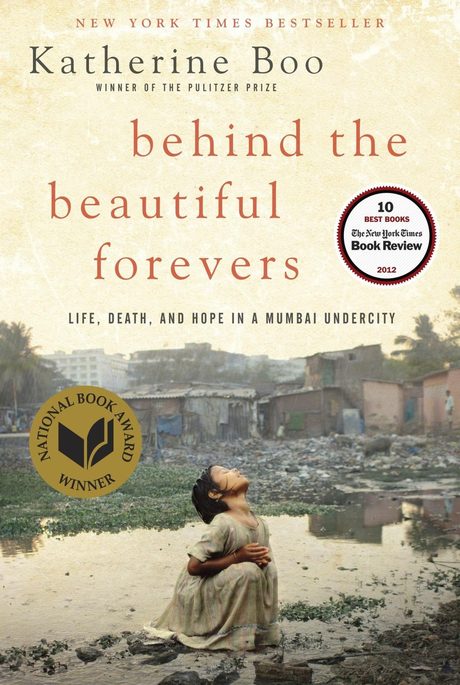
Door 3: The city as the country (non fiction)
Behind the Beautiful Forevers
Katherine Boo2012about 256 pages
Three years inside one settlement beside the Mumbai airport, reported so closely that you keep forgetting it is not a novel.
Annawadi sat on airport land behind a wall carrying tile advertisements, which is where the title comes from. Boo, a staff writer at the New Yorker, spent three years there with translators and a video camera, following a teenage garbage sorter whose family's small rise sets off a neighbour's rage, and a woman working her way up through the local political machinery. Boo never appears on the page. The book reads like fiction and is footnoted like a court file. What stayed with me was not the poverty, it was the competition between the poor, arranged and profited from by everybody above them.
Why it is at 4
Fourth because it answers the question statistics cannot: what does one family's climb actually cost, and who ends up paying for it. Mehta gives you the whole city, Boo gives you one lane and goes much deeper into it. Read them in either order and Mumbai stops being an abstraction with a population figure attached.
Read it ifyou want reporting so close that it reads like a novel
Skip it ifyou need a hopeful ending to finish a book
quiet, forensic, devastatingBest for: readers who distrust statisticsmumbaipovertyreportage
Heads up: suicide, the deaths of children, police extortion
5
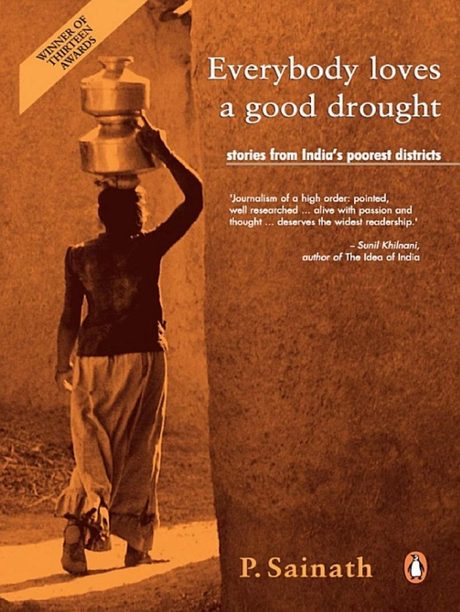
Door 4: The India that is not on television (non fiction)
Everybody Loves a Good Drought
P. Sainath1996about 513 pages
Sainath went to the poorest districts in the country and filed stories about people rather than schemes, and the reporting has not aged.
In the early nineties Sainath got a newspaper fellowship and did the thing Indian journalism almost never does: he left the cities and stayed away for a long time. These are dispatches from the poorest districts in the country, on displacement by dams, debt that outlives the person who took it, schools without teachers, illnesses that bankrupt whole families, and development money that reaches everybody except the people it was budgeted for. The title comes from a line he heard about how much cash a declared drought brings into a district. It is funny the way a joke told at a funeral is funny.
Why it is at 5
Fifth because most Indians do not live in the cities that the books above are set in, and almost nothing you scroll past online covers them. The caveat: these datelines are from the nineties. Sainath's later work shows how much of it is unchanged, so treat the specific numbers as history and the mechanisms as current.
Read it ifyou want rural India from somebody who actually went and stayed
Skip it ifyou want current data rather than reporting from the nineties
dry, angry, concreteBest for: winning dinner table policy argumentsruralpovertyjournalism
6
Door 2: Caste, unfiltered (non fiction)
Ants Among Elephants
Sujatha Gidla2017
A family history that shows what caste does across three generations, written by a woman who now works on the New York subway.
Gidla was born into an untouchable family in Andhra Pradesh, Christian by conversion, educated through luck and stubbornness in equal parts. The book follows her mother, a college lecturer who never once gets a fair posting, and her uncle, a poet who joins the Communist movement and ends up leading an armed struggle from the forests. It is a family story and a political history at the same time, told in flat unsentimental sentences that land harder than any adjective could. Her opening pages, where she tries to explain caste to Americans, are the best short answer to that question I have read anywhere.
Why it is at 6
Sixth, and placed alongside Ambedkar deliberately. He gives you the argument, she gives you what the argument looks like inside one family over seventy years, including the parts that embarrass everybody: the caste politics inside the Left, inside the church, inside a marriage.
Read it ifyou want caste as lived history rather than as theory
Skip it ifyou want a single life with a neat arc and a resolution
flat, unsparing, unforgettableBest for: reading straight after Ambedkarcastememoirandhra
7
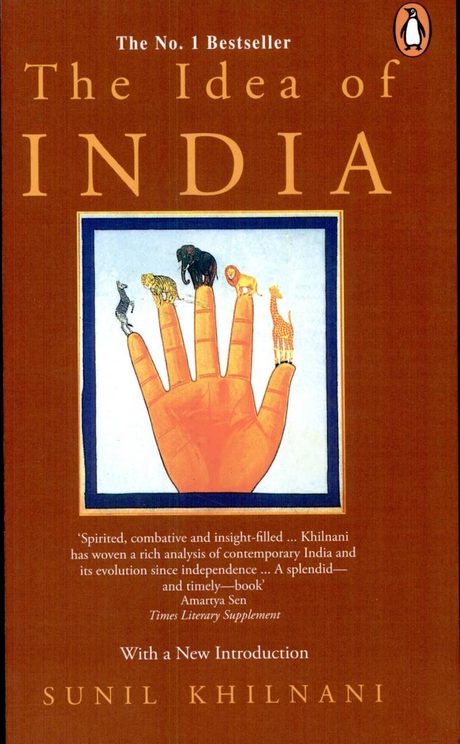
Door 1: How we got here (non fiction)
The Idea of India
Sunil Khilnani1997about 296 pages
A short book on where the idea of an Indian nation came from, and why holding it together was always a strange thing to attempt.
Khilnani's book is compact and built from a handful of long essays: on democracy, on the state Nehru designed, on cities, and on the fight over who gets to define the nation. His central claim is that India as one political idea is recent, largely a twentieth century invention, and that its survival is stranger than any of its failures. He writes about Nehru with admiration and without worship, which is rarer than it sounds. If Guha is the whole film, this is the director explaining the plot to you in an hour.
Why it is at 7
Seventh because it is the fastest route to the conceptual frame, and because you will read the news differently afterwards. It is more abstract than everything above it, so I would not start here unless essays are your natural habitat. Some of its nineties optimism reads oddly now, which is useful in its own way.
Read it ifyou like ideas argued properly in essay form
Skip it ifyou want people and stories rather than concepts
elegant, compact, arguedBest for: one weekend of thinkingpoliticsessaysnation
8
Door 5: Money (non fiction)
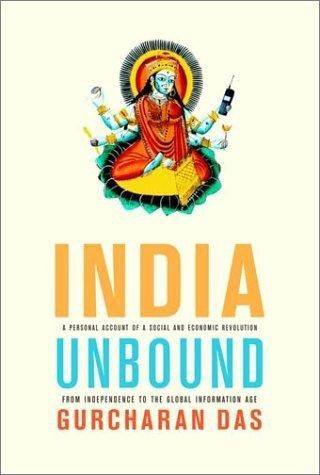
India Unbound
Gurcharan Das2000about 448 pages
How India talked itself into a permit economy for forty years, told by a man who ran companies through the whole thing.
Das grew up alongside independence, ran businesses through the licence raj, and watched the 1991 reforms arrive from inside the private sector. The book mixes memoir with economic history: why the state decided how many scooters a factory was allowed to make, what that did to ambition, and what happened once the rules loosened. He is openly pro market and never pretends otherwise, which makes the book easy to argue with, and arguing with it is most of the value. The chapters on small town entrepreneurs in the nineties are the ones I still think about.
Why it is at 8
Eighth because most Indians under thirty have no memory of the economy before 1991 and no idea how deliberate the scarcity was. Das is one side of a live argument. Sainath above and Crabtree below are the correction, and reading all three is far more useful than reading any one of them alone.
Read it ifyou want economics delivered as a story with people in it
Skip it ifyou want a neutral account, because this one has picked a side
optimistic, personal, pro marketBest for: understanding pre 1991 Indiaeconomy1991memoir
9

Door 5: Money (non fiction)
The Billionaire Raj
James Crabtree2018about 320 pages
A Financial Times correspondent maps the new Indian rich, the debts underneath them, and the politics that keeps the arrangement upright.
Crabtree ran the Financial Times bureau in Mumbai and spent those years getting inside the tycoon class. There is a chapter that opens at a party in Antilia, a chapter on Vijay Mallya's rise and departure, chapters on the bad loans parked inside state banks, on cricket money and election money, and on industrialists who turned into a political force of their own. His frame is America's Gilded Age: robber barons first, a reckoning later, possibly. It is gossipy in the best way, and every piece of gossip is attached to a balance sheet.
Why it is at 9
Ninth because it updates India Unbound by two decades and answers the question that book leaves hanging: liberalisation for whom exactly. If you read one book on how money and power work in India right now, make it this one. It closes in 2018, so treat the final chapter as a snapshot rather than a forecast.
Read it ifyou want the money story with real names in it
Skip it ifyou want a data heavy economics text
sharp, reported, readableBest for: anyone who follows business newseconomyinequalityreportage
10

Door 1: How we got here (non fiction)
The Anarchy
William Dalrymple2019about 577 pages
How a company with a small London office and a large private army ended up ruling a subcontinent, and who in India helped it.
Dalrymple runs the East India Company story from the 1599 charter to the point where the Company held Delhi and the Mughal emperor was effectively on its payroll. What makes it land is his use of Persian and Indian sources alongside British ones, so the takeover stops being a tale of European genius and becomes something messier: a fragmenting empire, ambitious regional rulers, Indian bankers financing both sides, and a corporation that worked out that violence was cheaper than trade. The chapter on the Bengal famine is hard going. The battles, unusually for military history, are easy to follow.
Why it is at 10
Tenth, and really the prequel to number one. Read it if you have ever wondered how a few thousand men from an office took over, because the honest answer is that they did not do it alone. It sits here rather than higher because you can understand modern India without it, although you will understand it better with it.
Read it ifyou want colonial history that moves at the speed of a thriller
Skip it ifyou want the social history of the Raj rather than the conquest
fast, cinematic, grimBest for: history readers who want narrativecolonialeast india companyhistory
11

Door 6: The wound (novel)
Train to Pakistan
Khushwant Singh1956about 194 pages
Under two hundred pages on how a Punjab village where nobody hated anybody became a killing ground in a single monsoon.
Mano Majra is a small village beside the new border, half Sikh and half Muslim, with a moneylender, a dacoit, a jailed Communist idealist and a nervous magistrate. Partition reaches it first as rumour, then as a train that pulls in carrying no living passengers. Khushwant Singh wrote this less than a decade after the events and refuses every available consolation: there is no heroic community here and no villain shipped in from outside, only neighbours doing arithmetic about survival. The last twenty pages frightened me more than any thriller, mostly because everybody in them sounds so reasonable.
Why it is at 11
Eleventh, and the only book here you can finish in one evening. Guha and Khilnani explain 1947 as a political event. This one puts you in the village while it happens, and that experience is what still shapes borders, elections and family silences seventy five years later. Start here if long non fiction scares you off.
Read it ifyou want the emotional truth of Partition, and quickly
Skip it ifyou cannot take communal violence described on the page
spare, tense, unforgivingBest for: one evening, cover to coverfictionpartitionpunjab
Heads up: communal killing, sexual violence referred to
12
Door 7: How Indians argue (non fiction)
The Argumentative Indian
Amartya Sen2005about 432 pages
Sen's case that public argument is an old Indian habit rather than something imported along with the parliament building.
A set of essays with one claim running through them: the tradition of open dispute in India is ancient and fairly continuous, from the debates recorded in the Upanishads to Ashoka's councils to Akbar's evenings of religious argument, and this habit, not spirituality and not saintliness, is what democracy here actually stands on. Sen also goes after the exotic Western reading of India and the selective Hindutva reading of it, and he writes about Tagore's quarrel with Gandhi better than anybody else has. It is a professor's book, with a professor's habit of making the same point twice.
Why it is at 12
Twelfth because it is the best answer to a question that Indians and foreigners both keep asking: how does a country this divided keep settling things with ballots. The rank is not a comment on the thinking, it is about the reading experience. The essays repeat each other and two of them are for specialists. Skim those two and keep the rest.
Read it ifyou want the intellectual history sitting under Indian democracy
Skip it ifyou find academic essays heavy going
learned, generous, repetitiveBest for: readers who enjoy ideasessaysdemocracyhistory of ideas
13

Door 8: The side doors (non fiction)
A Corner of a Foreign Field
Ramachandra Guha2002about 654 pages
The social history of India told through cricket, starting with the Dalit bowler his own team would not make captain.
Guha uses cricket to write about caste, religion, empire and nation, and it works because in India the game was organised along exactly those lines. Bombay ran a tournament in which Hindus, Parsis, Muslims and Europeans played as communities. The book opens with Palwankar Baloo, a bowler from an untouchable family in the early 1900s whose team mates took their tea separately from him, and whose brother later captained the same side. From there it moves through the nationalist argument about whether to play the coloniser's game at all, and out into partition and the fixture nobody can watch calmly.
Why it is at 13
Thirteenth because it is the most enjoyable book on this list and also a serious argument: sport is where a country rehearses its divisions in public and calls it entertainment. If the word history makes you sleepy and the word cricket does not, this is your way into everything above it.
Read it ifyou love cricket and want it to mean something
Skip it ifcricket bores you, because there is a great deal of cricket
warm, curious, scholarlyBest for: cricket fans who readcricketcastesocial history
14
Door 8: The side doors (novel)
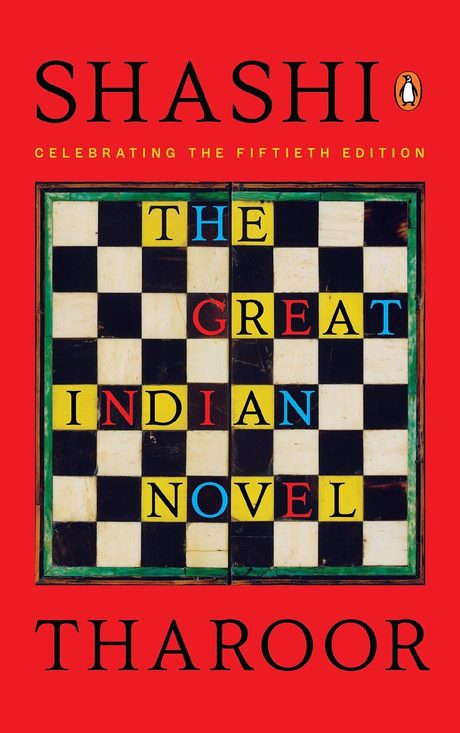
The Great Indian Novel
Shashi Tharoor1989about 866 pages
The Mahabharata retold as twentieth century Indian politics, with Gandhi as the vow bound patriarch and Indira as Priya Duryodhani.
Tharoor maps the Mahabharata onto the freedom movement and the decades after it, so the blind king, the celibate grandfather and the hundred brothers all find counterparts in the Congress, the Raj and the Emergency. It is a comic novel assembled from puns, parody and set pieces, narrated by an old man dictating his memoirs to a secretary who would rather be elsewhere. When it works it is very funny and genuinely sharp about how Indian power behaves. When it does not, the wordplay keeps going long after the joke has finished.
Why it is at 14
Fourteenth because satire teaches differently: you end up remembering the Emergency as a character rather than as a date. It does need prior knowledge of both the epic and the politics, so read it after Guha and not before. Whether Tharoor's vocabulary is a pleasure or a chore depends entirely on your mood that week.
Read it ifyou know the Mahabharata and want it turned into a weapon
Skip it ifyou want a straightforward novel with a plot to follow
clever, playful, showyBest for: readers who like literary jokesfictionsatiremahabharata
15
Door 9: Before all of it (non fiction)
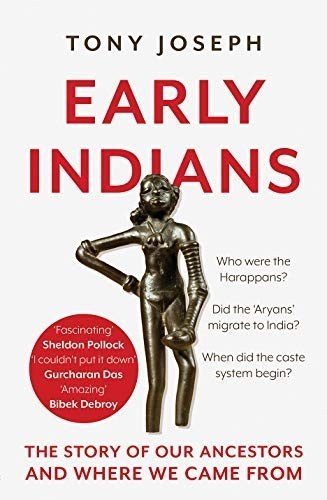
Early Indians
Tony Joseph2018about 262 pages
What ancient DNA says about who Indians are and where they came from, written for readers who are not geneticists.
Tony Joseph, a journalist rather than a scientist, reads a decade of ancient DNA research and turns it into a clear sequence of migrations: the first modern humans arriving out of Africa tens of thousands of years ago, farmers moving in from the Iranian region, the Harappan cities, and then herders from the Central Asian steppe arriving in the second millennium BCE. His real point is that every Indian alive today is a mixture of those streams. He shows his evidence, marks where researchers still disagree, and is honest that some of this is politically explosive here.
Why it is at 15
Fifteenth on the list and first in chronology, so read it early if the question you care about is who Indians are rather than what Indians did. It sits low only because it has the least to say about the present. Genetics moves quickly, so check whether a newer edition or a newer study has shifted the picture.
Read it ifyou want prehistory and genetics without the jargon
Skip it ifyou want written history rather than evidence from bones
clear, patient, carefulBest for: settling family WhatsApp argumentsprehistorygeneticsmigration
16
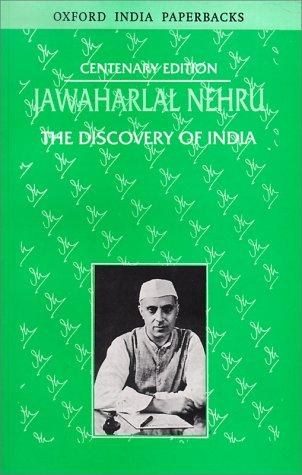
Door 10: The primary source (non fiction)
The Discovery of India
Jawaharlal Nehru1946about 642 pages
Nehru wrote it in a prison cell over three years, and it is less a history of India than a record of how he imagined it.
Written in Ahmednagar Fort between 1942 and 1946, while Nehru and most of the Congress leadership were locked up through the Quit India years. He sweeps from the Indus valley to the freedom movement, and the sweep is uneven: parts of the ancient history are romantic and long since overtaken, and he is always happier with an idea than with evidence. Read it as a document instead of a textbook. This is the mind that went on to design much of the country's first fifty years, thinking out loud with nothing else to do but write.
Why it is at 16
Sixteenth, and I want to be straight about why it is here at all. As history it has been overtaken by everything above it. As a primary source it has no rival, because you get to watch a future prime minister assemble the story he then governed by. Read after Khilnani and Guha it makes sense. Read first, it will bore you by page eighty.
Read it ifyou want the founder's own version of the country
Skip it ifyou want reliable ancient history
grand, dated, revealingBest for: reading after the modern historiesprimary sourcenehruhistory
Worth knowing
The reading path, if you want an order instead of a ranking
Start with Train to Pakistan for the feeling, because it takes one evening and it makes 1947 personal rather than historical. Then India After Gandhi for the shape of everything that followed. Then Annihilation of Caste, which is short and will quietly reorganise how you read the first two. After that, follow your own interest: Maximum City if you live in a city, Everybody Loves a Good Drought if you do not, The Billionaire Raj if you follow money and markets.
Save The Discovery of India for last. It only becomes interesting once you know enough to notice what Nehru is doing with the past, and it is a slog if you do not.
Worth knowing
A note on editions
Annihilation of Caste is out of copyright and floats around in cheap reprints with no notes at all, which is a waste of a text this dense. The annotated critical edition from Navayana is worth the extra few hundred rupees because it carries the Gandhi exchange and Arundhati Roy's long introduction, which set off its own public argument that is worth reading about afterwards. For India After Gandhi, buy the most recent revised edition, since the later ones extend the story by another decade.
People also ask
Questions, answered
Which single book should I read first to understand India?
India After Gandhi, if you can commit to nine hundred pages. It runs from 1947 to the recent past and gives you the frame every other book here fits into. If the length is a problem, read Train to Pakistan in one evening for what Partition felt like, then Sunil Khilnani's The Idea of India, which does the conceptual work in roughly two hundred pages. Between those two you get both the feeling and the frame for about a week of reading.
Are these books for Indians or for foreign readers?
Both, though they land differently. A foreign reader gets the whole thing fresh. An Indian reader gets the odd experience of learning the history of arguments they grew up inside, particularly on caste, language politics and the Emergency. Nothing here assumes a history degree. Two of them, Sen and Khilnani, do assume you enjoy essays, so begin somewhere else if that is not your thing.
Why is Freedom at Midnight not on this list?
Because it is a wonderful read and a shaky history. Collins and Lapierre wrote it as narrative drama and leaned heavily on Mountbatten's own account, and historians have been picking at its sourcing and its sympathies since the seventies. If you want 1947 quickly, read Train to Pakistan for the human experience and the relevant chapters of India After Gandhi for what happened. Then read Freedom at Midnight afterwards for pleasure, knowing what it is.
How long does it take to get through all sixteen?
About a year at one a month, which is a fair pace for books this dense, and you should not read them in one block. The three shortest, Train to Pakistan, Annihilation of Caste and The Idea of India, take maybe two weeks together and already give you a working picture of the country. India After Gandhi and The Anarchy are the two that need a proper run up and a free weekend.
Is there any fiction on this list?
Two novels: Train to Pakistan and The Great Indian Novel, both labelled as fiction in their entries. Everything else is reported non fiction, history, or one primary source from 1946. I kept the fiction count low because the title promises understanding rather than the best Indian novels, and the novels have their own lists on this site. Midnight's Children and Sacred Games are superb and would have produced a completely different list.
Do I need to know Indian history before starting?
No. Fifteen of the sixteen assume nothing beyond school level familiarity and explain their own background as they go. The exception is The Great Indian Novel, a parody that only works if you already know the Mahabharata and the outline of Congress politics, which is exactly why it sits at fourteen. If your school history stopped in 1947, the top of this list is built for that gap.
Before you go
What to read tonight
If you are still deciding, run the cheap experiment first. Buy Train to Pakistan tonight, read it over the weekend, and see which questions it leaves you holding. If they are about borders and power, go to Guha. If they are about who sits where and who eats with whom, go to Ambedkar and then Gidla. If they are about money, read Das and then Crabtree in that order, because the argument between those two books is the argument about modern India.
One more suggestion. Read at least one of these with somebody older in your family and ask them where they were. Most of the twentieth century on this list is still inside living memory in your own house, and no book beats a first hand account delivered over tea.
Keep going
Lists that pair with this one
Indian Fiction
14 Best Partition Novels and Books, Ranked by Where to Start
Fiction and first-hand testimony from both sides of the 1947 line, ordered so you begin with the one you can actually finish.
Indian Fiction
16 Best Novels Set in Mumbai, Mapped Neighbourhood by Neighbourhood
Sixteen Bombay novels ranked by how much of the city you carry out with you, from a Worli chawl to a tower in Vakola.
Indian Fiction
The 20 Best Indian Books in Translation, Ranked by Where to Start
Twenty books from ten Indian languages, ordered from the easiest way in to the one that will fight you, with the translator named every time.
Books Like
15 Books Like Sapiens: Big Arguments You Can Actually Finish
Every one is real, verified and ranked by how much of the Sapiens feeling comes back, including the book that argues Harari is wrong.
Indian Fiction
12 Best Novels Set in Delhi, Plus 3 That Are Not Fiction
Delhi is at least five cities stacked on one map, so I have ranked these by which one you actually take away.