A friend of mine bought War of Lanka because the cover looked good, got ninety pages in, and messaged me asking why Sita kept doing things he had already read about. He had walked into the fourth book of a series whose first three run alongside each other instead of one after another. Nobody makes that mistake with Harry Potter, and it is the single reason this page exists.
Amish has written three separate things. The Shiva Trilogy, which is finished. The Ram Chandra series, four books so far. The Indic Chronicles, which is historical fiction with no gods in it at all. Then there is a shelf of non-fiction, two of those books written with his sister. The series connect to each other, though not in the way most people assume, and the connection is a reward for reading in the right order rather than a requirement.
So here is the whole catalogue, twelve books, in the order I would hand them to you. Publication order and in-world story order both appear further down the page, because they are not the same thing and one of them will actively spoil the other. If you have never read him, begin at number one and do not skip ahead to Ram, however good that cover looks in the shop.
How I picked these
- The order on this page is a reading order, not a ranking and not a publication list. The two agree for the first three books and then split, and I say why at each point where they part company.
- Every title verified through Google Books and Open Library with a real cover, and the year on each entry is first publication rather than the reprint date on the edition you will buy today.
- Fiction first, all nine books of it, then the three non-fiction titles. Nobody arrives at Amish through his essays, so putting them up top would be dishonest about how people actually read him.
- The two books co-written with his sister Bhavna Roy are marked as such, because half the internet lists them under his name alone.
- No ranking, no demotions. Where a book is weaker than its neighbours I say so inside the entry and leave it in sequence, since a route only works if you follow it.
The whole list at a glance
All 12 books, in order
| # | Book | Author | Year | Vibe | Best for |
|---|
| 1 | The Immortals of Meluha | Amish Tripathi | 2010 | fast, inventive, loud | your first Indian mythology novel |
| 2 | The Secret of the Nagas | Amish Tripathi | 2011 | questy, revealing | reading straight after book one |
| 3 | The Oath of the Vayuputras | Amish Tripathi | 2013 | big, talky, final | finishing what you started |
| 4 | Ram: Scion of Ikshvaku | Amish Tripathi | 2015 | controlled, political | readers who found Meluha too loose |
| 5 | Sita: Warrior of Mithila | Amish Tripathi | 2017 | brisk, capable, warm | reading right after book one |
| 6 | Raavan: Enemy of Aryavarta | Amish Tripathi | 2019 | dark, sympathetic, slow | character readers |
| 7 | War of Lanka | Amish Tripathi | 2022 | big, converging, satisfying | series finishers |
| 8 | Legend of Suheldev: The King Who Saved India | Amish Tripathi | 2020 | lean, martial, patriotic | history readers |
| 9 | The Chola Tigers: Avengers of Somnath | Amish | 2025 | martial, vengeful, brisk | readers who liked Suheldev |
| 10 | Immortal India: Young Country, Timeless Civilization | Amish Tripathi | 2017 | argumentative, repetitive | understanding his politics |
| 11 | Dharma: Decoding the Epics for a Meaningful Life | Amish Tripathi | 2020 | conversational, gentle | a single evening |
| 12 | Idols | Amish Tripathi | 2023 | narrow, patient | one specific question |
The list
The books, ranked
1

Shiva Trilogy, book 1
The Immortals of Meluha
Amish Tripathi2010about 362 pages
A Tibetan tribal chief migrates to a kingdom that runs like a spreadsheet, drinks something he should not, and wakes up as a prophecy.
Shiva leads the Guna tribe near Mansarovar and takes an offer to move his people down to Meluha, a kingdom so organised it feels administered rather than lived in. He drinks the Somras, his throat turns blue, and a country that has spent generations waiting for a blue-throated saviour decides he is the one. The idea underneath is the good one: what if the gods in our stories were people whose deeds got upgraded into legend over centuries. Shiva is written as a soldier who swears, jokes, smokes and dislikes ceremony, and that voice is what got half of India reading a mythology novel.
Why it is at 1
First because it is the front door and because it is still the best thing he has written. The prose is functional at best and the dialogue frequently sounds like a strategy meeting, and none of that matters at the speed this book moves. Every novel after it is better built and less exciting. Start here even when somebody tells you to start with Ram.
Read it ifyou want a fast reinvention of Shiva with modern dialogue
Skip it ifclunky sentences pull you straight out of a story
fast, inventive, loudBest for: your first Indian mythology novelshiva trilogymythologyadventure
2

Shiva Trilogy, book 2
The Secret of the Nagas
Amish Tripathi2011about 309 pages
Shiva hunts the hooded Naga who killed a friend, and every answer he finds makes the map larger.
The chase from the end of book one becomes the engine of this one. Shiva travels east, through Branga and towards the forbidden land of the Nagas, the deformed people every Meluhan child is raised to fear. It is mostly journey and reveal, and the reveals are the good kind, the sort that send you back to a scene from the first book to read it again with new information. This is also where the trilogy's real argument surfaces: that evil is a by-product rather than a people or a person, and that the thing you love most is usually the thing producing it.
Why it is at 2
Second in sequence and second in quality. The plotting is the best of the three and it ends on the strongest cliffhanger in his catalogue, which is precisely why nobody stops here. The middle drags through geography, and the philosophical speeches start to lengthen, a habit that eventually swallows book three whole.
Read it ifyou finished Meluha and want the questions answered
Skip it ifyou refuse to tolerate a cliffhanger ending
questy, revealingBest for: reading straight after book oneshiva trilogymythologyquest
3

Shiva Trilogy, book 3
The Oath of the Vayuputras
Amish Tripathi2013about 400 pages
Shiva learns what evil actually is in this world, and then has to decide what to do about an entire country.
The last of the trilogy answers everything: the identity of evil, the Vayuputras who are the tribe left behind by the previous Mahadev, and the war that Shiva's decision starts. When it moves, it moves well, and the final act carries real weight, including a loss readers still argue about a decade later. The problem is the long middle, where characters stop the story to deliver lectures on ethics, addiction and the price of progress. There is a genuinely interesting argument buried in there about a substance a whole society refuses to give up, and it arrives as a seminar instead of a scene.
Why it is at 3
Third because it has to be read third, not because it earns the spot. This is the weakest book of the trilogy by some distance, and the one that lost him a chunk of his early readers. Read it anyway. Leaving the Shiva Trilogy unfinished after that cliffhanger is a worse fate than sitting through the speeches.
Read it ifyou need the trilogy closed and can skim a lecture
Skip it iflong philosophical detours make you abandon books
big, talky, finalBest for: finishing what you startedshiva trilogymythologywar
Heads up: a major character death
4
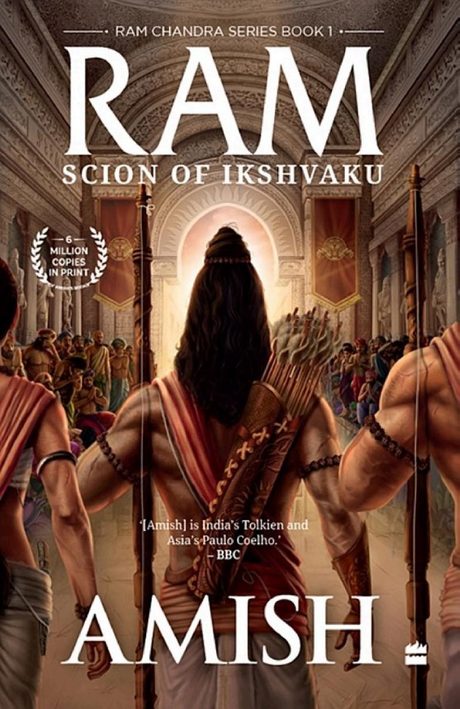
Ram Chandra series, book 1
Ram: Scion of Ikshvaku
Amish Tripathi2015about 333 pages
Ayodhya has lost a war, and its prince is blamed for the defeat before he can walk.
The Ram Chandra series restarts the whole project in a much earlier era, and this is the first of four. Ayodhya is broken after a defeat by the trader king Raavan, the kingdom is deep in debt, and Ram is born on the day of that loss, so a superstitious court decides the baby is the cause. What Amish does with him is make him rigid on purpose: a man who follows the law to the letter because the country around him has stopped following anything at all. Sita arrives late in this book, and the famous events land in the final third.
Why it is at 4
Fourth, and the best constructed novel of the twelve. The Ayodhya politics are sharp, the argument between law and mercy runs through the plot rather than sitting in speeches, and the pacing is the most controlled he has managed. It is not the most fun, which is why Meluha keeps the top of the reading order. Do not begin the series here just because it is a first book.
Read it ifyou want the tightest, most disciplined book he has written
Skip it ifa hero who follows rules to the letter bores you
controlled, politicalBest for: readers who found Meluha too looseram chandraayodhyamythology
5
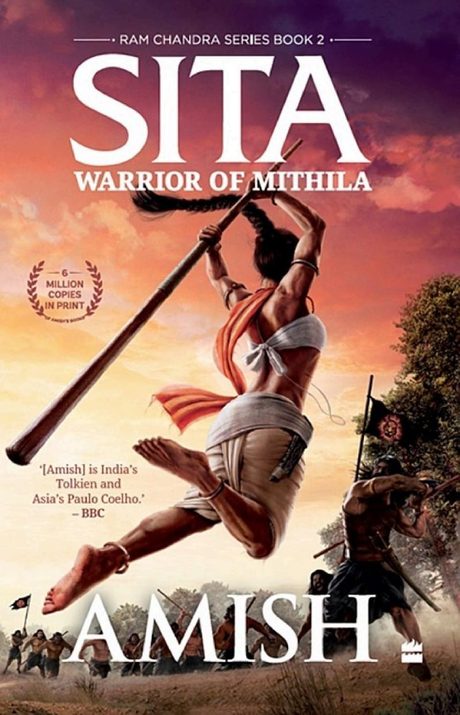
Ram Chandra series, book 2
Sita: Warrior of Mithila
Amish Tripathi2017about 331 pages
The same years you just read, told by the woman who was running a kingdom long before she met a prince.
This is where the series brings its trick into the open. Sita covers roughly the same span of years as Scion of Ikshvaku, told from her side, so you watch scenes you already know from a different chair and get whole chapters you did not have before. She is an adopted child in Mithila, trained by a guru, effectively running the administration of a small, poor kingdom while her father reads philosophy and stays out of it. She is the most convincing lead he has written, and the book moves faster than the one before it.
Why it is at 5
Fifth, and immediately after Ram, because the overlap only works if the two books sit close together. Leave a year between them and the repeated scenes feel like a repeat instead of a second angle. This is where the multilinear idea pays for itself, and it is the most enjoyable of the four, because Sita gets to be competent in ways Ram is never allowed to be.
Read it ifyou want a heroine with a job, a spine and a kingdom to run
Skip it ifrevisiting the same events from another view annoys you
brisk, capable, warmBest for: reading right after book oneram chandrasitamythology
6
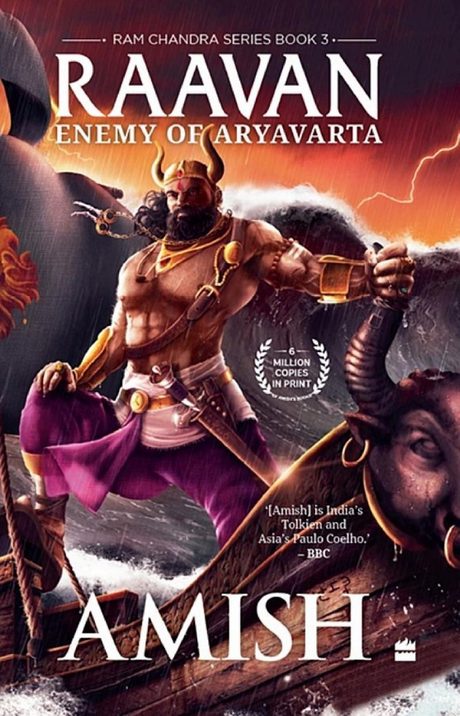
Ram Chandra series, book 3
Raavan: Enemy of Aryavarta
Amish Tripathi2019about 332 pages
A third pass over the same years, this time from the man everybody in the first two books is afraid of.
Raavan grows up an outcast, becomes a trader, then a warlord, and builds Lanka into the wealthiest place in the world while carrying a private grief that explains most of what he later does. It is a rise-and-rot story with a properly complicated man at its centre, and Raavan is the most interesting character Amish has created, precisely because he turns monstrous in steps the reader can follow one at a time. It is also the third book covering the same stretch of years, and by now you know exactly where it has to end up.
Why it is at 6
Sixth, and the one place I would let a reader bend the order. It has the best character work in the series and the least forward motion, since the events are already fixed by two books you have read. If your patience is going, read the first half and move to War of Lanka. Coming back to finish it later costs you nothing at all.
Read it ifyou want a villain written with genuine sympathy
Skip it ifyou have had enough of this same timeline
dark, sympathetic, slowBest for: character readersram chandraraavanmythology
Heads up: violence, and cruelty the book chooses to dwell on
7
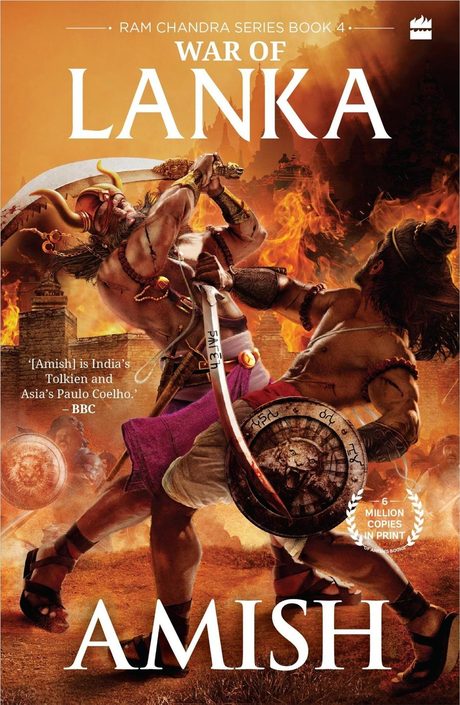
Ram Chandra series, book 4
War of Lanka
Amish Tripathi2022about 431 pages
Three timelines finally converge and the war you have waited three books for actually begins.
This is the payoff book. The strands from Ram, Sita and Raavan meet at last, Sita is taken, and the rest is the campaign to bring her back, which means alliances, a crossing and a siege. It is the longest book in the series and the most conventional, because a war novel has to be. The pleasure here is structural rather than surprising: you have watched three people become who they are, and now you watch them collide. The small scenes between allies land better than most of the battle writing does.
Why it is at 7
Seventh, and the end of the fiction sequence for this series so far. It is not the best of the four, but it is the book that justifies the strange structure of the other three, which is a real achievement. If you skip ahead to it, you will follow the plot perfectly and feel nothing, and that is the entire argument for reading these in order.
Read it ifyou have read all three and want the collision
Skip it iflong battle sequences lose you halfway
big, converging, satisfyingBest for: series finishersram chandrawarmythology
8
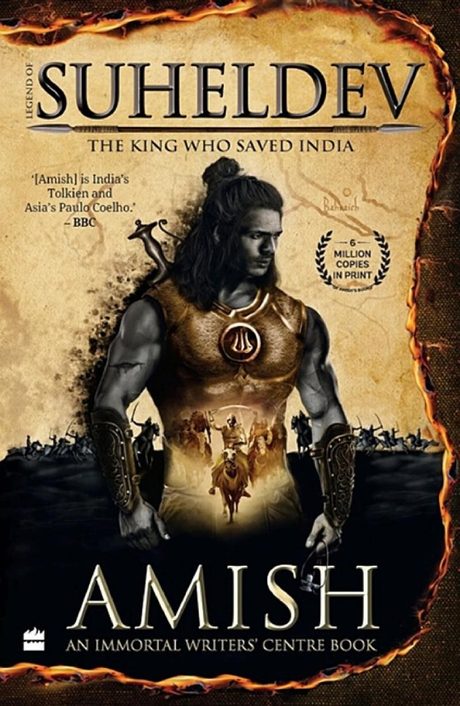
Indic Chronicles, book 1
Legend of Suheldev: The King Who Saved India
Amish Tripathi2020about 306 pages
No gods, no prophecy: an eleventh-century prince builds a coalition to stop an invading army at Bahraich.
His first book outside mythology, and it reads differently from the opening page. Suheldev is a prince of Shravasti in the eleventh century, and the story is built around the raids of Mahmud of Ghazni and the resistance that came after, ending at a battle near Bahraich. Amish describes this as fiction drawn from legend rather than documented history, and that framing is the honest one, because the record on Suheldev himself is thin and mostly written down centuries later. What you get is a lean war novel with a coalition-building plot, a shape Indian commercial fiction almost never attempts.
Why it is at 8
Eighth because the Indic Chronicles stand completely apart and can be read at any point, and this is where I would slot them: after the mythology, when you want to see what he does with no god in the room. It is the most accessible book on this page and the shortest route into his writing for anyone who wants no reincarnation and no prophecy. Both Indic Chronicles are marked An Immortal Writers Centre Book on the cover, which is his own studio.
Read it ifyou like historical war fiction and not mythology
Skip it ifyou want the philosophical layer his other books carry
lean, martial, patrioticBest for: history readersindic chronicleshistoricalwar
Heads up: battlefield violence, and a nationalist framing worth reading with your eyes open
9
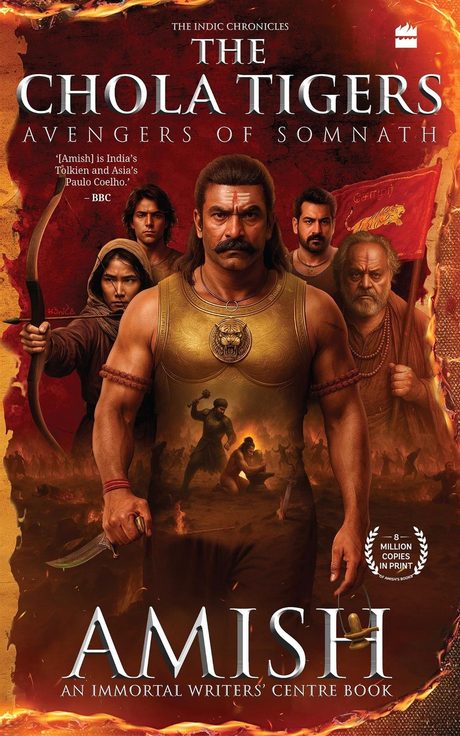
Indic Chronicles, book 2
The Chola Tigers: Avengers of Somnath
Amish2025about 480 pages
After Somnath is sacked in 1025, a band of fighters sets out to answer it, and the Cholas are the muscle.
The second Indic Chronicle opens at the raid on the Somnath temple and follows the retaliation, with the Chola empire in the frame. It is the newest book on this page, published in 2025 and credited simply to Amish on the cover, beside a line marking it an Immortal Writers Centre book. It is built the same way as Suheldev: a real historical trigger, an assembled band, a long march towards a confrontation. The Chola material is the fresher half, since south Indian history almost never gets this treatment in popular English fiction. As with the first one, treat the history as a starting point and not a source.
Why it is at 9
Ninth, and last of the fiction, purely because it is the newest. It needs nothing else read first, so if the eleventh century interests you more than Shiva does, this is a perfectly legitimate place to start reading him. It is a series book rather than a leap into new territory, so the pleasures on offer are familiar ones if Suheldev worked for you.
Read it ifyou want south Indian history inside a popular novel
Skip it ifrevenge plots aimed at a foreign invader are not your thing
martial, vengeful, briskBest for: readers who liked Suheldevindic chronicleshistoricalchola
Heads up: temple desecration and battlefield violence
10
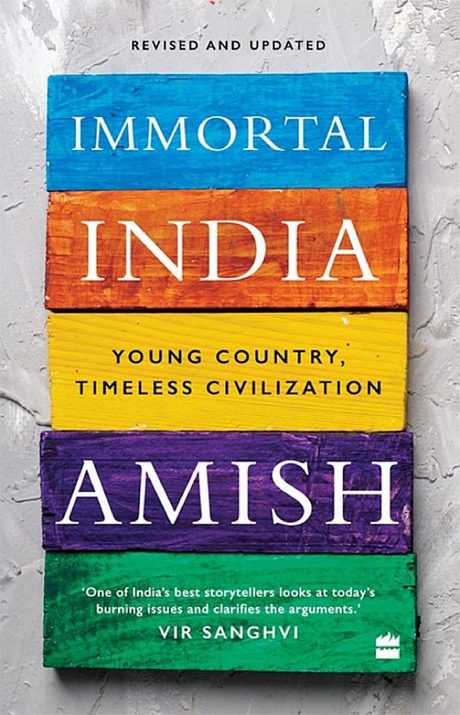
Non-fiction
Immortal India: Young Country, Timeless Civilization
Amish Tripathi2017about 235 pages
The first non-fiction collection: essays and talks on India, tradition, and why he thinks the two are not opposites.
This gathers his columns and speeches into short pieces on Indian history, religion, gender, tolerance, and the way modern India keeps arguing with its own past. It is the book where his positions get stated directly instead of through a character, which helps if you have been trying to work out what he actually believes from the novels alone. The essays are short and repetitive across the collection, since they were written separately for different audiences, so you will meet the same three or four arguments more than once before the end.
Why it is at 10
Tenth, first of the non-fiction, and the one to take if you read only one of the three. It is the clearest statement of the ideas driving the fiction, especially his claim that Indian tradition is more liberal than either its defenders or its critics usually allow. Agree with him or not, it reads better than the speeches inside the novels, because here he is not pretending a character said it.
Read it ifyou want the ideas behind the novels stated plainly
Skip it ifyou read him for story and nothing else
argumentative, repetitiveBest for: understanding his politicsnon-fictionessaysindia
11
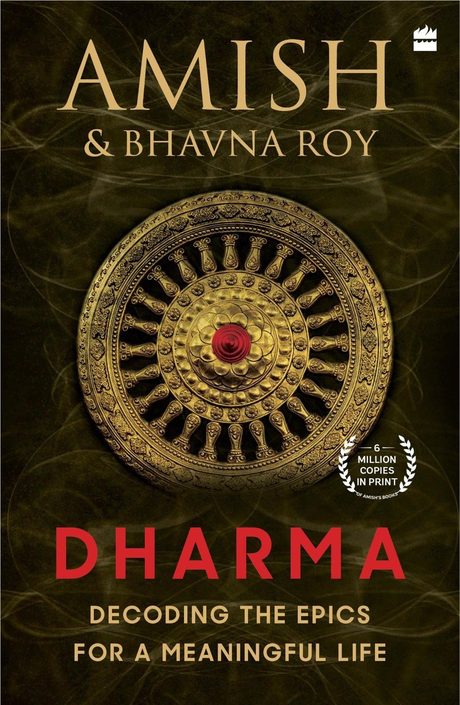
Non-fiction, with Bhavna Roy
Dharma: Decoding the Epics for a Meaningful Life
Amish Tripathi2020about 143 pages
A brother and sister talk through what the epics are actually asking you to do.
Written with his sister Bhavna Roy, this takes situations from the Ramayana, the Mahabharata and older texts and asks what a person is supposed to take from them today. The format sits closer to a dialogue than an essay, which suits the material: two people disagreeing gently about whether a character was right, then landing somewhere useful. It is short, it assumes no scholarship on your part, and it is the only book of his I would hand to somebody with no interest whatsoever in his novels.
Why it is at 11
Eleventh in sequence and the pleasant surprise of the non-fiction. It is warmer and far less certain than Immortal India, and the uncertainty is what makes it work, because the epics get treated here as arguments rather than instructions. Read it in an evening. It needs nothing else on this list read first, so it also works as a way to test whether you like his thinking before committing to a trilogy.
Read it ifyou want the epics discussed rather than retold
Skip it ifyou want scholarship with footnotes and citations
conversational, gentleBest for: a single eveningnon-fictionepicsphilosophy
12
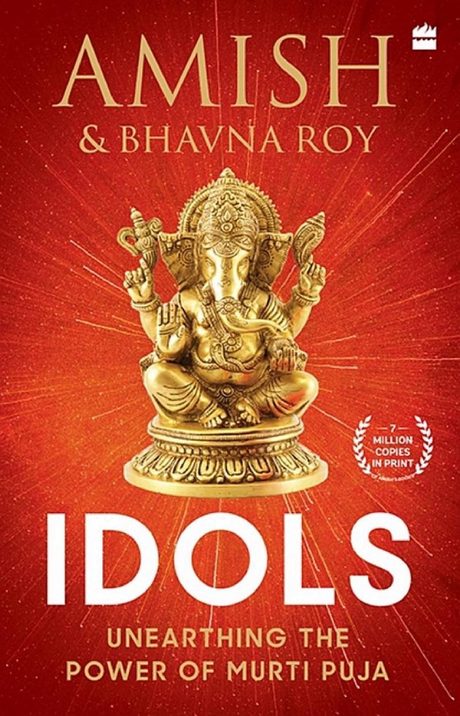
Non-fiction, with Bhavna Roy
Idols
Amish Tripathi2023about 218 pages
Why Hindus worship murtis, argued properly rather than assumed, by the same brother and sister pair.
The second book with Bhavna Roy takes a question outsiders ask constantly and insiders rarely have to answer out loud: what is actually going on when somebody worships a murti. It works through the symbolism, the history and the philosophical defence of the practice, and it is the most specialised thing on this page by a distance. If the subject holds no interest for you, nothing in here will change that. If you have ever been asked the question across a dinner table and fumbled the answer, this is a short book that hands you one.
Why it is at 12
Twelfth and last because it is the narrowest book of the twelve, which is not the same as the worst. It does one job carefully, and that is more than several of the novels can claim. Come to it only after Dharma, since the two share a voice and this one quietly assumes you are already interested in the questions the earlier book opened up.
Read it ifyou want a defence of murti worship you can actually repeat
Skip it ifreligious practice is not a subject you want a whole book about
narrow, patientBest for: one specific questionnon-fictionhinduismphilosophy
Worth knowing
The three orders, and which one to use
Publication order runs: Meluha 2010, Nagas 2011, Vayuputras 2013, Scion of Ikshvaku 2015, Sita 2017, Raavan 2019, Legend of Suheldev 2020, War of Lanka 2022, The Chola Tigers 2025. Notice that Suheldev landed in the middle of the Ram Chandra series, which is why so many online lists get tangled at that point.
Story order, if you insist on chronology: the Ram Chandra series is set around 3400 BCE, the Shiva Trilogy roughly fifteen hundred years after that, and the Indic Chronicles in the eleventh century CE, which is actual recorded history. So the in-world timeline runs Ram, then Shiva, then Suheldev and the Cholas. Reading in that order is a mistake. The Shiva Trilogy is the easier way in, and several things in the Ram books are written to be recognised by somebody who has already read it.
Reading order, which is what this page uses: Shiva Trilogy in sequence, Ram Chandra in sequence, then the Indic Chronicles, then the non-fiction whenever you feel like it. The only genuinely flexible piece is Suheldev, which needs nothing before it and works as a standalone for a reader who wants no mythology at all.
Worth knowing
What the multilinear structure actually means
Amish calls the Ram Chandra structure multilinear, and here is what that means when you are holding the books. Books one, two and three cover the same stretch of years from three different people: Ram, then Sita, then Raavan. They are not sequels to one another. Each starts near the beginning and runs to the same moment, when Sita is taken, and then book four picks up all three strands and carries them forward together.
This is why reading them out of order, or with long gaps in between, kills the effect. The whole pleasure is recognition: a scene you watched from outside in book one becomes something else entirely once you are inside the head of the person it happened to. Read them close together, ideally inside a couple of months, and the structure does what it was built to do. Leave a year between each and you will feel you are being told the same story three times, which is exactly what my friend with War of Lanka assumed was happening.
People also ask
Questions, answered
What is the correct order to read Amish Tripathi's books?
Start with the Shiva Trilogy in publication order: The Immortals of Meluha, The Secret of the Nagas, The Oath of the Vayuputras. Then the Ram Chandra series in publication order: Scion of Ikshvaku, Sita, Raavan, War of Lanka. Then the Indic Chronicles, meaning Legend of Suheldev and The Chola Tigers, both of which stand alone. The non-fiction can be picked up at any point. Ignore in-world chronology, which would have you begin with Ram and would cost you most of the effect.
Should I read the Ram Chandra series in chronological order?
There is no chronological order available, and that is deliberate. The first three books cover the same years from three different characters and all finish at roughly the same moment, so publication order is the only order that works. Read Ram, then Sita, then Raavan, then War of Lanka, and keep them close together. Space them a year apart and the overlapping scenes start feeling repetitive instead of revealing, which is the most common complaint about this series.
Is the Shiva Trilogy connected to the Ram Chandra series?
Yes, same world, roughly fifteen hundred years apart, with the Ram Chandra series set earlier. The links are references rather than plot: institutions and tribes that appear as ancient background in the Shiva books are being founded during the Ram books. You do not need either one to follow the other, but reading Shiva first makes the Ram books richer, which is the opposite of what a chronological reader would guess.
Which Amish Tripathi book should I read first?
The Immortals of Meluha, for almost everybody. It is the fastest, the freshest, and it asks the least of you as a reader. If mythology genuinely puts you off, start with Legend of Suheldev instead, which is straight historical war fiction with no gods and no prophecy anywhere in it. Do not start with War of Lanka or Sita however good those covers look, because both depend on books you have not read yet.
How many books has Amish Tripathi written?
Twelve are listed on this page as of 2026: nine novels across three series, plus three non-fiction books, two of them written with his sister Bhavna Roy. The Indic Chronicles are ongoing, so the count will keep moving. If you see a much larger number quoted somewhere, it is usually counting translations into Indian languages, which are the same books in different scripts, or counting boxed sets as separate items.
Is Amish Tripathi worth reading?
If you want ideas and pace, yes. If you want sentences, no. The prose is plain and the dialogue often sounds like a corporate strategy meeting, and the compensation is that very few writers in Indian fiction have better premises. Read the first sixty pages of Meluha and you will know your answer. People who bounce off him almost always bounce off the writing rather than the story, and that is a perfectly fair reason to stop.
Before you go
What to read tonight
If you are starting tonight, open The Immortals of Meluha and give it sixty pages. That is enough to know whether the plain prose is going to bother you, and if it does not, you have nine more books ahead and a clear route through all of them.
If you have already finished the Shiva Trilogy and stalled somewhere in the Ram Chandra books, the fix is usually spacing rather than quality. Put Ram, Sita and Raavan inside the same month and the structure starts doing its job again. And if mythology has simply stopped working for you, jump straight to Legend of Suheldev, which is the same writer with none of the gods, and find out whether it was the genre you were tired of rather than the man.
Keep going
Lists that pair with this one
Indian Fiction
18 Best Indian Mythology Fiction Books, Faithful to Wild
Ranked on one dial: how far each book strays from the epic it is built on, with an honest note on which are page-turners and which are literature.
Authors
The 14 Best Devdutt Pattanaik Books, in the Right Reading Order
Ranked as a sequence rather than a leaderboard, with the exact point where his books start repeating themselves.
Mood & Life
18 Books for People Who Don't Like Reading (Short and Fast)
Sorted by how much of your evening they ask for, starting with books you can finish tonight.
Indian Fiction
16 Best Books to Understand India, Ranked by What They Explain
Sixteen books, ten doors into the same country: history, caste, the mega city, the village, money, and where to start tonight.
Mood & Life
20 Unputdownable Books, Ranked by the Engine That Hooks You
I ranked these on one thing: how hard each book made it to stop reading, and which mechanic does the pulling.