12 Best Books on Comedy Writing, Ranked by What You Can Use
Ranked by how much usable technique survives the read, with a start here pick for jokes, sketch, sitcom and funny prose.
By Bhavik SarkhediUpdated August 2026Covers and data: Google Books, Open Library
I wrote a novel whose lead is a stand-up comedian, which meant I had to work out how a joke is built and not merely whether it landed. I had assumed funny was a personality. Two of the books below took that idea apart inside a chapter each. A joke has parts, the parts have names, and once you can see the machinery you cannot stop seeing it, which is the entry fee and worth paying.
The trouble with most lists on this subject is that they rank the same twelve titles by reputation and then quietly assume you want to do stand-up. Those are different jobs. Writing a monologue joke for tomorrow morning, holding a scene with three other improvisers, breaking a twenty two minute episode, and being funny in prose that nobody will ever perform are four separate skills with four separate toolkits.
So this list is ranked by technique per page: how much of the book is a method you can apply on Monday, and how much is company and morale. One to nine are craft books. Ten to twelve are conversations with people who do this for rent money, and they are here because morale matters too, only later than beginners think.
Below the list there is a short map telling you which single book to start with for each of the four goals. Every entry also has a skip line, because a manual that is wrong for your goal will waste more of your time than a bad novel ever could.
Ranked by technique per page: how much of the book is a method you can use versus a story about somebody who once used one.
All four jobs are covered on purpose, meaning jokes, improv and sketch, sitcom and screen, and funny prose, because most comedy writing lists silently assume stand-up.
Interview books were capped at three, since it is very easy to pad a list like this with anthologies of famous people being charming at each other.
Every book was checked through Google Books and Open Library with a real cover, and one respected title, Steve Kaplan's The Hidden Tools of Comedy, is missing only because no verified cover image existed for any edition I could reach.
Nothing here made the list for being funny in itself. Several of these books are quite dry, which is allowed, because a manual has a different job than a comic novel.
The Comic Toolbox: How to Be Funny Even If You're Not
John Vorhaus1994
Comedy treated as a problem to be solved, with exercises, by a screenwriter who got tired of people calling it a gift.
Vorhaus opens from a position that irritates people and then proves it: comedy is a set of solvable problems rather than a personality you either have or do not. He works through the comic premise, the clash between a character and the world they are stuck in, the notion that comedy grows out of truth plus pain, and the habit of making bold choices early instead of safe ones. Every section closes with exercises he genuinely expects you to do. The tone is dry and mildly impatient, like a teacher who has heard your excuse before. It is short and there is almost no padding.
Why it is at 1
First because it rearranges how you read comedy permanently, and it manages that in the opening fifty pages. Toplyn below hands you more formulas and Dean gives a cleaner mechanism for the single joke, but Vorhaus is the only one here who fixes your posture towards the whole activity. Do the exercises, because reading this passively wastes most of it.
Read it ifyou want your assumptions about funny taken apart with tools
Skip it ifyou will not do written exercises, since half the value lives there
dry, practical, bracingBest for: anyone starting from zerocraftexercisesscreenwriting
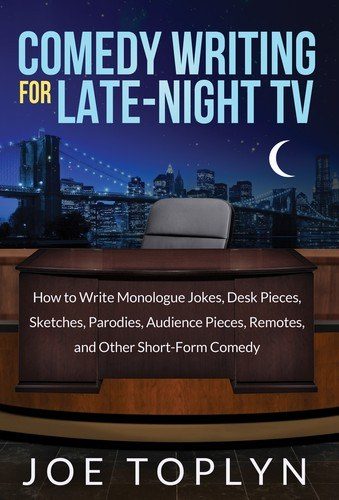
The most literal instruction manual on this list, from a writer who supplied monologue jokes to Letterman and Leno.
Toplyn wrote for David Letterman and Jay Leno, and this reads like the internal training document a head writer hands a nervous new hire. It breaks short form comedy into named parts: how to choose a monologue topic, several specific procedures for generating punchlines out of that topic, then desk pieces, sketches, parodies, audience bits and remote segments, each with its own method. Worked examples run throughout, showing the ugly middle stage of a joke before it is any good. Nothing in it is inspirational and that is exactly the point of it.
Why it is at 2
Second because no other book here will produce more finished jokes per hour of reading. It misses the top spot only for being narrow: everything is engineered for topical short form, so for a novel or a film this is the wrong instrument entirely. If you write a topical newsletter, a feed, or monologues for a corporate host, this is the best money on the page.
Read it ifyou need to produce topical jokes against a deadline
Skip it ifyou want theory or encouragement rather than procedures
systematic, unsentimental, thoroughBest for: topical and short form writersjokestelevisionsystem
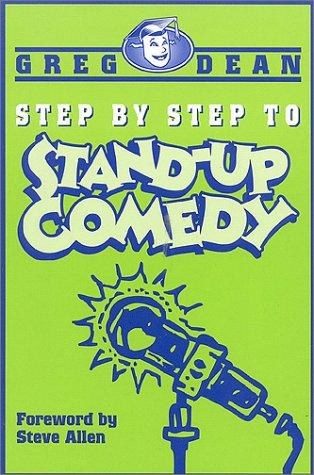
The book that shows what is actually happening inside a joke, using setups, punches, and an assumption you did not notice making.
Dean teaches the joke as a mechanism rather than a mood. The setup makes you assume one story, the punch reveals a second story that was sitting there the whole time, and the switch between the two is where the laugh comes from. He names the moving parts, including the target assumption and the reinterpretation, then makes you build jokes out of those parts on paper. The second half turns to performance: working a room, surviving a bad night, assembling a set from material you have tested. The prose is plain and occasionally clunky, and the model underneath is very hard to argue with.
Why it is at 3
Third, and the one to read first if stand-up is specifically what you want. Dean's two story model of a joke is the single most useful idea on this list and he explains it more cleanly than anybody else here. It ranks under Toplyn only because Toplyn hands you more different tools. If you can afford two books, buy these two.
Read it ifyou want to see the gears inside a joke and then build one
Skip it ifyou are writing prose or scripts rather than performing anything
clear, mechanical, patientBest for: first time stand-upsstand-upjoke structureperformance
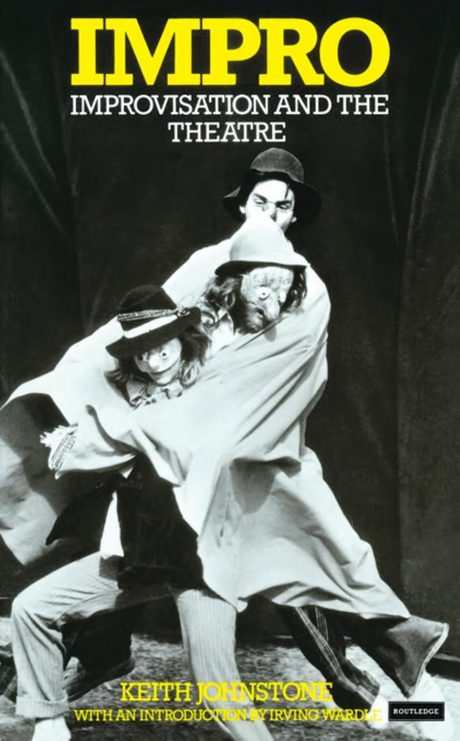
A theatre teacher's notes on status, spontaneity, and why adults play worse than children, and it quietly explains half of all comedy.
Johnstone taught at the Royal Court in London and wrote this out of what he kept finding in the rehearsal room. The famous part is status: every exchange between two people has one of them going up and the other going down, and once you can see that, you can see why some scenes are funny and others simply sit there. There are also chapters on spontaneity, on the way schooling kills invention, on narrative skill, and on masks and trance, where it gets genuinely strange. This is not a comedy manual. It is a book about being alive on stage that comedy writers keep robbing.
Why it is at 4
Fourth because status is the deepest single idea in this entire list and Johnstone is the one who found it. Almost every sitcom scene that works is a status transaction, whether the writer knows the term or not. It ranks below the three above because you have to do the translation yourself: nothing here is filed under comedy technique, and the last third wanders into mask work.
Read it ifyou want the theory sitting underneath why scenes are funny
Skip it ifyou want joke formulas rather than a new way of seeing
strange, original, foundationalBest for: sketch, improv and scene writersimprovstatustheatre
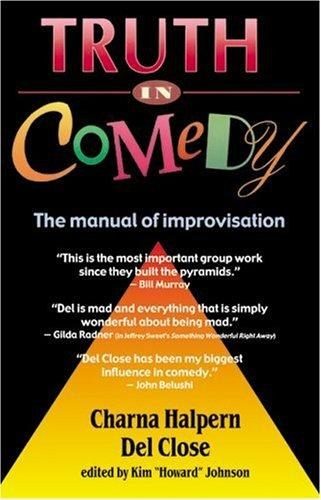
The short manual behind long form improv, written with Del Close, and the source of most of what modern sketch does.
Halpern wrote this with Del Close and Kim Johnson, and it sets out the long form school that ran through Chicago and then through most of American comedy. The instruction is easy to say and hard to do: agree with your partner, add to whatever they gave you, look for the honest thing rather than the joke, and trust that funny turns up when nobody is chasing it. It also explains the Harold, the structure where scenes and themes recur and connect across a set. It is a slim book with a great deal inside, and it is almost entirely about listening rather than being clever.
Why it is at 5
Fifth, and the fastest route into how sketch and improv actually operate. It sits just below Impro because Johnstone goes further down, but this one is more usable at a Tuesday evening workshop. Its weakness is proportion: it states the central idea early and then repeats it with more examples. For a book this short, that is still a fair trade.
Read it ifyou are doing improv or writing sketch with other people
Skip it ifyou work alone and never intend to stand in a room with performers
generous, direct, communalBest for: improv and sketch groupsimprovsketchchicago
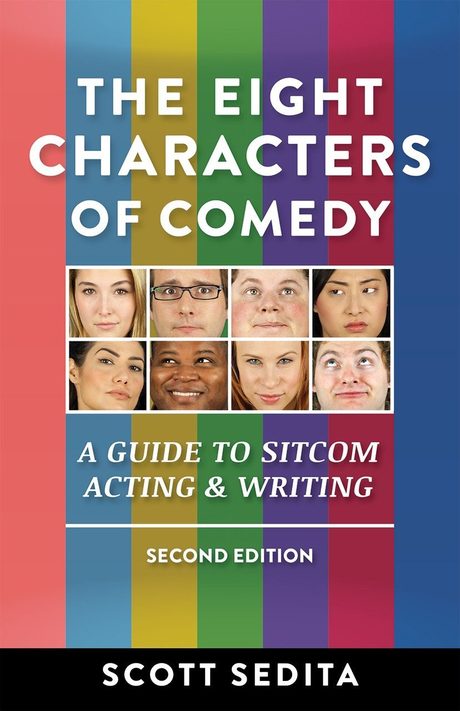
Eight character types that keep reappearing in sitcoms, with why each one is funny and how to write lines for them.
Sedita is an acting coach in Los Angeles and he built this around a claim that most successful sitcom casts are assembled from the same eight roles, among them the logical smart one, the lovable loser and the dumb one. He shows how each type generates comedy through what it wants and what it cannot see about itself, then runs examples from well known shows so you can test the framework against something you have already watched. A good deal of the book covers auditioning and playing comedy, since it was written for actors first. Writers get the more useful half.
Why it is at 6
Sixth, and the pick if your goal is a sitcom or a comedy screenplay. Nothing else here is as directly about ensemble construction, which is the thing new sitcom writers get wrong first and hardest. It sits here rather than higher because a large slice of the book is aimed at actors, and because any typology becomes a crutch if you stop questioning it.
Read it ifyou are building a comedy ensemble or a sitcom pilot
Skip it ifyou write alone or you distrust character archetypes on principle
practical, television, bluntBest for: sitcom and screen writerssitcomcharacterscreenwriting
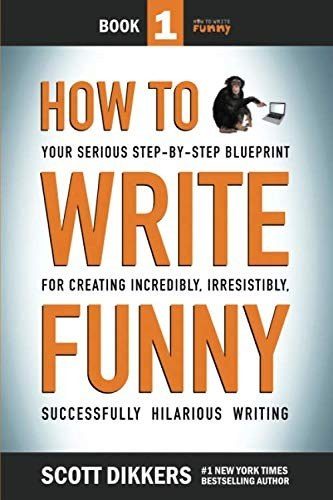
The founding editor of The Onion breaks humour into filters you can run any plain, boring sentence through.
Dikkers edited The Onion for years and this is his attempt to write down what that room was doing without ever saying it aloud. His main tool is a set of funny filters, each one a distinct way of bending a plain statement, including irony, hyperbole, wordplay, parody, shock and misplaced focus. You take something true and dull, push it through one filter, and look at what comes out the other side. He is also honest about how much rewriting one funny sentence takes. The book design is amateurish and the self published feel puts some readers off, so ignore the cover.
Why it is at 7
Seventh, and the one to start with if you write prose, captions, newsletters or advertising rather than performing anything. The filters are the most portable idea on this list, useful anywhere a sentence needs to be funnier than it currently is. It sits here because of repetition, and because the book keeps steering you towards the author's other books and courses.
Read it ifyou write funny words that nobody will ever perform
Skip it ifamateur book design and repeated self promotion will annoy you
clever, repetitive, portableBest for: prose, captions and copyprosesatirethe onion
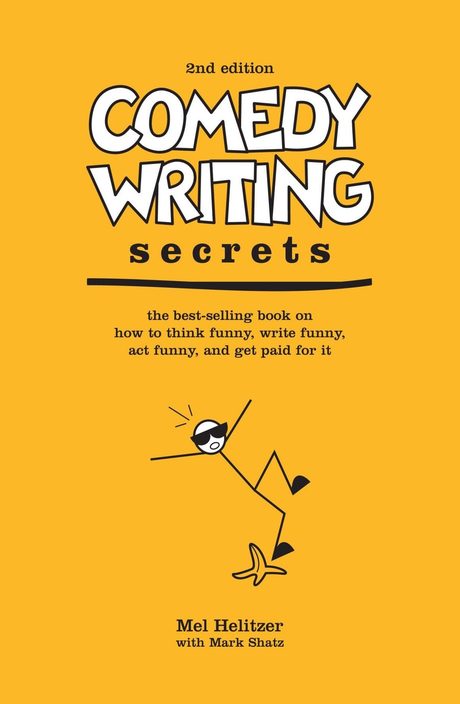
The old university textbook of humour writing, still the widest single volume here, with examples that have aged like milk.
Helitzer taught humour writing at a university and this grew directly out of that course, which is exactly how it reads: chapters, definitions, drills, and hundreds of examples. He offers a formula for what makes humour work, built around target, hostility, realism, exaggeration, emotion and surprise, then applies it across stand-up, speeches, sketches, greeting cards, advertising and journalism. The range is the selling point, because no other book here covers a wedding speech and a sitcom between the same two covers. The problem is the examples: many are decades old and a fair number would not be printed today.
Why it is at 8
Eighth because it casts the widest net on this list and is the least pleasant to actually sit and read. If you want one reference volume that touches every kind of humour writing there is, this is that volume, and the formula inside it does work. The dated examples make it slow going, and later editions with a co-author have cleaned up some of that but not all.
Read it ifyou want one reference covering every kind of humour writing
Skip it ifdated and sometimes crude examples will put you off a book
textbook, thorough, creakyBest for: a reference shelfreferenceformulahumour writing
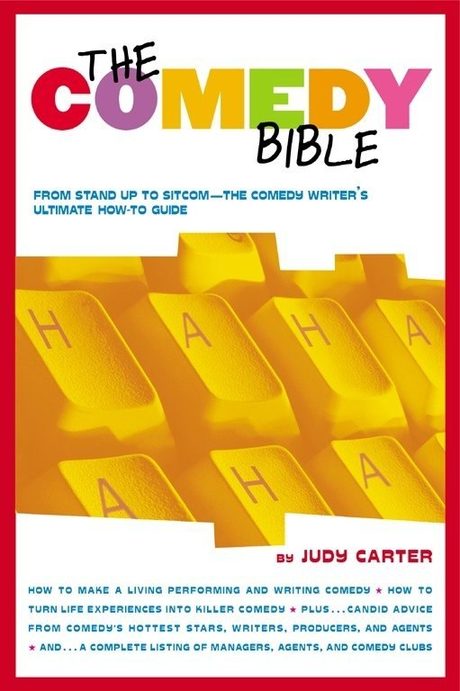
A comedy course arranged as daily assignments, aimed squarely at getting you onto a stage and eventually getting paid.
Carter runs comedy workshops and this is that workshop transcribed, organised so you can work through it a day at a time with tasks at every step. It handles stand-up first, then moves into sitcom scripts, one person shows, and using comedy in corporate speaking, a lane almost nobody else here bothers with. There is heavy emphasis on mining your own irritations for material, and on the business side of it: getting stage time, building a set, dealing with an agent. The voice is loud and motivational, much closer to a coach than a theorist.
Why it is at 9
Ninth because the structure is the value here rather than the ideas. If you need somebody to tell you what to do today, this is the only book on the list that assigns homework by the day. The comedy theory in it is thinner than Dean or Vorhaus, and the club and agent advice is written for an American scene, so Indian readers should take that half as broad shape rather than instruction.
Read it ifyou need a structured course with daily assignments
Skip it ifmotivational coaching voices make you want to leave the room
loud, structured, commercialBest for: people who need deadlinescoursestand-upbusiness
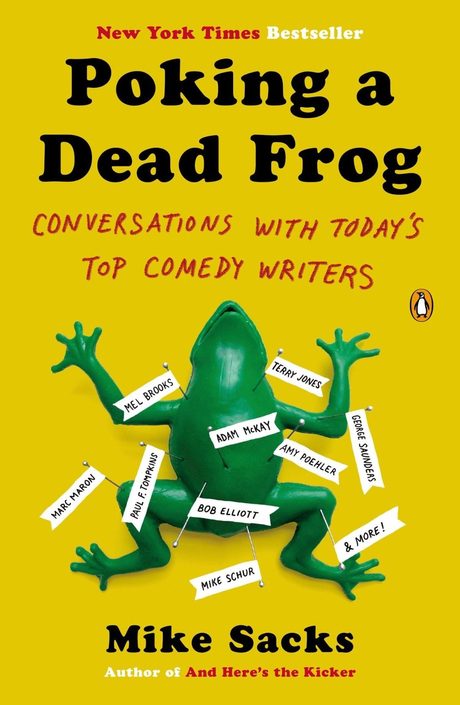
Long interviews with working comedy writers, plus short bursts of very specific advice from people who do this for rent money.
Sacks interviews comedy writers across several generations and asks them practical questions instead of famous ones: how a script gets broken, how much of the day goes on staring at nothing, what happens when a room turns against your idea in front of you. Between the interviews he drops short pieces of concentrated advice and oddly precise craft knowledge. What comes through across all of it is how unglamorous the job is and how much of it is rewriting. Read it to find out what the work feels like from inside, rather than how to do one part of it.
Why it is at 10
Tenth, and the start of the conversation half of this list. It is the best of the three interview books because Sacks asks about process instead of anecdotes. It ranks below every craft book above it for one plain reason: you cannot apply an interview. Read this after you have tried something and failed at it, not before you start.
Read it ifyou want to know what the job is really like day to day
Skip it ifyou want a method you can put to work this week
candid, roomy, unglamorousBest for: writers between projectsinterviewsprocesscareer
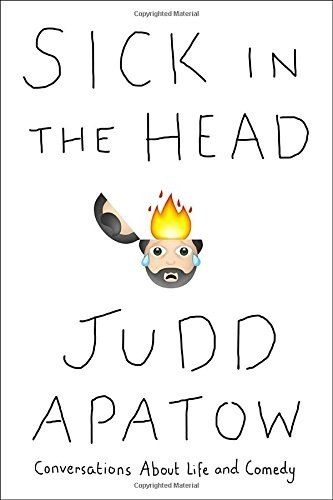
Thirty years of Apatow interviewing comedians, beginning when he was a teenager with a school radio show and enormous nerve.
Apatow started interviewing comedians as a fifteen year old for his high school radio station, and somehow talked established names into sitting down with him. He kept the tapes, kept interviewing people for decades as he became a director himself, and this book collects them. The early ones are the treasure: a teenager asking famous comedians earnest questions about how they do what they do, and the comedians answering him seriously. The later conversations are between peers and run looser. There is very little technique in here. There is a great deal about what this life does to the people who pick it.
Why it is at 11
Eleventh because it is the most enjoyable book on the list and the least instructive one. You will learn how comedians think about failure, money, envy and the particular loneliness of the job, which matters more than beginners expect it to. Just do not mistake reading it for working. It edges above Born Standing Up only because it covers many careers rather than one.
Read it ifyou want to sit inside comedy culture for a week
Skip it ifyou want craft instruction with no anecdotes attached
warm, sprawling, gossipyBest for: reading in small dosesinterviewscomediansculture
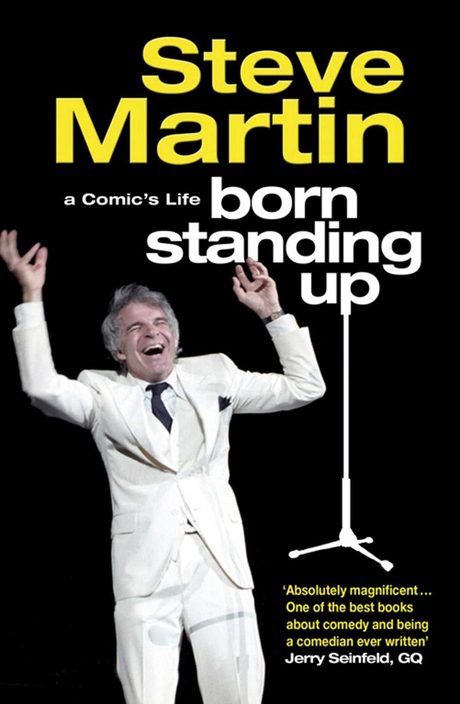
Steve Martin on the eighteen years it took him to get good, and on walking away at the moment it finally worked.
Martin tells the story of building an act out of nothing, starting with magic tricks at Disneyland and ending in arenas, and the middle of the book is years upon years of small rooms and bad nights. He is precise about the theory he was working from, which was to strip out the punchlines and let the audience decide when to laugh, and honest about the anxiety attacks and the flatness that arrived alongside the success. Then he stopped completely and never went back to stand-up. It is a short book written with real control, and the coldness in it is deliberate.
Why it is at 12
Twelfth and last, and the only one here I would call necessary. Every other book on this list tells you how comedy works. This one tells you how long it takes, which is the fact beginners most need and least want to hear. Read it when you are discouraged, then read it again when something finally lands and you feel oddly nothing.
Read it ifyou need proof that slow progress is the normal kind
Skip it ifyou want technique rather than somebody's life story
controlled, cold, honestBest for: a discouraged weekmemoirstand-upcareer
Pairs with: Poking a Dead Frog, which shows the same slowness across dozens of careers at once
If you want to write and perform stand-up, begin with Step by Step to Stand-Up Comedy, then add The Comedy Bible for structure and stage time. If you want topical jokes for a monologue, a newsletter or a feed, go straight to Comedy Writing for Late-Night TV and read nothing else until you have written fifty of them.
For sketch or improv, read Truth in Comedy first because it is shorter, then Impro once you are ready to have your ideas about performance rearranged from the floor up. For a sitcom or a comedy screenplay, start with The Eight Characters of Comedy and then watch two seasons of something with that framework open beside you.
For funny prose, captions, advertising or essays, start with How to Write Funny and its filters, then read The Comic Toolbox for the wider picture. And whatever the goal is, The Comic Toolbox remains the safest single purchase on this page, because it does useful work on all four.
Worth knowing
What none of these books will do for you
None of them will make you funny in conversation. That is a different skill, closer to timing and reading a room, and it gets learned by being in rooms. What these books give you is the ability to build something funny deliberately, on a deadline, on a day when you feel about as funny as a tax form, which is the actual job.
The other honest warning is about examples. Almost everything here draws on American television and American clubs, so the references come from shows you may never have watched. The mechanisms travel perfectly well, since a target assumption behaves the same in Gujarati as in English, and the status games at a Diwali lunch are precisely the ones Johnstone is describing. The examples do not travel. Do that translation yourself and keep a running list of local ones as you read.
People also ask
Questions, answered
What is the best book on comedy writing for beginners?
The Comic Toolbox by John Vorhaus, because it starts by dismantling the belief that funny is something you are born with, and it replaces that with problems you can work on. It suits every kind of comedy writing rather than one. If you already know you want to perform stand-up, buy Step by Step to Stand-Up Comedy by Greg Dean instead and start writing jokes in week one.
Can you actually learn to be funny from a book?
You can learn to build funny things on purpose, which is a different and more useful skill than being naturally quick. A book cannot give you timing or a face, and it will not help you at a dinner table. What it can do is show you why a line works, so that when your instinct fails on a Wednesday afternoon you still have a method. Every professional comedy writer is running one, whether they call it that or not.
Which book should I read to write stand-up comedy?
Greg Dean's Step by Step to Stand-Up Comedy first, for the joke mechanism, then Judy Carter's The Comedy Bible if you need the structure of daily assignments and advice on getting stage time. Add Comedy Writing for Late-Night TV once you can already write a working joke, because Toplyn will then multiply your output. Three books is more than enough. The rest of your progress happens at open mics.
Are these comedy writing books useful for Indian writers?
The mechanisms are, completely. A setup and punch behaves the same in Hindi, Gujarati or English, and status games at a family lunch in Ahmedabad are the same ones Keith Johnstone describes in a London rehearsal room. What does not travel is the examples, which lean heavily on American shows and clubs, and the business advice about agents and clubs. Read those chapters as shape rather than instruction, and keep your own list of local examples as you go.
What is the difference between The Comic Toolbox and How to Write Funny?
Vorhaus works at the level of the whole piece, so he is thinking about premise, character and structure, which makes him better for scripts, stories and anything with a shape. Dikkers works at the level of the sentence, giving you filters to bend a plain statement into a funny one, which makes him better for headlines, captions and copy. Most people writing comedy today need both, and they are short enough to read in the same week.
Do I need to read all twelve of these?
No, and trying to would be a way of avoiding the writing. Pick the one that matches your goal from the map above, read it with a notebook, and produce something bad. Then pick a second one only when you hit a specific wall, because a book read against a real problem teaches about five times as much as a book read out of enthusiasm.
Before you go
What to read tonight
If you are buying one book tonight, make it The Comic Toolbox, and do not read it in bed. Read it at a table with a notebook and do the exercises as they arrive, because that is where the value is hiding. If you are buying two, add whichever goal specific book matches what you actually want to write, and then ignore the rest of this list until you have finished something.
Then write forty bad jokes. Not four, forty, because the hit rate is brutal at the start and it improves faster than anyone tells you. Once you have a stack of your own attempts to look at, Poking a Dead Frog and Born Standing Up will read like completely different books, and that is the right moment to open them.