My first Khushwant Singh was a joke book, bought at a railway stall in Ahmedabad because it cost less than a plate of samosas and the train was late. I laughed maybe four times in two hours and filed him away as a dirty old man with a column and a generous publisher. It took another eight years, and a secondhand copy of Train to Pakistan with somebody else's name written inside the cover, before I worked out that I had met the wrong Khushwant.
There are three of him. The novelist, who wrote one of the finest books anybody has written about Partition and then never got that close again. The historian, who spent years on a two-volume history of the Sikhs that students are still handed. The columnist, who supplied India with malice, poetry, obituaries and dirty jokes every week for decades, and who is the reason the first two get underrated at every bookshop counter in the country.
So this list runs one to twelve, ranked by how much of the real writer you get for your money, and every entry tells you which Khushwant you are buying. There is also a section on the repetition problem, because several of his collections share the same material and nobody mentions that while you are paying. Quick picks first, in case you are standing in a shop right now with a train to catch.
How I picked these
- Ranked by original writing per rupee. A slim novel beats a fat anthology of columns you have already read in the newspaper, every time.
- Joke books are out. The one-liner collections are the reason casual readers underrate him, and none of that writing is what anybody will remember him for.
- Every book here was checked through Google Books and Open Library and has a real cover behind a real edition. Two I badly wanted failed that test: I Shall Not Hear the Nightingale, his 1959 novel about a Sikh family split between loyalty and rebellion in wartime Punjab, and The End of India, written in 2003 after the violence in Gujarat. Both are worth your time if you find them. I am not going to list a book you cannot see.
- The two-volume history counts as one entry, because volume two only makes sense once you have read volume one.
- Also cut: Khushwantnama, the Delhi anthologies he edited rather than wrote, and the late books assembled out of earlier material with help.
The whole list at a glance
All 12 books, in order
| # | Book | Author | Year | Vibe | Best for |
|---|
| 1 | Train to Pakistan | Khushwant Singh | 1956 | spare, cold, devastating | the one book to start with |
| 2 | Delhi: A Novel | Khushwant Singh | 1990 | sprawling, bawdy, furious | readers who know Delhi |
| 3 | Truth, Love and a Little Malice: An Autobiography | Khushwant Singh | 2002 | candid, gossipy, unbothered | readers who already like him |
| 4 | A History of the Sikhs | Khushwant Singh | 1963 | plain, patient, authoritative | readers new to Sikh history |
| 5 | The Portrait of a Lady | Khushwant Singh | 2009 | short, wry, unsentimental | commuters and dippers |
| 6 | Ranjit Singh: Maharaja of the Punjab | Khushwant Singh | 1962 | sober, researched, unsentimental | readers who liked the Sikh history |
| 7 | Death at My Doorstep | Khushwant Singh | 2005 | wry, personal, unsentimental | readers who like Indian political gossip |
| 8 | Not a Nice Man to Know: The Best of Khushwant Singh | Khushwant Singh | 1993 | varied, representative, uneven | first-time samplers |
| 9 | The Sunset Club | Khushwant Singh | 2010 | gentle, ribald, elegiac | fans finishing the shelf |
| 10 | Absolute Khushwant | Khushwant Singh | 2010 | brisk, opinionated, light | short journeys and gifts |
| 11 | Women and Men in My Life | Khushwant Singh | 1995 | gossipy, personal, dated | readers of Indian political history |
| 12 | The Company of Women | Khushwant Singh | 1999 | explicit, repetitive, dated | completists only |
The list
The books, ranked
1

The novelist
Train to Pakistan
Khushwant Singh1956about 194 pages
A village on the new border, a train that arrives wrong, and two hundred pages that never once raise their voice.
Mano Majra is a village on the Sutlej where Sikhs and Muslims have lived side by side long enough to stop noticing, until the summer of 1947 puts a border a few miles away. Singh gives you a village dacoit in love with a Muslim weaver's daughter, a city communist who arrives to organise nobody in particular, and a magistrate who would prefer the problem to solve itself. Then the trains start coming. It is under two hundred pages, it never editorialises, and it lands harder than most of the Partition writing that followed it.
Why it is at 1
First, and there is no argument to have about it. He wrote this in his one long burst of restraint and never wrote anything so controlled again. Everything else on this list is Khushwant Singh talking. This is Khushwant Singh listening, and the difference is the whole reason he matters.
Read it ifyou want Partition written from inside one village, with no lecture attached
Skip it ifyou need a hopeful ending or cannot read about communal killing
spare, cold, devastatingBest for: the one book to start withnovelpartition1947
Heads up: communal violence and mass death, described plainly
2

The novelist
Delhi: A Novel
Khushwant Singh1990about 460 pages
Six centuries of Delhi told by a shabby narrator and the woman the city keeps deciding not to see.
The book alternates between a present-day narrator, a journalist who is not trying very hard to be likeable, and long historical chapters that drop you into Delhi under different rulers, among poets, invaders and massacres. His companion in the present is Bhagmati, a hijra, and she is the best thing he ever invented, because through her he can say what the city does to anyone it has decided is disposable. He worked on this for decades and it shows in both directions: some chapters are extraordinary, others are dead weight you push through.
Why it is at 2
Second because at its peak it is the most ambitious thing he attempted, and the closing section, which walks into the killings of 1984, is the angriest writing of his career. It is uneven in a way Train to Pakistan never is, and the leering register wears thin by the middle. Read it anyway, and skim when it sags.
Read it ifyou love Delhi or want a novel that picks a fight with a city
Skip it ifyou want consistency, because several historical chapters drag badly
sprawling, bawdy, furiousBest for: readers who know Delhinoveldelhihistory
Heads up: explicit sex throughout, and riot violence in the closing chapters
3

The autobiography
Truth, Love and a Little Malice: An Autobiography
Khushwant Singh2002about 436 pages
The memoir he threatened to publish for years, and the only place all three Khushwants sit in one room.
Here is the life: a Sikh boy in a family that helped build New Delhi, law in London, a diplomatic posting he was poorly suited to, editing magazines and newspapers where he made them matter and made enemies at speed, the Emergency and the friendships it cost him, the writers he loved and the politicians he did not. It took years to reach print because several people disliked their portraits and said so through lawyers. He is honest about his own cowardice more often than you expect, and that is what saves the book from being a long boast.
Why it is at 3
Third because it is the best single book for understanding the man, and because the prose here is warmer and looser than in his columns. It ranks below the novels because a life this well connected can turn into a list of names, and in stretches it does. Read it after Train to Pakistan, when you already care who he was.
Read it ifyou want the man behind the column, with the score-settling intact
Skip it ifyou dislike memoirs thick with names you may not recognise
candid, gossipy, unbotheredBest for: readers who already like himautobiographyjournalismdelhi
4
The historian
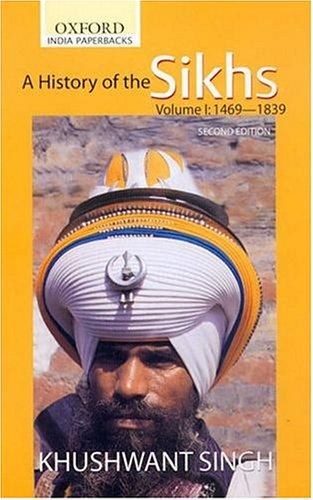
A History of the Sikhs
Khushwant Singh1963
Nanak to Ranjit Singh and beyond, written plainly enough for a reader starting from nothing.
This is the work he wanted to be judged by, and he gave it years. Volume one runs from Nanak in the fifteenth century through the building of the Sikh community, the wars and the martyrdoms, to Ranjit Singh's kingdom in Punjab. Volume two carries the story through annexation, the colonial period and Partition, and later editions push it further still. He writes it as narrative rather than as argument, with no jargon and no defensiveness, which is why it became the book people are handed first and why it stayed there.
Why it is at 4
Fourth, and the only book on this list written by a researcher rather than a fast columnist. It ranks below the memoir purely on pace, because a history moves at a history's speed. If you have any interest in Punjab, in Sikh history, or in why 1984 broke what it broke, start here rather than on the internet.
Read it ifyou want Sikh history from a writer who did the archive work
Skip it ifyou want narrative pull, because this reads like the textbook it became
plain, patient, authoritativeBest for: readers new to Sikh historyhistorysikhspunjab
5

The story writer
The Portrait of a Lady
Khushwant Singh2009about 486 pages
The collected stories, including the one about his grandmother that half of India first met inside a school textbook.
The stories are the part of his work people quote without knowing whose it is. The title piece is a portrait of his grandmother, her mornings, her sparrows, her steady disapproval, and the distance that opens once he goes abroad, and it does in a few pages what his novels take three hundred to attempt. Around it sit the crueller ones, village stories that turn on a single act, and a few where his cynicism gets the better of the material. The collection gathers work written across decades, so the quality moves around.
Why it is at 5
Fifth because it is the fastest way to see what he could do when he stopped performing. The stories carry none of the column writer's need to be liked, and the best of them are as good as anything in the novels. It sits here rather than higher because a mixed collection is always a harder recommendation than one great book.
Read it ifyou want short, sharp writing you can finish in one sitting
Skip it ifyou want a collection where every piece is on the same level
short, wry, unsentimentalBest for: commuters and dippersshort storiesschool textclassic
6
The historian
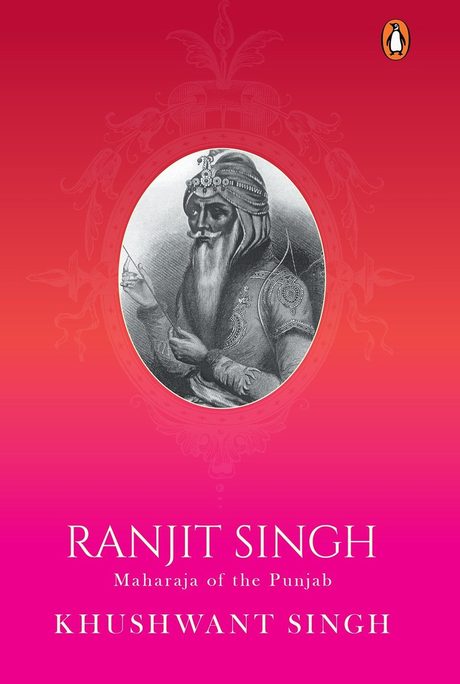
Ranjit Singh: Maharaja of the Punjab
Khushwant Singh1962about 339 pages
The one-eyed maharaja who held Punjab together, written by a historian who refuses to turn him into a saint.
Ranjit Singh took a Punjab of feuding chiefs and made it a kingdom run from Lahore, hired European officers to drill his army, picked up the Koh-i-Noor along the way, and kept the British on the far side of the Sutlej for forty years. Singh tells it without the devotional tone that usually attaches to the man, so you get the drinking and the appetite and the political cunning, and you also get the central failure, which is that he built nothing capable of surviving him. The kingdom was gone within a decade of his death.
Why it is at 6
Sixth because it is the second-best piece of research he ever did and almost nobody reads it now. If the two-volume history feels like too much commitment, this is the same historian with one life to organise the material around, which makes it much easier to get through. It ranks below the stories only because its audience is narrower.
Read it ifyou want Punjab's last independent kingdom told through one man
Skip it ifyou want a novel, because this is a straight historical biography
sober, researched, unsentimentalBest for: readers who liked the Sikh historyhistorybiographypunjab
7

The columnist, at his best
Death at My Doorstep
Khushwant Singh2005about 191 pages
Obituaries of the famous, written by a man who knew them personally and declined to be polite about it.
Singh wrote obituaries the way most people write about an ex: with affection, accuracy and the occasional score left unsettled. This gathers the ones he wrote about politicians, writers, editors and friends, and the pleasure is watching him refuse the form's basic rule, which is to lie kindly for a paragraph and move on. Running underneath all of it is his own approaching death, a subject he circled for years with a cheerfulness that never quite reads as performance.
Why it is at 7
Seventh, and the highest of the books drawn from his journalism, because the obituary is the one newspaper form that fitted him exactly: short, personal, and impossible to fake. Everything ranked below this repeats itself somewhere. This one does not, and it is the book that made me take his column work seriously.
Read it ifyou like honest writing about the dead and the well known
Skip it ifthe Indian public figures of the last century mean nothing to you
wry, personal, unsentimentalBest for: readers who like Indian political gossipessaysobituariesjournalism
8
The sampler
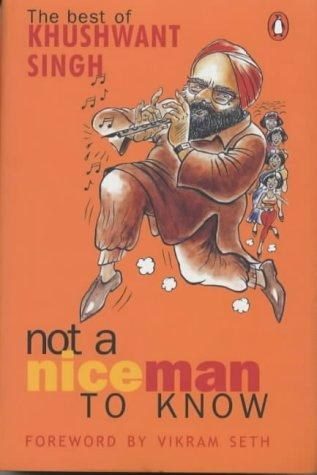
Not a Nice Man to Know: The Best of Khushwant Singh
Khushwant Singh1993about 584 pages
The one anthology worth owning: fiction, reporting and profiles chosen to show the whole writer at once.
If you want one book that covers every Khushwant at a single price, this is the sensible buy. It pulls from the novels, the stories, the reporting and the profiles, and sets the serious writer beside the entertainer so you can see how far apart the two of them stand. The title is his own line about himself, which tells you how much he enjoyed the reputation, and the edition carries a foreword by Vikram Seth. As with all anthologies, the shape belongs to the editor and the pieces are cut out of longer work.
Why it is at 8
Eighth because a sampler cannot beat the books it samples, but this is the best made of them and the only one I would hand to somebody still deciding whether he is worth their time. If you buy this, do not also buy the other collections, because you will be paying twice for a lot of the same pages.
Read it ifyou want a fair sample before committing to a novel
Skip it ifyou already own two of his books, since the overlap starts right here
varied, representative, unevenBest for: first-time samplersanthologyselectionjournalism
9
The last novel
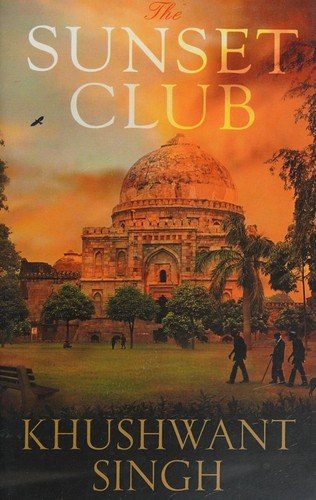
The Sunset Club
Khushwant Singh2010about 229 pages
Three old men on a bench in Lodhi Gardens, one year of India passing behind them, and no plot to speak of.
A Sikh, a Hindu and a Muslim, all in their eighties, meet at sunset in Lodhi Gardens and talk their way through a year: the news, prostate trouble, memory, sex they can no longer have, and death they can see arriving. The book is built on the calendar, month by month, which gives it a gentle rhythm and almost no forward motion. He published it at ninety-five, which is either the best or the worst reason to read it, depending on your patience for an old man enjoying himself in print.
Why it is at 9
Ninth because it is charming and slight, and because frankness about ageing bodies is genuinely rare in Indian fiction. It sits low because nothing happens by design, and the sexual material, which he clearly thought was daring, mostly reads as tired now. Read it as the last chapter of his voice, not as a novel.
Read it ifyou want old age written without dignity or shame attached
Skip it ifyou need plot, or find elderly men discussing sex unbearable
gentle, ribald, elegiacBest for: fans finishing the shelfnoveldelhiold age
Heads up: frank sexual content and a lot of bodily detail
10
The columnist, packaged
Absolute Khushwant
Khushwant Singh2010about 157 pages
His positions on god, sex, death, writing and India, in chapters short enough for a waiting room.
This is Khushwant Singh sorted into topics: on religion, which he did not have; on sex, which he wrote about far more than anybody his age was expected to; on death, which he had made his peace with; on writing, on Pakistan, on his own routine of exercise, whisky at seven and bed by nine. The chapters run two or three pages each. It is genuinely easy to read and it is also a product, put together late in his life and aimed squarely at the airport shelf.
Why it is at 10
Tenth because it is the most efficient version of the late Khushwant and the easiest book here to give somebody who does not read much. It ranks this low because almost nothing in it is missing from the autobiography, where it is told better and at length. Buy it for a train journey rather than for a shelf.
Read it ifyou want the man's opinions in small, quick pieces
Skip it ifyou have read the autobiography, because you have already met most of this
brisk, opinionated, lightBest for: short journeys and giftsessaysopinionslate work
11
The profiles
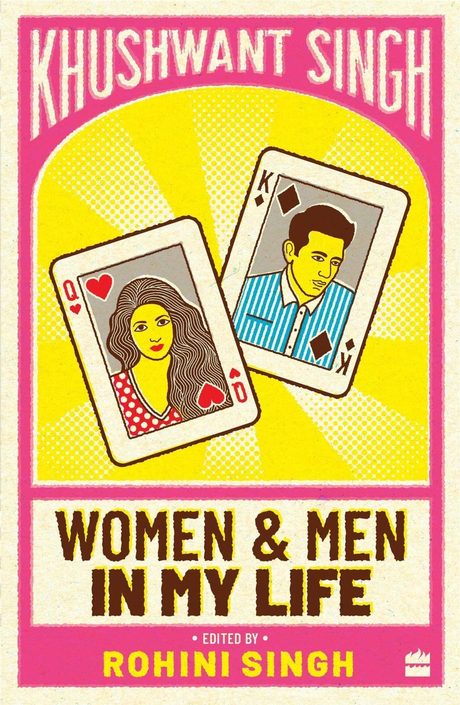
Women and Men in My Life
Khushwant Singh1995about 111 pages
Portraits of the people he knew, written by a man who had stopped worrying about future invitations.
Singh spent sixty years within arm's reach of the people who ran India, wrote its books and made most of its noise, and this is him going through the address book in public. Politicians, editors, writers, socialites, a few friends he genuinely loved. He is warm about the ones he respected and merciless about the rest, and he rarely bothers to disguise which is which. How much you enjoy it depends almost entirely on how many of the names still mean something to you.
Why it is at 11
Eleventh because it is the most dated book on this list. The writing is fine, but a profile collection lives on recognition, and a reader in their twenties today will not know half of these people. If the names land for you, move it up four places. If they do not, skip it and read the obituaries instead.
Read it ifyou know twentieth-century Indian public life and want gossip with a byline
Skip it ifthe names in Indian newspapers of the 1980s mean nothing to you
gossipy, personal, datedBest for: readers of Indian political historyprofilesjournalismmemoir
12
Approach with caution
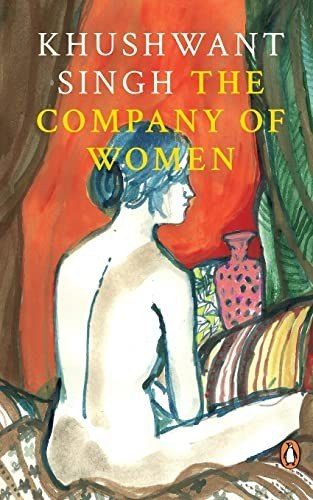
The Company of Women
Khushwant Singh1999about 242 pages
A Delhi businessman advertises for female company after his marriage collapses, and the novel goes exactly where you fear.
Mohan Kumar has money, a failed marriage and a plan: he will spend the years he has left in the company of women found through the newspaper. What follows is a sequence of encounters written in considerable detail, with a moral arriving at the end like a bill nobody asked for. Singh was in his eighties when he published it and clearly enjoying the freedom of a man with nothing left to protect. The prose moves easily. The imagination is narrow, and the women exist mostly as bodies with a backstory attached.
Why it is at 12
Twelfth, last, and on this list mainly because you will find it in every bookshop in India and deserve a warning first. It is the book that fixed his reputation as a dirty old man and it earns that reputation honestly. Read it if you are completing the shelf. Do not read it first, and do not judge Train to Pakistan by it.
Read it ifyou are working through his whole shelf and want the notorious one
Skip it ifexplicit sex written by a man in his eighties about much younger women is not your idea of an evening
explicit, repetitive, datedBest for: completists onlynovelexplicitlate work
Heads up: extended explicit sexual content, and a treatment of women many readers will find reductive
Worth knowing
The three Khushwants, and which one you are buying
The novelist wrote a handful of novels, of which one is great and one gets close. That Khushwant is at ranks one, two and nine, and he is the reason anybody is still arguing about him.
The historian spent years in archives and produced a two-volume history of the Sikhs and a biography of Ranjit Singh that are still handed to students. That Khushwant is at four and six, and he is the one nobody quotes at parties, which is a pity, because he did the hardest work.
The columnist wrote for newspapers for decades, and everything from rank seven down comes out of that work, directly or repackaged. He is why your uncle thinks Khushwant Singh was a joke merchant with a whisky habit. He is also, on his day, the most readable Indian journalist of his century, and the obituaries are the proof.
Worth knowing
The repetition problem nobody warns you about
Somewhere after 1990 the publishing industry worked out that a Khushwant Singh collection sells regardless of what is inside it, and the collections started arriving faster than the writing did. Absolute Khushwant, Not a Nice Man to Know, Women and Men in My Life and the various best-of volumes all draw on the same body of columns, profiles and set pieces, so buying three of them means meeting the same anecdotes in three different bindings. The autobiography carries the fullest version of most of them.
The rule I would use is one novel, one history, one collection. Take Train to Pakistan, then A History of the Sikhs if the subject genuinely interests you or Ranjit Singh if it only half does, then exactly one anthology. After that, stop buying and reread the novel, which will give you more on a second pass than a fourth book of his opinions about god ever will.
People also ask
Questions, answered
Which is the best Khushwant Singh book?
Train to Pakistan, published in 1956, and the gap between it and everything else he wrote is wide. It is short, it refuses to sentimentalise, and it puts Partition inside one border village instead of inside a speech. His other well-known novel, Delhi, is more ambitious and far less controlled. If a person has time for one book of his in a lifetime, this is the one that earns the slot.
Where should a beginner start with Khushwant Singh?
Train to Pakistan, always. It runs under two hundred pages and goes down in one sitting. If you prefer nonfiction, begin with the autobiography, Truth, Love and a Little Malice, which has the man and most of a century inside it. If you only have an evening, the collected stories in The Portrait of a Lady will show you what he could do without asking for any commitment.
Is Khushwant Singh worth reading today?
For four or five books, yes, without argument. For the shelf of column collections, mostly no, unless you enjoy his company enough that repetition stops mattering. The novels and the histories hold up completely. The joke books and the late anthologies have aged into period pieces, and some of his writing about women has aged worse than that. Read him selectively and he is one of India's essential writers.
Why is Khushwant Singh called a dirty old man?
Because he built the character himself and enjoyed wearing it. The cartoon of him sitting inside a light bulb with a bottle and a book, the columns about sex, and the late novel The Company of Women all fed the image, and he never tried to correct it. It sold newspapers for fifty years. The cost is that many readers now assume the man who wrote Train to Pakistan was a joke writer with a byline.
Which Khushwant Singh book do students read in school?
The Portrait of a Lady, his short story about his grandmother, has been in Indian school textbooks for years, which is where most people meet him without registering the name. Train to Pakistan turns up on college lists for Partition literature and modern Indian history. Neither is a bad introduction, though reading him at sixteen for an exam and reading him at twenty-five by choice produce very different opinions of the man.
Do I need to read A History of the Sikhs before his novels?
No. They are separate projects and the fiction assumes nothing. Read the history if you want to understand Punjab, the Sikh community, or the background noise behind both his novels and the events of 1984. If you want a lighter way in, Ranjit Singh: Maharaja of the Punjab covers one life instead of five centuries and moves at a much faster clip.
Before you go
What to read tonight
If tonight is the night, make it Train to Pakistan. You will finish it before you sleep, which is not the same thing as sleeping afterwards. If you have already read it and are stuck between the second novel and the autobiography, ask what you actually want from him: Delhi if you want the writer at full stretch, Truth, Love and a Little Malice if you want the man with his guard down.
And if somebody hands you one of the joke books, take it, laugh at four of them, and let it decide nothing. He spent fifty years playing the naughty grandfather because it sold papers and because it amused him enormously. The writer underneath that costume put a village on a riverbank in 1947 and never once reached for a punchline.
Keep going
Lists that pair with this one
Indian Fiction
14 Best Partition Novels and Books, Ranked by Where to Start
Fiction and first-hand testimony from both sides of the 1947 line, ordered so you begin with the one you can actually finish.
Indian Fiction
12 Best Novels Set in Delhi, Plus 3 That Are Not Fiction
Delhi is at least five cities stacked on one map, so I have ranked these by which one you actually take away.
Indian Fiction
16 Best Indian Short Story Collections (Where to Start in Each)
Sixteen collections worth your evening, ranked by how much patience each one asks for, with the exact story to read first in every book.
Indian Fiction
16 Best Books to Understand India, Ranked by What They Explain
Sixteen books, ten doors into the same country: history, caste, the mega city, the village, money, and where to start tonight.
Authors
Paulo Coelho Books Ranked: 12 Sorted by Story vs Message
I split every book into how much of it is an actual novel and how much is Coelho talking straight at you, then ranked on which mix works.