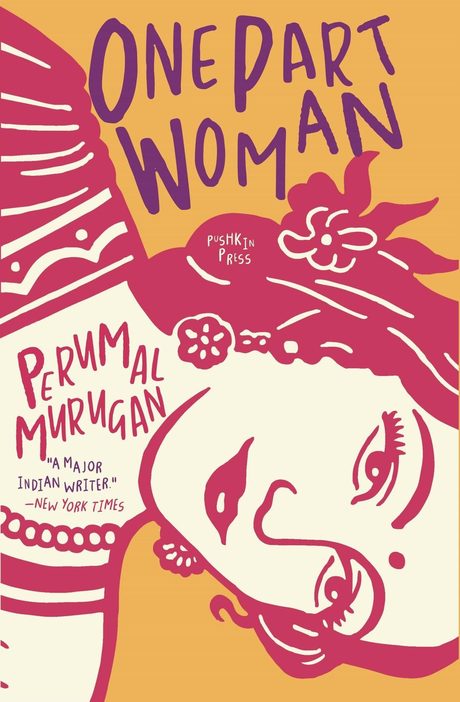
My first R. K. Narayan arrived with a question paper attached, which is the worst possible way to meet a writer. Swami and Friends was on a school list, and I decided within twenty pages that it was flat: no villain, no twist, just a boy who breaks a window and then worries about it for several chapters. I picked up The Guide at twenty six, in a hospital corridor, because somebody had abandoned a copy on the chair beside me. Same plain sentences, entirely different effect on me. The problem had never been the book.
Here is what I had missed as a teenager. Narayan writes the way a patient uncle talks over the second cup of tea, with no visible effort anywhere in the sentence, and readers raised on drama mistake that calm for emptiness. Then, usually in the last thirty pages, almost every one of these books does something quietly terrible to a character you had stopped worrying about. The gentleness is the delivery system, not the cargo.
So this list is ranked for a person starting today rather than for an exam. Twelve books, best first, each carrying a sting rating out of ten that tells you how hard the ending hits, because that is the part nobody warns you about. The Malgudi books can be read in any order and I explain why below. Quick picks sit right underneath this if you have ten seconds and a train to catch.
How I picked these
- Ranked for someone picking him up this week, not for a syllabus. Academic standing got nobody a higher spot.
- Ten novels and story collections, one memoir, one epic retelling. I left out the Mahabharata retelling and the late novellas because those are for readers who are already converted.
- Every edition here was checked through Google Books and Open Library, so the covers and the printings are real ones you can actually find.
- The Bachelor of Arts, his second novel, missed the twelve. It has the best opening of the early books and the most deflated ending, and for a first-timer Swami and Friends does the same job with more charm.
- The two books I would keep away from beginners are still on the list, ranked low, with the reason stated instead of buried.
The whole list at a glance
All 12 books, in order
| # | Book | Author | Year | Vibe | Best for |
|---|
| 1 | Malgudi Days | R. K. Narayan | 1943 | calm, wry, unhurried | first-time Narayan readers |
| 2 | The Guide | R. K. Narayan | 1958 | sly, comic, then cold | readers who like an unreliable narrator |
| 3 | The English Teacher | R. K. Narayan | 1945 | tender, domestic, devastating | readers who want to be moved |
| 4 | Swami and Friends | R. K. Narayan | 1935 | funny, exact, quietly sad | readers who liked their own school days |
| 5 | The Financial Expert | R. K. Narayan | 1952 | sharp, comic, ruthless | readers who enjoy a fall |
| 6 | The Man-Eater of Malgudi | R. K. Narayan | 1961 | comic, tense, mythic | readers who want plot |
| 7 | The Vendor of Sweets | R. K. Narayan | 1967 | warm, ironic, generational | readers with complicated parents |
| 8 | My Days: A Memoir | R. K. Narayan | 1974 | plain, funny, unsentimental | readers who want the writer's life |
| 9 | The Dark Room | R. K. Narayan | 1938 | bleak, controlled, angry | readers who want the uncomfortable one |
| 10 | The Painter of Signs | R. K. Narayan | 1976 | dry, modern, restless | readers past their first three |
| 11 | Waiting for the Mahatma | R. K. Narayan | 1955 | gentle, historical, uneven | readers already deep into Narayan |
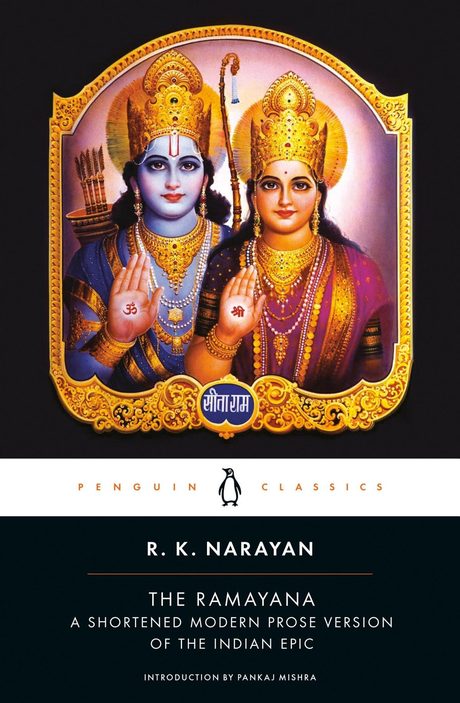
| 12 | The Ramayana: A Shortened Modern Prose Version of the Indian Epic | R. K. Narayan | 1972 | brisk, clear, story-first | newcomers to the epic |
The list
The books, ranked
1

Sting 4/10, start here
Malgudi Days
R. K. Narayan1943about 260 pages
Thirty-two short stories from a town he invented, and the cheapest way to find out whether Narayan is a writer you want in your life.
Thirty-two stories set in Malgudi, a South Indian town Narayan made up and then furnished so completely that people still argue about which real place it is. The pieces are deliberately small. An astrologer working by lamplight at a village fair recognises a customer from a very bad night years ago. A postman decides which letters to hand over and when, and pays for the decision. Most run six or eight pages and almost none of them land where you expect. What holds the collection together is a narrator who never raises his voice and never quite lets anybody off. First published in 1943, expanded for readers outside India in 1982.
Why it is at 1
First because it costs you the least. If Narayan is not for you, you will know by the end of the second story and you will have lost fifteen minutes. If he is, there are thirty more waiting and a town you will keep coming back to for years. The novels are the bigger achievements, The Guide especially, but none of them recruit a reader this efficiently.
Read it ifyou want to test a famous writer without committing to a whole novel
Skip it ifyou find short stories unsatisfying and only ever finish long books
calm, wry, unhurriedBest for: first-time Narayan readersshort storiesmalgudiclassic
Pairs with: the 1986 Doordarshan series of the same name, which used many of these stories
2
Sting 8/10
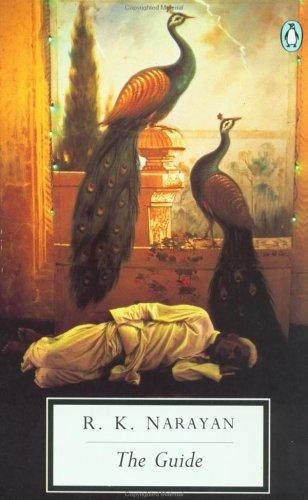
The Guide
R. K. Narayan1958about 234 pages
A charming liar talks his way into a woman's life, a prison sentence, and finally into being mistaken for a saint.
Raju runs a small tourist-guide business out of Malgudi railway station and tells visitors whatever they want to hear, which turns out to be a transferable skill. He meets Marco, a scholar who cares more about cave paintings than about his wife, and Rosie, the wife, a dancer from a community respectable Malgudi looks down on. Raju becomes her manager and then more than that, forges a signature, and goes to prison. On release he sits down in a ruined temple beside a dry river, is taken for a holy man by a village that badly needs one, and feels the role close around him. Two timelines run in parallel and meet on the last page.
Why it is at 2
Second, and it would be first if I were ranking by achievement rather than by where to begin. It is the most complete book he wrote, comic for two hundred pages and then not comic at all. It sits below Malgudi Days only because the split timeline asks more of you on page one than a story collection does. It also brought him the first Sahitya Akademi Award given to a book in English, in 1960.
Read it ifyou want one Narayan novel and you want it to be the real thing
Skip it ifyou need a hero you can root for cleanly from start to finish
sly, comic, then coldBest for: readers who like an unreliable narratornovelmalgudicon man
Pairs with: the 1965 film Guide with Dev Anand and Waheeda Rehman, which is a far more romantic animal than the book
3
Sting 10/10
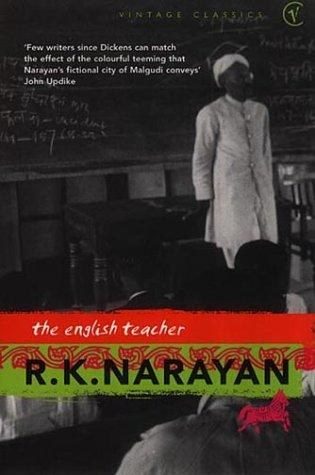
The English Teacher
R. K. Narayan1945about 31 pages
A young lecturer's ordinary happy life, and then the illness that takes it apart, written by a man who had just lived through the same thing.
Krishna teaches English at a mission college, grumbles about marking, and is quietly delighted when his wife and small daughter come to live with him. The first half is domestic comfort recorded in close detail: rent, vegetables, a child learning to talk, a husband who does not know how lucky he is. Then typhoid arrives. The second half follows Krishna trying to reach his wife after her death, first through grief and later through a medium who takes dictation from her. Narayan lost his own young wife a few years before he wrote this, and the book never pretends otherwise.
Why it is at 3
Third because it is the one that stays with people, and I have watched it undo readers who thought they were safe with a gentle Indian classic. It ranks below The Guide only because the seance chapters lose a chunk of readers who will follow him anywhere else. Take those chapters as a widower's honest record of what he wanted to believe and the book holds.
Read it ifyou can take a slow, tender first half knowing what is coming
Skip it ifyou are recently bereaved, or the supernatural in a realist novel annoys you
tender, domestic, devastatingBest for: readers who want to be movednovelgriefmarriage
Heads up: the death of a spouse from illness, and a child losing a parent
4
Sting 5/10
Swami and Friends
R. K. Narayan1935about 200 pages
The first Malgudi book: a ten-year-old, a cricket team, a friendship he cannot hold on to, and school as a daily humiliation.
Swaminathan is ten, bad at arithmetic, loyal to the wrong people, and permanently on the edge of trouble he did not plan. His world is the classroom, the street, and a cricket team assembled with more ambition than equipment. Around him the nationalist agitation of the 1930s bubbles up, and he joins a protest mostly because his friends are in it. The comedy is exact about how children actually think, and the last stretch turns without warning into a book about losing a friend. Graham Greene read the manuscript, found it a publisher, and talked him into shortening his name for English readers.
Why it is at 4
Fourth because it is where Malgudi begins and because it is very funny, but a first-time reader can mistake the low stakes for no stakes. Read it after you already like him and the ending will get you. Read it first, as I did at fourteen, and you may put him down for a decade.
Read it ifyou want childhood written without a single drop of nostalgia syrup
Skip it ifyou want adult stakes and cannot spend two hundred pages inside a boy's head
funny, exact, quietly sadBest for: readers who liked their own school daysnovelchildhoodmalgudi
Pairs with: The English Teacher, which follows the same trio of early novels into adult life
5

Sting 8/10
The Financial Expert
R. K. Narayan1952about 217 pages
A man runs a lending business from under a tree outside the bank, gets rich, and finds out what money does to a son.
Margayya sits under a banyan tree outside the co-operative bank with a tin box, filling in loan forms for villagers who cannot read them and taking a cut of the proceeds. He is greedy, vain, superstitious, and completely recognisable. A run of luck and a stretch of shrewdness turn him into the richest man in Malgudi, and the money then goes to work on his household, particularly on Balu, a son who has been given everything and asked for nothing. Narayan tracks the rise with real comic relish and the fall with none at all.
Why it is at 5
Fifth because it is the best of his money novels and, for my rupee, the funniest sustained writing he did before the Man-Eater. It sits behind The Guide because Margayya is a smaller soul than Raju and the book knows it. If you have watched anyone in your family chase a scheme, the last forty pages will feel like a family story you were told once.
Read it ifyou like satire about money that never turns into a sermon
Skip it ifyou need someone likeable at the centre of a book
sharp, comic, ruthlessBest for: readers who enjoy a fallnovelmoneysatire
6
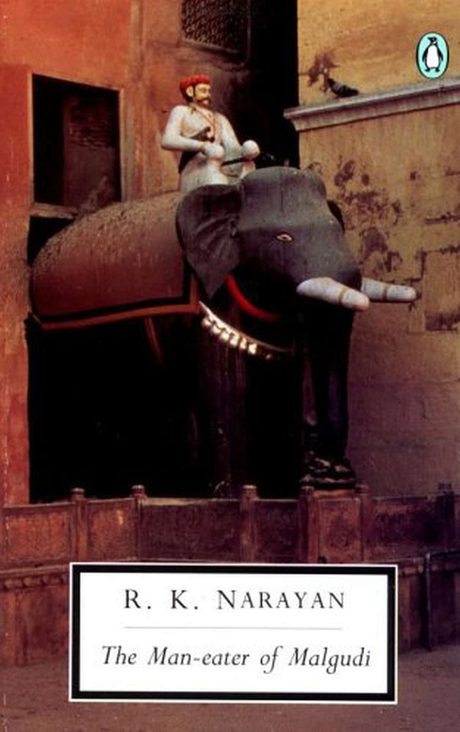
Sting 6/10, funniest
The Man-Eater of Malgudi
R. K. Narayan1961about 180 pages
A mild printer lets a taxidermist move into his attic, and slowly realises there is no polite way to get a monster out of your house.
Nataraj runs a small printing press and a large circle of loafers who use his front room as a club. Vasu, a taxidermist with enormous arms and no manners, installs himself in the attic, fills it with dead animals, and starts treating the whole town as his supply. Nataraj is far too well brought up to throw him out, which is the joke and also the horror. The plot builds towards a temple elephant and a festival, and Narayan is openly borrowing the shape of the old myth about a demon who is given a boon that destroys him.
Why it is at 6
Sixth on this ranking and first if you want to laugh. It is the book where his comedy has the most bite, and the mythological frame gives the ending a snap the realist novels do not attempt. It ranks here rather than higher because Vasu is a device more than a person, brilliant as the device is.
Read it ifyou want a comic novel with a villain and a real plot engine
Skip it ifdescriptions of dead animals and taxidermy put you off your lunch
comic, tense, mythicBest for: readers who want plotnovelcomedymalgudi
Heads up: animal death throughout, described matter-of-factly
7
Sting 7/10
The Vendor of Sweets
R. K. Narayan1967about 140 pages
A Gandhian sweet-shop owner meets his Americanised son, and every Indian parent since has recognised the conversation.
Jagan sells sweets, reads the Bhagavad Gita between customers, keeps two sets of accounts, and believes his frugality is a spiritual practice. His son Mali goes to America, comes back with a foreign partner and a business plan involving a machine that writes stories, and expects his father to fund it. The generational collision is handled without a single villain: Jagan's piety is partly a performance, Mali's contempt is partly fair, and both of them are lonely. The book is a hundred and forty pages and it does not waste one of them.
Why it is at 7
Seventh, and it climbs for readers in their thirties whose parents are getting older. This is his most direct book about what children owe and what parents pretend not to want. It sits below the Man-Eater only because the comedy is quieter, though the last chapter is one of his best endings.
Read it ifyou have had the argument about going abroad with somebody who raised you
Skip it ifyou want a big canvas, since almost all of this happens in one shop and one house
warm, ironic, generationalBest for: readers with complicated parentsnovelfamilymalgudi
8

Sting 7/10, the memoir
My Days: A Memoir
R. K. Narayan1974about 133 pages
The writer's own life told in the same flat, funny voice he gave to Malgudi, including the loss the novels keep circling.
Narayan grew up in Madras in his grandmother's house, was taught arithmetic and Sanskrit by her, failed and repeated exams, drifted through jobs he was unfit for, and decided to be a writer at a time when Indians writing novels in English were a rounding error. The memoir covers the manuscript that went around London until Graham Greene rescued it, the marriage he chose against the horoscopes, his wife's early death, and the long working years after. He writes about all of it with the same steady voice, which somehow makes the hard parts harder.
Why it is at 8
Eighth because it is a memoir and you should meet the fiction first, but it belongs this high because of what it does to the novels. Read The English Teacher and then read the corresponding chapters here and you will see exactly what he transposed and what he could not bring himself to change. There is no self-pity anywhere in it.
Read it ifyou have read two or three of the novels and want to know the man
Skip it ifyou have not read him yet, since the memoir gives away the emotional weather of the fiction
plain, funny, unsentimentalBest for: readers who want the writer's lifememoirwriting life
Pairs with: The English Teacher, which is the novel version of the worst thing in this book
9

Sting 9/10
The Dark Room
R. K. Narayan1938about 220 pages
His third novel, and the one where the comedy drops away: a wife with no money, no options, and a husband who has stopped bothering to hide anything.
Savitri keeps house for Ramani, an insurance office manager who treats his family as an audience for his moods. When he begins an affair with a woman at his office and stops concealing it, Savitri shuts herself in a storeroom, then walks out of the house entirely. What follows is the most unsparing stretch Narayan ever wrote, because the world outside offers her almost nothing: no training, no earnings of her own, and children she cannot take with her. The book was published in 1938 and it is still the sharpest thing in his work about what a marriage costs a woman with no money.
Why it is at 9
Ninth on a ranking made for new readers, and much higher if you are ranking by nerve. This is his least comfortable book and the one that most complicates the image of him as the gentle chronicler of small-town life. It sits here only because it lacks the range of the top five, and because starting with it would give you a completely false idea of what reading Narayan is like.
Read it ifyou want to see him with the charm switched off
Skip it ifyou came to Narayan for comfort, because there is none here
bleak, controlled, angryBest for: readers who want the uncomfortable onenovelmarriageearly work
Heads up: marital cruelty, infidelity, and a suicide attempt
10
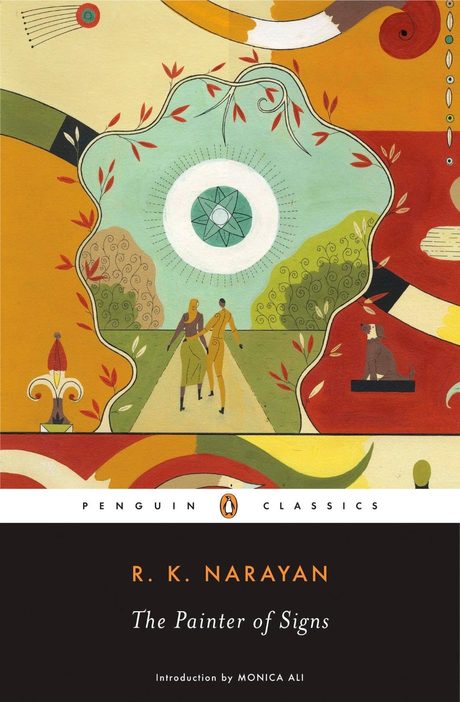
Sting 6/10
The Painter of Signs
R. K. Narayan1976about 180 pages
A sign painter falls for a family planning worker who has organised her entire life around not being anybody's wife.
Raman paints shop boards in Malgudi, thinks of himself as a man of reason, and is quite pleased with that idea until Daisy arrives. She travels the district for the family planning programme, argues with village elders about birth control, and has no interest in marriage, children, or Raman's plans for her. He follows her around the countryside on a bullock cart pretending it is about lettering. Narayan wrote it while India's population campaign was at its most forceful, and the book keeps that pressure in the background of what is otherwise a comedy about a man out of his depth.
Why it is at 10
Tenth because it is the best of the later novels and the most interesting woman in his fiction is in it. The catch is that Raman is a weaker centre than Jagan or Margayya, and the ending resolves by exhaustion rather than by decision. Worth your time once you have read four or five others.
Read it ifyou want late Narayan with an argument inside it
Skip it ifyou want the classic Malgudi warmth, since this one is drier and more modern
dry, modern, restlessBest for: readers past their first threenovellate workromance
11
Sting 5/10
Waiting for the Mahatma
R. K. Narayan1955about 260 pages
A layabout joins the freedom movement to impress a girl, and Gandhi walks through the novel as an actual character.
Sriram lives off his grandmother's savings and has no plans until he sees Bharati collecting donations for Gandhi. He follows her into the movement with motives nobody in the book pretends are political, and finds himself painting slogans, hiding out, and eventually in jail while the country changes around him. Gandhi appears in person, speaks, and is written with more caution than Narayan usually allows himself. The story runs to the end of the freedom struggle and stops on the day everybody knows is coming.
Why it is at 11
Eleventh because the two halves never fully marry. The love story is charming, the history is respectfully handled, and the join between them stays visible in a way it never does in The Guide. It is still worth reading for the sheer nerve of putting Gandhi on the page while the memory was fresh. Save it for when you have read five others and want the completist experience.
Read it ifyou want the freedom struggle at street level rather than in a textbook
Skip it ifyou want his sharpest work, because this is his most cautious novel
gentle, historical, unevenBest for: readers already deep into Narayannovelhistorygandhi
12
Not a novel
The Ramayana: A Shortened Modern Prose Version of the Indian Epic
R. K. Narayan1972about 196 pages
The epic retold in about two hundred pages of clear prose, based on the eleventh-century Tamil version by Kamban.
Narayan takes the Ramayana, works mainly from Kamban's Tamil telling rather than the Sanskrit, and compresses it into a book you can finish over a weekend. He keeps the narrative moving, cuts the theology to a minimum, and treats the characters as characters, so Kaikeyi has motives you can follow and Ravana is a person rather than a set of horns. It reads like a novelist retelling a story he has known since childhood, which is exactly what it is. He did the same job for the Mahabharata six years later.
Why it is at 12
Last because it is not his own story and because the pleasure is different in kind. If you grew up with these stories, this is the version to hand a friend who did not. If you want scholarship, footnotes, or the full text, this is emphatically the wrong book and it says so itself. As an introduction it is hard to beat for the time it asks of you.
Read it ifyou want the epic in one weekend, in plain modern English
Skip it ifyou want a complete or scholarly translation with the theology intact
brisk, clear, story-firstBest for: newcomers to the epicretellingmythologyepic
Pairs with: Gods, Demons and Others, his collection of shorter tales from the same tradition
Worth knowing
How the sting rating works
Every book gets a sting mark out of ten, and it measures one thing: how hard the ending hits relative to how gentle the book felt on the way in. It is my own scale and I am arguing for it in the open. A 4 means you close the book smiling. A 7 means you sit still for a minute. A 10 means The English Teacher, and you should not read it on a work night.
The reason this matters more with Narayan than with most writers is that his surface never signals trouble. There is no ominous weather, no chapter that slows down to warn you, no change in the register of the sentences. A man goes to buy groceries in the same voice in which a marriage ends. Readers who quit him after one book usually quit because the surface bored them, and they left before the surface did anything.
Worth knowing
Does Malgudi have a reading order
No, and this is the question I get most. Malgudi is not a continuous world with a timeline you can break. It is a stage set that Narayan rebuilt for each book, so the same street can hold a printing press in one novel and not exist in the next, and characters almost never cross over. Pick any book and you are not missing anything.
The only loose grouping worth knowing is the first three: Swami and Friends, The Bachelor of Arts, and The English Teacher move roughly from childhood to college to marriage, and they are sometimes sold as a set. Even there the connection is thematic rather than serial. Reading them in order gives you a nice arc of one life stage after another, and reading them out of order costs you nothing at all.
People also ask
Questions, answered
Which R. K. Narayan book should I read first?
Malgudi Days, because it lets you sample him for the price of two stories instead of a whole novel. If you would rather start with a novel, The Guide is the one, and it is the book most people mean when they call him a great writer. Avoid starting with The English Teacher or The Dark Room, not because they are weak but because both give a very partial picture of what reading him is usually like.
Is Malgudi a real place in India?
No. Narayan invented it, and he was deliberately vague about which town it resembled, which is why people have spent decades assigning it to Mysore, Lalgudi, Coimbatore and half a dozen other places. The town has a railway station, a river called the Sarayu, a mission college and a market road, and those details stay reasonably stable across the books even when nothing else does. Treat it as a real place he happened to be the only visitor to.
Did R. K. Narayan win any major awards?
The Guide brought him the first Sahitya Akademi Award given to a book written in English, in 1960, which is the prize most often attached to his name. He also served as a nominated member of the Rajya Sabha, where his first speech was about the weight of school bags and what the school system does to a child's imagination, a subject anyone who has read Swami and Friends could have predicted.
Is R. K. Narayan easy to read in English?
Yes, and that is the whole design. His vocabulary is small on purpose, the sentences are short, and there is no experiment in the prose to trip over, which makes him one of the safest classic authors for a reader who is not yet confident in long English fiction. The difficulty is elsewhere: you have to be patient with a plot that takes its time and willing to notice what he does not say.
How is the Malgudi Days book different from the television series?
The series ran on Doordarshan from 1986 under Shankar Nag and adapted stories from across Narayan's short fiction, not only the ones inside this collection. The episodes add faces, music and a fixed idea of what Malgudi looks like, which the book leaves entirely to you. Watch it after reading a few stories rather than before, so the town you build in your head is your own.
Which R. K. Narayan book is the saddest?
The English Teacher, without much competition, because it is drawn from the death of his own wife and he refuses every available consolation until the final chapters. The Dark Room is the bleakest in a different way, since nothing is taken from Savitri by fate, only by the ordinary arrangement of a marriage and the ordinary shortage of money. One book grieves, the other indicts.
Before you go
What to read tonight
If it is late and you want to start tonight, open Malgudi Days at An Astrologer's Day and read exactly one story. That is the whole test. Nothing in it will grab your collar, and either the last line makes you look up or it does not.
If you are choosing between the two big novels, take The Guide when you want to watch a man talk himself into a life, and The English Teacher when you can afford to be taken apart. And once you have four or five of these behind you, go back to Swami and Friends, which you may have read at school and filed under boring. It is a different book when you know what he does with endings.
Keep going
Lists that pair with this one
Authors
The 13 Best Ruskin Bond Books, Ranked (Where to Start at Any Age)
Thirteen distinct books, ranked by what they give a first-time reader, with an age label on every one.
Indian Fiction
16 Best Indian Short Story Collections (Where to Start in Each)
Sixteen collections worth your evening, ranked by how much patience each one asks for, with the exact story to read first in every book.
Mood & Life
Classic Books for Beginners: 21 Ranked Easiest to Hardest
Twenty one classics arranged on a four rung ladder, easiest first, so you finish the first one instead of abandoning it at page thirty.
Indian Fiction
16 Best Books to Understand India, Ranked by What They Explain
Sixteen books, ten doors into the same country: history, caste, the mega city, the village, money, and where to start tonight.
Indian Fiction
The 20 Best Indian Books in Translation, Ranked by Where to Start
Twenty books from ten Indian languages, ordered from the easiest way in to the one that will fight you, with the translator named every time.