Satire goes off. That is the thing nobody warns you about. A novel that flattened its target in 1938 can read in 2026 like somebody shouting at a building that was demolished years ago, and you sit there admiring the technique with a completely straight face. Meanwhile a book written sixty years ago about army paperwork will describe your last conversation with a bank so exactly that you have to put it down.
So I scored these on two questions instead of one. Is it still funny on the page, and is the thing it was aiming at still standing. A book needs both to rank high here. Catch-22 has both. Scoop is a beautiful machine aimed at a version of the foreign press that no longer exists in that form, so it sits in the middle despite being close to perfect.
Half this list is Indian and half is not, which is roughly the split of the good stuff. Every entry says what the book is aiming at, in plain words, because a satire you cannot aim is just a comic novel with a grudge. Sixteen books, ranked one to sixteen. Two of the most respected names here are near the bottom and I explain why.
How I picked these
- Two scores, not one: still funny, and still accurate. A book had to earn both to make the top five.
- Every entry names its target. If I could not say in one line what the book was attacking, it went out as comedy rather than satire.
- Half Indian, half global, deliberately. Indian satire is treated as a minor genre by people who have not read Shrilal Shukla, and that seemed worth fixing.
- I cut the political allegories that only work as puzzles. If you need a key to the real-world figures before page one is funny, it is a crossword.
- One book here is far lighter than the rest and I have ranked it last and said so, rather than pretending a corporate comedy belongs next to Orwell.
The whole list at a glance
All 16 books, in order
| # | Book | Author | Year | Vibe | Best for |
|---|
| 1 | Catch-22 | Joseph Heller | 1961 | circular, furious, hilarious | anyone who has fought an institution |
| 2 | Raag Darbari | Shrilal Shukla | 1968 | dry, patient, merciless | anyone who deals with Indian officialdom |
| 3 | English, August | Upamanyu Chatterjee | 1988 | stoned, funny, deadpan | young Indians in the wrong career |
| 4 | The Sellout | Paul Beatty | 2015 | fast, filthy, brilliant | readers who want maximum jokes |
| 5 | Animal Farm | George Orwell | 1945 | cold, clear, devastating | one evening, any age |
| 6 | A Confederacy of Dunces | John Kennedy Toole | 1980 | loud, grotesque, joyous | readers who like a monster |
| 7 | Serious Men | Manu Joseph | 2010 | cynical, sharp, funny | readers who want modern Indian satire |
| 8 | The White Tiger | Aravind Adiga | 2008 | menacing, chatty, angry | readers who want class rage |
| 9 | Lucky Jim | Kingsley Amis | 1954 | sly, precise, English | anyone stuck in academia |
| 10 | Ravan & Eddie | Kiran Nagarkar | 1994 | warm, bawdy, digressive | Mumbai readers |
| 11 | Scoop | Evelyn Waugh | 1938 | arch, brisk, cruel | journalists |
| 12 | Slaughterhouse-Five | Kurt Vonnegut | 1969 | fractured, deadpan, sad | readers who want war without heroics |
| 13 | The Great Indian Novel | Shashi Tharoor | 1989 | clever, showy, wordy | history and mythology readers |
| 14 | Money | Martin Amis | 1984 | loud, greedy, virtuosic | readers who came for the prose |
| 15 | Vernon God Little | DBC Pierre | 2003 | manic, profane, uneven | readers who want it ugly |
| 16 | Dork | Sidin Vadukut | 2010 | light, sharp, silly | office readers and commuters |
The list
The books, ranked
1
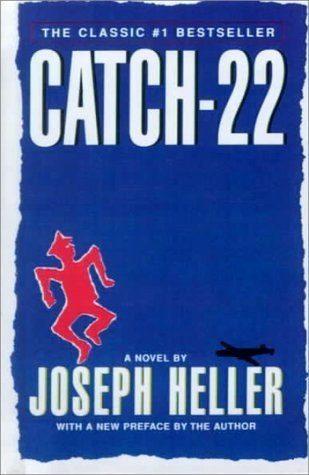
Target: the logic of institutions
Catch-22
Joseph Heller1961
A bomber pilot works out that the only way off combat duty is to be insane, and that asking to leave proves he is not.
Yossarian is stationed on a Mediterranean island in the last stretch of the Second World War and has arrived at one conclusion: strangers are trying to kill him, and the people who keep raising the number of missions he must fly are on his own side. Around him Heller builds an entire economy of absurdity, including an officer who turns the war into a trading syndicate and sells the same goods to both armies. The book loops, repeats and doubles back, and the repetition is the joke, because that is exactly how bureaucracy feels from the inside.
Why it is at 1
First on both scores and it is not close. The comedy still works line by line, and the target is more alive now than in 1961, since every one of us has since argued with an insurance company, a university office, or an airline about a rule that exists only to protect itself. The last hundred pages also stop being funny in a way you will not forget.
Read it ifyou want the definitive book on why organisations behave insanely
Skip it ifyou need a plot that moves in a straight line, because this one circles
circular, furious, hilariousBest for: anyone who has fought an institutionwarbureaucracyclassic
Heads up: war deaths described plainly in the final third
2
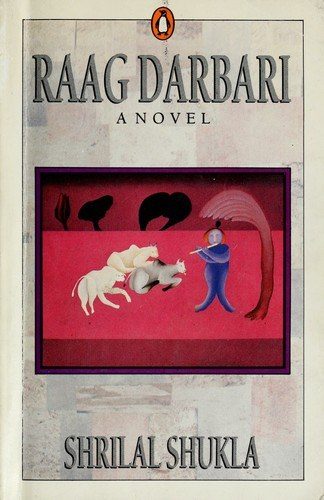
Target: how power actually works in an Indian village
Raag Darbari
Shrilal Shuklatranslated by Gillian Wright1968about 362 pages
A young researcher visits his uncle's village and finds one man running the college, the co-op and the panchayat as a private firm.
Ranganath arrives in Shivpalganj expecting rest and country air. What he gets is an education in how a village is actually governed: an uncle who controls the local college through the managing committee, a cooperative union that exists to move money sideways, court cases that never end because ending them would waste them, and a police station that everyone understands perfectly. Shukla wrote it in Hindi in 1968 after years in the administrative service, and Gillian Wright's English carries the deadpan without flattening it.
Why it is at 2
Second because the target has not shifted an inch in nearly sixty years. Read the college committee chapters and then read a newspaper story about a state university appointment, and the only difference will be the year on the masthead. It ranks below Catch-22 only because the humour is dry rather than explosive and the translation cannot fully carry the Awadhi.
Read it ifyou want to understand Indian local politics better than any nonfiction will teach you
Skip it ifyou need forward momentum, because this book strolls on purpose
dry, patient, mercilessBest for: anyone who deals with Indian officialdomhinditranslationrural india
Pairs with: English, August, for the same country seen from the other side of the desk
3
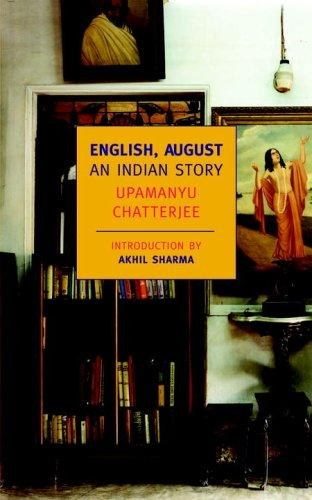
Target: the Indian civil service, and the educated Indian who despises it
English, August
Upamanyu Chatterjee1988about 291 pages
A newly minted IAS officer is posted to a town he cannot pronounce, and spends a year being bored so precisely that it becomes art.
Agastya Sen is twenty-four, English-speaking, Delhi-raised, and now the assistant collector of Madna, where the heat is unreasonable and the work is a series of meetings about nothing. He smokes, he lies to everyone including himself, he invents alternative biographies for strangers, and he does very little administering. Chatterjee wrote the definitive book about a specific Indian type: the young man with an expensive education, a state job, and no idea what he is for.
Why it is at 3
Third because both scores hold. Madna still exists, thousands of Agastyas still get posted there every year, and the comedy of a man performing competence he does not have is permanent. It ranks under Raag Darbari because Shukla is looking at the whole machine while Chatterjee is looking mostly at one young man, which is funnier but smaller.
Read it ifyou have ever taken a job you were completely unsuited to and stayed anyway
Skip it ifan aimless narrator who does nothing will frustrate you
stoned, funny, deadpanBest for: young Indians in the wrong careeriassmall towncoming of age
Heads up: casual drug use and a fair amount of male self-absorption
4

Target: the American pretence that race has been sorted out
The Sellout
Paul Beatty2015about 215 pages
A Black farmer in Los Angeles reinstates segregation in his own neighbourhood, and the plan works so well it reaches the Supreme Court.
The narrator grows up in a Los Angeles neighbourhood that gets quietly erased from the maps, raised by a father who used him for psychological experiments. To bring the place back into existence he does the most offensive thing available: he resegregates the local school and acquires a man who insists on being his slave. Beatty writes at a speed that is genuinely difficult to keep up with, stacking jokes about race, class, education and civic pride until the reader is laughing at something they will have trouble explaining later.
Why it is at 4
Fourth because sentence for sentence it is the funniest book here, and because the target is not only alive, it has learned new tricks since 2015. It sits below the top three purely on stamina: the density that makes the first hundred pages thrilling makes the middle hard work.
Read it ifyou want comedy that goes exactly where you hope it will not
Skip it ifyou want a plot, or you need your satire to be polite
fast, filthy, brilliantBest for: readers who want maximum jokesamericanracebooker
Heads up: constant racial slurs used satirically, plus sexual content
5
Target: the revolution that becomes the thing it overthrew
Animal Farm
George Orwell1945about 161 pages
The animals throw out the farmer, run the place themselves, and slowly discover which of them was always going to end up in the farmhouse.
Orwell wrote a hundred-page fable about farm animals staging a revolution and then watching the pigs consolidate power one small reasonable step at a time. Nothing about it is subtle and that is the design: he wanted a book a fifteen year old could finish in an evening and never fully shake off. The genius is in the pacing of the betrayal, because no single change is outrageous enough to fight about, and by the end every original rule has been quietly amended.
Why it is at 5
Fifth because it is the most efficient book on this list and its target is permanently in season. You can read it in two hours and then apply it to any organisation you have belonged to, including ones with no politics in them at all. It is not higher because it is a fable rather than a novel, so the pleasures are colder than the books above it.
Read it ifyou want the shortest possible education in how power consolidates
Skip it ifyou want characters rather than positions on a board
cold, clear, devastatingBest for: one evening, any ageallegorypoliticsshort
6
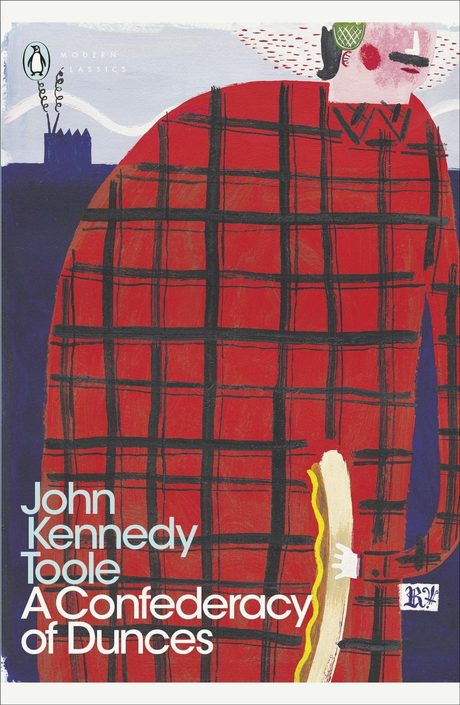
Target: the man convinced the modern world is beneath him
A Confederacy of Dunces
John Kennedy Toole1980about 374 pages
A thirty-year-old medievalist in New Orleans is forced by his mother to get a job, and inflicts himself on the city one employer at a time.
Ignatius J. Reilly is enormous, unemployed, and certain that the collapse of civilisation began somewhere around the Renaissance. He lives with his mother, writes furious notes on lined paper, attends the cinema in order to be outraged, and is finally pushed out to earn a living. Toole runs him through a hot dog cart, a trouser factory and a nightclub, and around him assembles a cast of New Orleans characters who all have their own delusions running at full volume.
Why it is at 6
Sixth because the target turned out to be prophetic. Ignatius is every man who has ever posted a two thousand word explanation of why the world is wrong and he is not, and the internet has since produced millions of him. It ranks here rather than higher because the satire is aimed at a personality rather than a system, which makes it funnier and less useful.
Read it ifyou enjoy spending time with somebody genuinely insufferable
Skip it ifan unlikeable protagonist for four hundred pages is not your idea of fun
loud, grotesque, joyousBest for: readers who like a monsteramericannew orleanscomic novel
7

Target: caste, and who India allows to be called intelligent
Serious Men
Manu Joseph2010about 353 pages
A Dalit clerk in a Mumbai science institute decides to build a genius, using the only material available, which is his ten-year-old son.
Ayyan Mani is personal assistant to a Brahmin astronomer at a research institute, which means he watches serious men take themselves seriously all day and then goes home to a chawl. So he starts a small, escalating fiction: that his son is a prodigy. Joseph runs this alongside the astronomer's own affair and his obsession with alien microbes, and the two plots keep exposing each other. Very few Indian novels are this direct about how caste decides who gets believed.
Why it is at 7
Seventh, and the sharpest contemporary Indian satire on this list. The target is in perfect health: every institution in the country still has a floor of people who see everything and are counted as furniture. It is below the top group only because the ending softens, and because Joseph occasionally likes a line so much that he lets it slow the story.
Read it ifyou want a savage, funny book about caste that never turns into a lecture
Skip it ifyou want characters to be likeable, because almost nobody here is
cynical, sharp, funnyBest for: readers who want modern Indian satirecastemumbaiinstitutions
8

Target: the servant economy and the people who find it natural
The White Tiger
Aravind Adiga2008about 320 pages
A driver writes to the Chinese premier explaining, in a friendly tone, exactly how he became a Bangalore businessman.
Balram Halwai narrates his own life in a series of night-time letters: village childhood, tea shop, a job driving for a rich family in Delhi, and the arrangement by which a servant in India is trusted absolutely because he has been made incapable of leaving. Adiga's image for this is a coop of chickens who watch the bird in front of them being slaughtered and do not run. The voice is chatty, flattering and quietly menacing, which is what makes the book work.
Why it is at 8
Eighth. The target is real and the anger is real, and the coop is still the most useful metaphor anybody has produced for Indian domestic labour. The honest caveat is that Balram sometimes sounds less like a driver from Bihar and more like a writer performing one, and the India on the page is arranged for maximum shock. Both things can be true.
Read it ifyou want the class rage most Indian fiction is too polite to print
Skip it ifyou have had enough of poverty written for an international audience
menacing, chatty, angryBest for: readers who want class rageclassdelhimodern india
Heads up: a murder, described without remorse
9
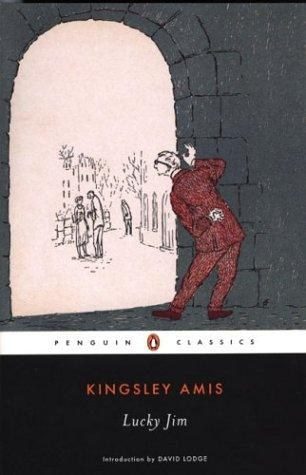
Target: academic pretension, and the English weekend
Lucky Jim
Kingsley Amis1954about 250 pages
A junior history lecturer who hates history must survive a professor's musical weekend and a public lecture he is in no state to give.
Jim Dixon has a temporary post at a provincial English university and a professor whose good opinion he needs and whose company he cannot bear. He is expected to be enthusiastic about madrigals, medieval economics and a weekend of amateur recorder playing. Amis builds the whole book out of the gap between what Jim says and the faces he makes when nobody is looking, and it culminates in a lecture that goes wrong so gradually and so completely that people still quote it seventy years later.
Why it is at 9
Ninth because the comedy is immaculate and the target has narrowed. Universities still run on performed enthusiasm, so the joke lands, but the specific English world of sherry, madrigals and the professor's approval has thinned out. Read it for the technique, which is why so many comic novelists list it as the book that taught them timing.
Read it ifyou want a masterclass in comic timing on the page
Skip it ifvery English mid-century social comedy leaves you cold
sly, precise, EnglishBest for: anyone stuck in academiabritishacademiaclassic
10

Target: religion, Hindi cinema, and the fiction that a chawl has walls
Ravan & Eddie
Kiran Nagarkar1994
Two boys grow up in the same Bombay chawl, one Hindu and one Catholic, kept apart by everything except the building itself.
Ravan and Eddie live in the same block of the same Bombay chawl and are connected by a death neither of them was old enough to witness. Nagarkar follows them from childhood into adolescence through Hindi film worship, church, gangs, sex education by rumour, and the specific geography of a building where every family knows every other family's business. Between chapters he inserts short digressions on things like the chawl as a social invention, and those are some of the funniest pages in Indian fiction.
Why it is at 10
Tenth because it is more comic novel than satire, which is a category note and not a criticism. When it does aim, at religious separation and at what Hindi cinema does to a boy's expectations, it hits cleanly. It ranks here because the target is affectionate rather than angry, and affection blunts satire even while it improves the book.
Read it ifyou want Bombay written from inside a chawl by somebody who loves it
Skip it ifyou want a tight plot, because this is deliberately episodic
warm, bawdy, digressiveBest for: Mumbai readersmumbaichawlcomic novel
Heads up: adolescent sexual material and communal tension
11

Target: the foreign correspondent and the newspaper that sends him
Scoop
Evelyn Waugh1938about 240 pages
A nature columnist is sent by clerical error to cover a war in a country he cannot find, and accidentally files the story of the year.
William Boot writes a gentle countryside column about badgers. Through a mix-up of names a national newspaper dispatches him to the African republic of Ishmaelia to cover a war that may not be happening. There he joins a pack of veteran correspondents who file vivid dispatches from the hotel bar, invent developments, and follow each other to whichever town the herd has decided is the story. Waugh had been a correspondent himself and the contempt is first-hand.
Why it is at 11
Eleventh, and it hurts to put a book this well made in the middle. The problem is the target. The expense-account foreign correspondent barely exists now, and the modern version of the disease, twenty outlets rewriting one tweet, is a different animal. Still funny, still true in outline, aimed at a building that has been renovated.
Read it ifyou work in media and want to feel both seen and insulted
Skip it ifcolonial-era jokes about Africa will put you off, and they are here
arch, brisk, cruelBest for: journalistsbritishmediaclassic
Heads up: period racial attitudes and language typical of 1938
12
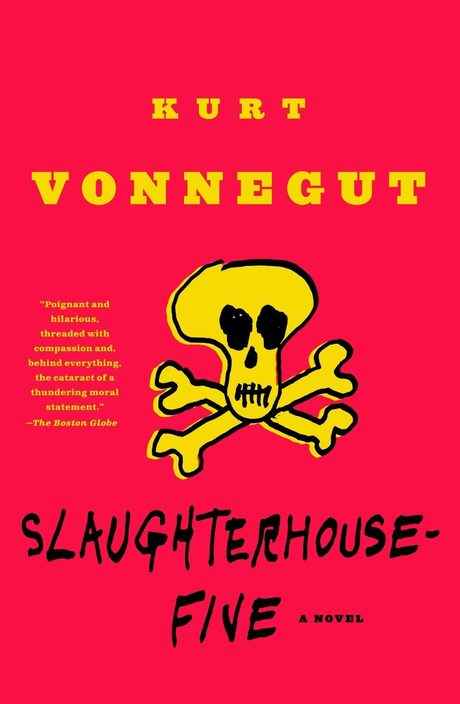
Target: the story we tell ourselves about war afterwards
Slaughterhouse-Five
Kurt Vonnegut1969about 288 pages
A man who has come unstuck in time keeps returning to the night Dresden burned, and to the aliens who explain that none of it matters.
Billy Pilgrim experiences his life out of order: optometry practice, marriage, prisoner of war camp, a zoo on another planet, and always Dresden. Vonnegut was in that city as a prisoner when it was firebombed, and the novel is his admission that he could not write about it directly, so he wrote around it for twenty years and then wrote this. Every death gets the same three words, which starts as a tic and ends as the whole argument.
Why it is at 12
Twelfth because it is satire only part of the time, and I ranked strictly. When it aims at the war novel itself, at the notion that mass death can be made to mean something, it is unanswerable. The alien material dilutes it for some readers. Nobody should read this expecting jokes, though there are more than you remember.
Read it ifyou want an anti-war novel that refuses every anti-war cliche
Skip it ifyou want a straight narrative and no science fiction
fractured, deadpan, sadBest for: readers who want war without heroicswaramericanscience fiction
Heads up: mass civilian death, prisoner of war conditions, suicide
13
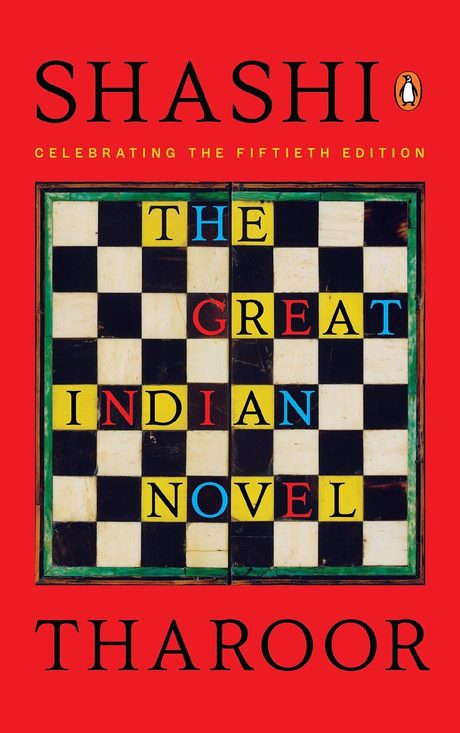
Target: twentieth century Indian politics, told as the Mahabharata
The Great Indian Novel
Shashi Tharoor1989about 866 pages
The freedom movement and the decades after it, retold with Gandhi, Nehru and Indira Gandhi cast in the epic's roles.
Tharoor takes the Mahabharata and maps modern Indian history onto it, so that a blind emperor becomes a certain kind of idealist prime minister and a determined daughter becomes something considerably more frightening. It is dictated by an old man to a reluctant secretary, it is full of puns, and it is genuinely funny about how Indian politics recycles the same family drama for a century. The prose is show-off prose and it knows it.
Why it is at 13
Thirteenth because of the entry fee. To get the jokes you need both the epic and the political history, and if either is missing half the book is a series of names doing things. That is a real limitation for a satire, which should ideally work first and reward knowledge second. Where it lands it lands hard, particularly on the Emergency.
Read it ifyou know the Mahabharata and modern Indian history and want them collided
Skip it ifyou know neither, because the book will not help you
clever, showy, wordyBest for: history and mythology readersmahabharatapoliticsindian history
14

Target: appetite, and the decade that made it a personality
Money
Martin Amis1984about 399 pages
An advertising man flies between London and New York to make his first film, consuming everything within reach, including himself.
John Self drinks, eats, spends and watches pornography at a rate designed to be unbearable, while assembling a film with actors who each want the script rewritten in their favour. Amis gives him a voice of tremendous energy, a stream of consumption that is very funny for two hundred pages and then becomes something closer to a diagnosis. There is also a character called Martin Amis, which was a much stranger move in 1984 than it sounds now.
Why it is at 14
Fourteenth because the voice is a genuine achievement and the target has become harder to hit. Excess is no longer shocking, so the transgressive charge has drained out, leaving a superbly written book about a man you would not want to sit near. The misogyny is Self's, the novel knows it, and plenty of readers still find that an unconvincing defence.
Read it ifyou want prose energy and can tolerate a repulsive narrator
Skip it ifsustained misogyny and grossness on the page are not worth the sentences to you
loud, greedy, virtuosicBest for: readers who came for the prosebritish1980sexcess
Heads up: misogyny, alcoholism, pornography, and a great deal of vomit
15

Target: the American media appetite after a tragedy
Vernon God Little
DBC Pierre2003about 219 pages
A fifteen-year-old Texan becomes the face of a school shooting he did not commit, because the town and the cameras need somebody today.
Vernon's friend kills sixteen classmates and then himself, which leaves the town, the news channels and an ambitious local fixer with a problem: there is nobody left to punish. So they settle on Vernon. Pierre writes him in a Texan teenage voice full of invented profanity, and pushes the story through interrogation, flight to Mexico and a televised finale that is grotesque in exactly the way American true crime coverage is grotesque.
Why it is at 15
Fifteenth. The target is agonisingly current, which should rank it higher, but the execution wobbles. The voice is a genuine invention and the last act tips into a broadness that lets the reader off. Compare it with The Sellout, which goes further and stays in control, and you can see the difference between rage and craft aligned and rage running ahead.
Read it ifyou want a nasty, energetic book about how a tragedy becomes content
Skip it ifschool shootings played for black comedy is a line you do not cross
manic, profane, unevenBest for: readers who want it uglyamericanmediablack comedy
Heads up: a school shooting, executions, and constant profanity
16
Target: Indian consulting, and the confident MBA
Dork
Sidin Vadukut2010about 246 pages
The diary of a management graduate who is certain he is the smartest person in every room, written by somebody who has met that man.
Robin Varghese leaves business school for a consulting job and starts a diary, which turns out to be a record of one catastrophic misjudgment after another delivered in the voice of a man who thinks he is winning. Vadukut nails the specific dialect of Indian corporate life, the slide deck as a moral position, the pointless offsite, the client who wants a number changed. It is a small book with modest ambitions and it hits all of them.
Why it is at 16
Last, and placed there honestly rather than dismissively. It is a corporate comedy with satirical aim rather than a satire, and it does not carry the weight of anything above it. But the target is alive in every office park in Gurugram and Bengaluru, and if you have sat through a consulting pitch you will laugh out loud at least four times.
Read it ifyou work in Indian corporate life and want to see it written down
Skip it ifyou want your satire to have real stakes
light, sharp, sillyBest for: office readers and commuterscorporateindiadiary
Worth knowing
How the two scores work
Still funny is the easy one. Read a page cold, with no reverence and no memory of what your teacher said about it, and see whether your face moves. Still right is the harder test, and it is the one that separates a live satire from a museum piece. Ask what the book is aiming at, then ask whether that thing is still walking around. Catch-22 aimed at the internal logic of institutions and institutions have only multiplied. Scoop aimed at a species of newspaper man who has largely been made redundant, so the same quality of writing produces less voltage.
This is also why Raag Darbari sits at number two on a list where most readers would expect a Western classic. Shukla aimed at how power gets held in an Indian district: through the college managing committee, the cooperative, the perpetual court case, the police station that everybody understands. Sixty years later not one of those mechanisms has been retired. That is the highest score a satire can get, and it is a depressing thing to award.
Worth knowing
A reading order if you want to start tonight
Begin with Animal Farm, which takes an evening and calibrates you. Then Catch-22, which will take a fortnight and change how you talk about work. Then pick a side: if you want the Indian sequence, read English, August, then Serious Men, then Raag Darbari last, because Shukla is the most demanding of the three and the most rewarding once you have the ear for it.
If you want the global sequence instead, go Confederacy of Dunces, then The Sellout, then Lucky Jim as a palate cleanser. Leave Money and Vernon God Little for when you are in the mood to be annoyed, and read Slaughterhouse-Five on its own, with nothing after it that day.
People also ask
Questions, answered
What is the best satirical novel of all time?
Catch-22, on the two tests that matter: it is still funny on any page you open, and the thing it attacks is stronger now than it was in 1961. Animal Farm is more efficient and The Sellout is funnier per line, but neither combines range and staying power the way Heller does. If you only ever read one satirical novel, that is the one.
What is the difference between satire and a comic novel?
Aim. A comic novel wants you to laugh, a satire wants you to laugh at something specific and then think worse of it afterwards. Ravan and Eddie is a very funny book that is mostly affectionate, so it reads as comedy with satirical passages. Serious Men wants you to notice who gets called intelligent in India and why. Both are worth reading, but only one of them is trying to leave a mark.
What are the best Indian satirical novels?
Raag Darbari by Shrilal Shukla, in Gillian Wright's translation, is the one most readers have never been pointed towards and the one I would start with. After that, English, August by Upamanyu Chatterjee for the civil service, Serious Men by Manu Joseph for caste and institutions, and The Great Indian Novel by Shashi Tharoor if you already know your Mahabharata. Dork is the light option.
Which satirical novel should I read first if I have never read one?
Animal Farm, because it takes about two hours, requires no background, and demonstrates the whole method in miniature. Once you have it, move to Catch-22 for scale or English, August if you want something Indian and closer to home. Avoid starting with The Great Indian Novel or Money, since both assume things about you that a first-time reader of satire will not have.
Do satirical novels age badly?
Some do, and it is worth knowing which before you buy. A satire dies when its target dies. Scoop is close to a perfect comic novel and its subject, the expense-account foreign correspondent, has mostly gone, so the sting is lighter now. Books aimed at permanent human arrangements, bureaucracy in Catch-22, power in Animal Farm, caste in Serious Men, are the ones that keep working.
Before you go
What to read tonight
Start with Animal Farm tonight if you have never done this before, and Catch-22 next week if it worked on you. If you already know the Western canon and want the gap in your reading filled, order Raag Darbari, put aside the expectation that a satire must be fast, and give it fifty pages before you judge it.
One last thing worth carrying out of this list. The books that survive are the ones aimed at arrangements rather than at people. Personalities date, and the man everybody was mocking in 1984 is now somebody's grandfather. Systems do not date. Which is why a novel about air force paperwork written before your parents were born can still describe, with unpleasant accuracy, the call you had with your bank on Tuesday.
Keep going
Lists that pair with this one
Comedy
18 Funny Books That Are Actually Funny, Ranked by Laugh Type
Three tiers, spit-your-tea, snort and chuckle, decided by what my face actually did while reading.
Comedy
The 16 Best Comedian Memoirs, Ranked by How Funny the Page Is
Stage-funny does not always survive the printing press, so I scored every one of these on the page alone.
Comedy
The 14 Funniest British Novels, Ranked by How Well They Travel
Dry, rude and obsessed with class, with an honest note on how much British context each one needs before the joke lands.
Indian Fiction
The 20 Best Indian Books in Translation, Ranked by Where to Start
Twenty books from ten Indian languages, ordered from the easiest way in to the one that will fight you, with the translator named every time.
Indian Fiction
16 Best Books to Understand India, Ranked by What They Explain
Sixteen books, ten doors into the same country: history, caste, the mega city, the village, money, and where to start tonight.