The first Urdu couplet that ever landed on me came at a cousin's sangeet in Ahmedabad, past midnight, when an uncle recited two lines of Faiz and the room went quiet in a way no song had managed all evening. I understood maybe four words. I nodded like I had understood forty. On the drive home I typed what I could remember into my phone, found the English translation, and it was correct, careful, flat, and worth about ten percent of what had happened in that room.
That gap is the whole problem with reading Urdu poetry in English. A ghazal runs on sound: a rhyme that returns, a refrain that lands like a door shutting, a rhythm you feel before you know the meaning. English carries the sense across easily enough. It cannot carry the music. Which is why the better books on this list do something smarter than translate, and give you the original alongside, either in Urdu script or in Roman letters, so you can hear the line while you read what it means.
So the order here is a ladder, not a hall of fame. Number one is where I would start a friend who knows no Urdu and has never read poetry by choice. By number twelve you are with a philosopher who wrote a large part of his work in Persian, and by then you are ready for him. Every book is real, and I checked each English edition myself rather than trusting a listicle. Quick picks are below if you want to buy one and get on with your evening.
How I picked these
- Ladder order, not greatness order. Ghalib is the finest poet on this list and he sits at eight, because starting with Ghalib is how most people decide Urdu poetry is not for them.
- Every edition checked through Google Books and Open Library with a real cover, so there are no ghost editions and no print on demand blanks here.
- I favoured books that give you the original as well as the English, in Urdu script or Roman transliteration, because half of a ghazal is its sound.
- Cut on purpose: great poets whose English editions exist only as scanned library volumes. Jaun Elia and Ahmad Faraz lost their slots that way, and it annoys me more than any other decision on this list.
- Two anthologies, one for the ghazal and one for the nazm, both by the same editor, because nobody else has done that job as well in English.
The whole list at a glance
All 12 books, in order
| # | Book | Author | Year | Vibe | Best for |
|---|
| 1 | The Taste of Words: An Introduction to Urdu Poetry | Raza Mir | 2014 | friendly, curious, unhurried | absolute beginners |
| 2 | The Colours of My Heart | Faiz Ahmed Faiz | 2017 | tender, defiant, quotable | readers who want one poet |
| 3 | Selected Poems | Gulzar | 2008 | quiet, playful, domestic | Hindi film song lovers |
| 4 | Kaifiyat: Verses on Love and Women | Kaifi Azmi | 2019 | direct, angry, humane | readers who like nazms |
| 5 | Hazaron Khawaishen Aisi: The Wonderful World of Urdu Ghazals | Anisur Rahman | 2018 | orderly, generous, teacherly | readers ready for the form |
| 6 | Defiance of the Rose | Parveen Shakir | 2019 | intimate, sharp, unapologetic | readers in their twenties |
| 7 | Sahir: A Literary Portrait | Surinder Deol | 2019 | biographical, affectionate, thorough | film song obsessives |
| 8 | Ghalib: Selected Poems and Letters | Mirza Asadullah Khan Ghalib | 2017 | dense, witty, bottomless | readers who want the summit |
| 9 | Selected Ghazals and Other Poems | Mir Taqi Mir | 2019 | spare, mournful, exact | patient readers |
| 10 | Hazaar Rang Shaairi: The Wonderful World of the Urdu Nazm | Anisur Rahman | 2022 | wide, patient, modern | readers who want the modern side |
| 11 | Four Walls and a Black Veil | Fahmida Riaz | 2004 | blunt, political, unafraid | readers who like difficult women |
| 12 | Tulip in the Desert: A Selection of the Poetry of Muhammad Iqbal | Muhammad Iqbal | 2000 | grand, philosophical, demanding | readers who like ideas |
The list
The books, ranked
1
Urdu needed: none
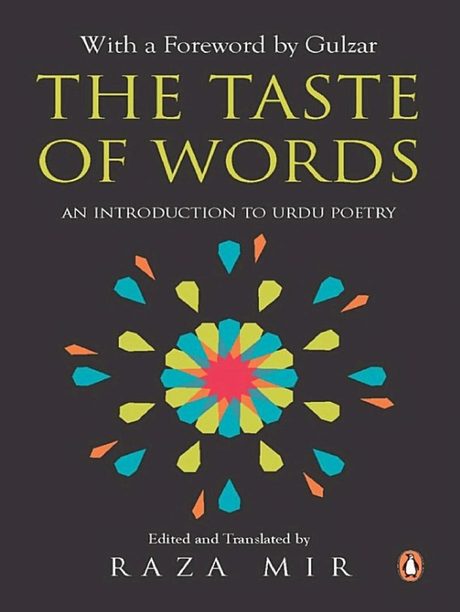
The Taste of Words: An Introduction to Urdu Poetry
Raza Mir2014about 328 pages
The book to buy if you have never read an Urdu poem and would rather not feel stupid about it.
Raza Mir teaches management in New Jersey and is, on the side, one of the warmest guides Urdu poetry has in English. He moves through dozens of poets from the eighteenth century to now, giving each poem in Roman letters so you can say it aloud, then the English, then a short piece of context: who this person was, what they were furious about, why the couplet your relatives quote at weddings is actually far sadder than the wedding. The register is a friend explaining rather than a scholar lecturing, and it assumes you know nothing without ever making that feel awkward.
Why it is at 1
First because it fixes the real problem. Most Urdu poetry books in English hand you a translation and wish you luck, so you get the meaning and never hear the poem. This one gives you the sound in Roman letters, the sense in English and the story behind the poet, which is the scaffolding a beginner actually needs. Read it before anything else here and every other book on this list gets easier.
Read it ifyou want to finally understand the couplets people quote at weddings
Skip it ifyou already read Urdu and want the poems without a guide holding your hand
friendly, curious, unhurriedBest for: absolute beginnersanthologybeginnertransliteration
Pairs with: Hazaron Khawaishen Aisi, once you know which poets you like
2

Urdu needed: none
The Colours of My Heart
Faiz Ahmed Faiztranslated by Baran Farooqi2017about 147 pages
The love poems read like protest and the protest poems read like love, which is the entire trick of Faiz.
Faiz Ahmed Faiz lived from 1911 to 1984, worked as a journalist and a teacher, was jailed by the Pakistani state in the 1950s, and wrote some of his most famous poems inside prison. Baran Farooqi's selection runs across his career, from the early romantic work to the political poems that got sung at protests for the next seventy years. What makes him the easiest great Urdu poet to read in English is that his images are pictures rather than wordplay: a dawn that is not the promised dawn, a beloved who might be a woman or a country. Pictures survive the crossing.
Why it is at 2
Second because if you read one poet from this list, it should be him. Faiz loses less in translation than anyone else here, and he gives a new reader the two things that hook people on poetry: lines you want to send to somebody, and the sense that a poem can be about your own government. Ghalib is greater. Faiz is where you start.
Read it ifyou want poems that work as love and as politics at once
Skip it ifyou want love poetry with no politics anywhere near it
tender, defiant, quotableBest for: readers who want one poetfaizmodernprotest
3

Urdu needed: none
Selected Poems
Gulzartranslated by Pavan K. Varma2008about 98 pages
You have been listening to this man since childhood without once calling it poetry.
Gulzar writes film songs that people mistake for simple, and poems that people mistake for songs. This selection, translated by Pavan K. Varma, is bilingual, so the original sits with the English and you can follow the sound even if you read only one of the two scripts. The poems are short, domestic and slightly odd: a moon that behaves like a neighbour, a train window, a woman's absence measured in ordinary objects. He also works in the triveni, a three line form he invented, where the third line turns the first two inside out.
Why it is at 3
Third because familiarity is a gift for a beginner and Gulzar is the most familiar voice in Urdu poetry for anyone raised on Hindi films. You already know his cadence, so the page feels less like homework. He is not the deepest poet here and he does not claim to be, but he is the shortest bridge between the songs you hum and the poems you have avoided.
Read it ifyou love film lyrics and want to see where they come from
Skip it ifyou want grand classical ghazals rather than small domestic poems
quiet, playful, domesticBest for: Hindi film song loversgulzarmodernbilingual
4

Urdu needed: none
Kaifiyat: Verses on Love and Women
Kaifi Azmitranslated by Rakhshanda Jalil2019about 180 pages
A communist film lyricist writing about women as people rather than as scenery, decades before it was fashionable.
Kaifi Azmi wrote lyrics for Hindi cinema, belonged to the Progressive Writers movement, and produced a body of poetry that keeps returning to one subject: what this society does to its women, and what it costs. Rakhshanda Jalil's selection gathers those poems, including the famous nazm that tells a woman to get up and walk beside the man rather than behind him. The poems are direct, often angry, and easier on a new reader than the classical ghazal, because a nazm argues one thing from beginning to end instead of leaping between couplets.
Why it is at 4
Fourth because it gives you modern Urdu poetry with a spine and a clear subject, which is a good place to be after Faiz and Gulzar have warmed you up. If you have watched Shabana Azmi in anything, you will recognise the family politics behind these poems. The caveat is scope: this is a themed selection, so you get one side of Kaifi rather than the whole man.
Read it ifyou want political poetry about women that is not written like a pamphlet
Skip it ifyou are looking for a complete overview of Kaifi Azmi's work
direct, angry, humaneBest for: readers who like nazmskaifi azminazmfeminist
5
Urdu needed: none, patience needed: some
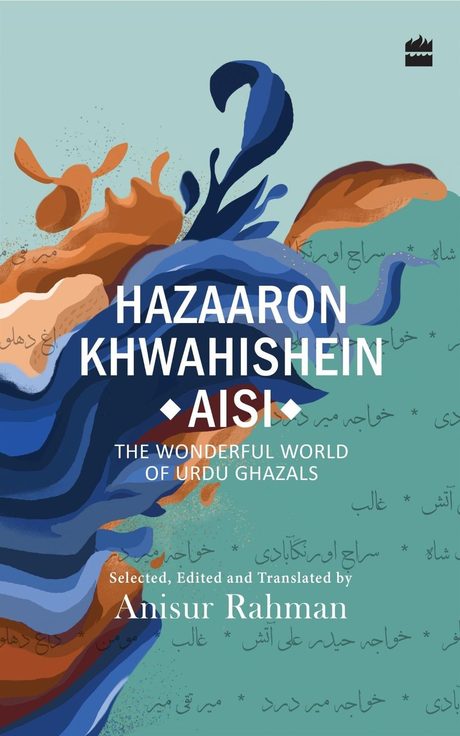
Hazaron Khawaishen Aisi: The Wonderful World of Urdu Ghazals
Anisur Rahman2018about 401 pages
The map of the ghazal, three centuries of it, with an editor who tells you how the form actually works.
Anisur Rahman taught English for decades and has spent the years since building the anthologies Urdu poetry in English badly needed. This one takes the ghazal from the eighteenth century to the present, gives you poets in sequence rather than in isolation, and opens with an introduction that explains the machinery: the repeated refrain, the rhyme that comes just before it, the way each couplet is its own small world. Reading it feels like being walked through a very old building by someone who knows which staircases are safe.
Why it is at 5
Fifth because an anthology is worth more than a single poet once you know your own taste, and this is the best ghazal anthology in English I have used. It sits below the individual collections deliberately: anthologies are for choosing, not for falling in love. Use it to find three poets you want to live with, then buy their books.
Read it ifyou want to see the whole tradition before picking a favourite
Skip it ifyou would rather go deep with one poet than sample forty
orderly, generous, teacherlyBest for: readers ready for the formanthologyghazalhistory
6
Urdu needed: none
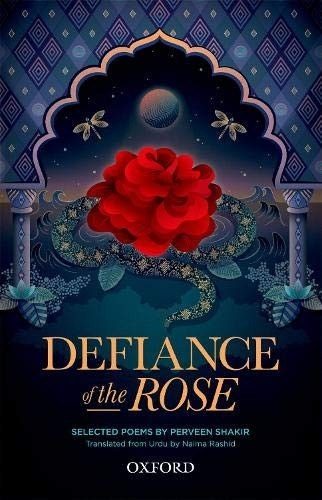
Defiance of the Rose
Parveen Shakirtranslated by Naima Rashid2019about 308 pages
The poet who wrote desire from a woman's side of the room and was called shameless for the trouble.
Parveen Shakir published her first collection, Khushbu, in 1976, worked in the Pakistani civil service, and died in a car accident in Islamabad in 1994 at forty two. Her poems put a woman at the centre of the ghazal as the one who wants rather than the one who is wanted, which sounds unremarkable now and was not remotely unremarkable then. Naima Rashid's translations keep the sharpness rather than smoothing her into a greeting card, and the selection covers the early romantic work as well as the later, colder poems about marriage and reputation.
Why it is at 6
Sixth because this list would be dishonest without a woman's voice near the top, and because Shakir is the poet most likely to make a young reader feel personally addressed. She is less quoted than Faiz and less studied than Ghalib, which says more about who does the quoting than about the poems. The English can only carry so much of her wordplay, and Rashid says so herself.
Read it ifyou want love poetry written from the woman's point of view
Skip it ifyou want the grand public poetry of protest and history
intimate, sharp, unapologeticBest for: readers in their twentiesparveen shakirmodernwomen poets
7
Life plus poems, not a pure collection
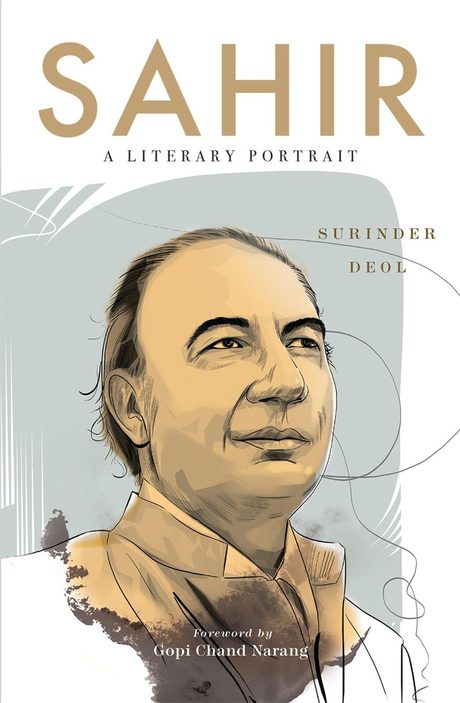
Sahir: A Literary Portrait
Surinder Deol2019about 343 pages
The man who wrote Pyaasa's songs, and the poems those songs were quietly recycling.
Surinder Deol builds a life of Sahir Ludhianvi around free verse translations of more than ninety of his poems and songs, so you get the biography and the work in one volume. Sahir is the rare figure who was a serious Urdu poet before he was a film lyricist and stayed one afterwards, which is why the songs carry lines nobody would risk writing today. The portrait covers the Ludhiana years, the move to Bombay, the political poems, and the long unhappy business of his private life without turning it into gossip.
Why it is at 7
Seventh because it is a hybrid and you should know that before buying. If you want a clean book of Sahir's poems with facing text, this is not quite it. What it does give you is context, which for a poet who lived inside the film industry turns out to matter enormously. Read it after Kaifi Azmi and the two of them start talking to each other.
Read it ifyou love old Hindi film songs and want the poet behind them
Skip it ifyou want poems alone with no biography wrapped around them
biographical, affectionate, thoroughBest for: film song obsessivessahirbiographyfilm
8
Urdu needed: helps a lot
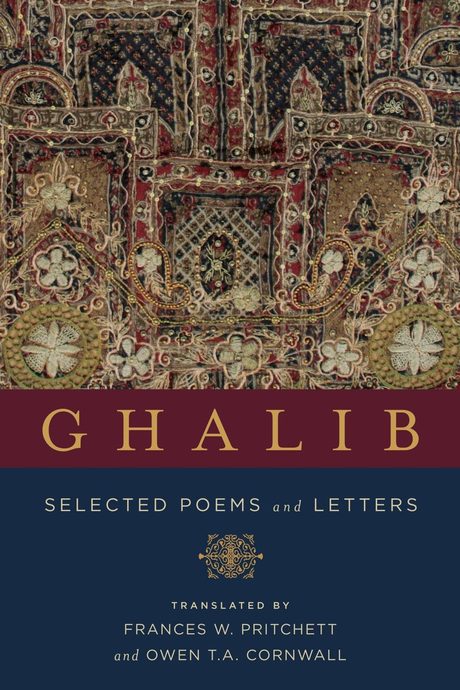
Ghalib: Selected Poems and Letters
Mirza Asadullah Khan Ghalibtranslated by Frances W. Pritchett and Owen T. A. Cornwall2017about 334 pages
The greatest poet in the language, plus the letters that make him a person you would actually want to drink with.
Ghalib lived from 1797 to 1869, watched Delhi burn in 1857, wrote constantly to friends about money, mangoes and mortality, and produced ghazals so compressed that Urdu readers still argue about single lines. This Columbia edition pairs a selection of the poems with a selection of the letters, and includes the Urdu text of the original poetry, which matters because a bare English Ghalib often reads like a shrug. The letters are the surprise: gossipy, self mocking, completely modern, the voice of a man complaining about his pension.
Why it is at 8
Eighth, and not because he is eighth best. Ghalib demands more from a reader than anyone else here, and the usual way people meet him is a bad translation on Instagram, which teaches them that the greatest Urdu poet writes fortune cookies. Come to him after the modern poets have taught you the grammar of the ghazal, use the letters as the door, and he opens up.
Read it ifyou are ready to reread a couplet four times and enjoy it
Skip it ifyou want poems you can absorb on a metro ride at speed
dense, witty, bottomlessBest for: readers who want the summitghalibclassicalletters
9
Urdu needed: helps a lot
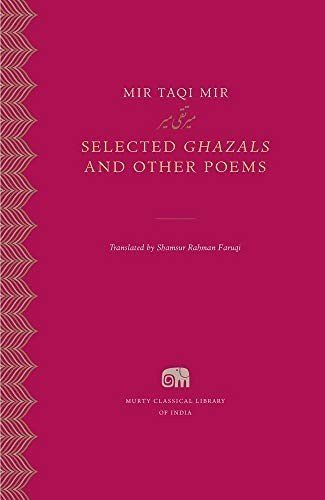
Selected Ghazals and Other Poems
Mir Taqi Mirtranslated by Shamsur Rahman Faruqi2019
The poet Ghalib himself looked up to, in an edition that prints the original facing the English.
Mir Taqi Mir wrote in the eighteenth century, lived through the sacking of Delhi more than once, and moved to Lucknow late in life carrying the grief of a city that no longer existed. His ghazals are plainer than Ghalib's and sadder, built on ordinary words placed with terrible precision. This Murty Classical Library volume comes with translations by Shamsur Rahman Faruqi, who spent a lifetime on Mir, and the series prints the original text facing the English so you can follow the line as you read.
Why it is at 9
Ninth because Mir asks for the same patience as Ghalib without the letters to ease you in. He rewards it differently: where Ghalib dazzles, Mir just quietly breaks something in you. Faruqi's introductions are the best company you can have for this poetry. Come here once the ghazal has stopped feeling like a foreign object.
Read it ifyou like plain language that turns out to be devastating
Skip it ifyou are new to the ghazal and want an easier first climb
spare, mournful, exactBest for: patient readersmirclassicalbilingual
10
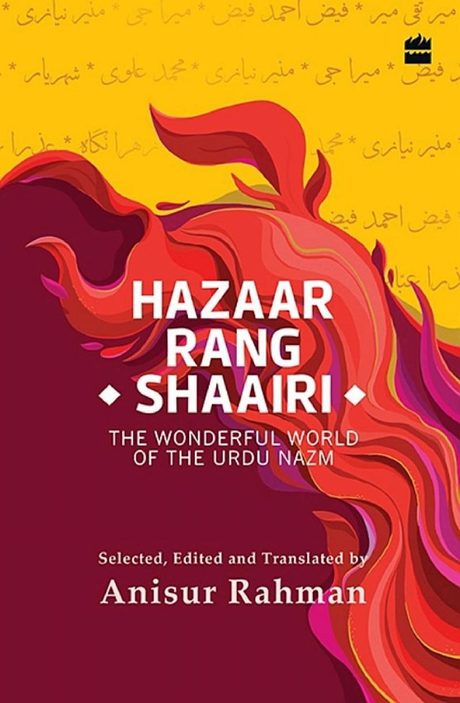
Urdu needed: none
Hazaar Rang Shaairi: The Wonderful World of the Urdu Nazm
Anisur Rahman2022about 426 pages
The companion anthology for the other half of Urdu poetry, the one that is not built on couplets.
If the ghazal is the form everybody quotes, the nazm is where modern Urdu poetry has done most of its thinking. This anthology follows the nazm through its long argument with itself, from the reformers of the nineteenth century to poets writing now, with Rahman's translations and the same patient introductions he gave the ghazal book. It is the better volume for a reader who finds couplets frustrating, because a nazm holds one subject and follows it through, the way an English poem does.
Why it is at 10
Tenth because it is a second helping rather than a first course, and because you will get more from it once the earlier books have given you names to look for. Yes, Anisur Rahman appears twice on this list. That is not laziness on my part, it is that no one else in English has mapped both forms this carefully.
Read it ifyou found the ghazal too fragmented and want whole poems
Skip it ifyou already own the ghazal anthology and want a different editor
wide, patient, modernBest for: readers who want the modern sideanthologynazmmodern
11
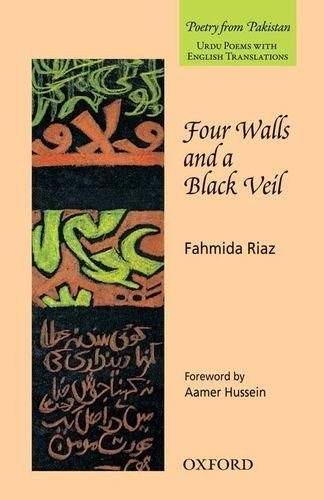
Urdu needed: none
Four Walls and a Black Veil
Fahmida Riaz2004about 156 pages
Poems about the body, exile and the state, by a woman who had to leave her country for writing them.
Fahmida Riaz wrote about desire and the female body at a time when the Pakistani state under Zia ul Haq took a direct interest in what women published, and she spent years of exile in India as a result. This English selection carries the poems that made her dangerous: sexuality written without shame, motherhood written without sentiment, and later work about borders and the disappointing sameness of the two countries. Her voice is harder and more political than Parveen Shakir's, and there is very little decoration in it.
Why it is at 11
Eleventh because it is a specialist pleasure rather than an entry point, not because it is a lesser book. Riaz asks you to care about the politics of Pakistan in the 1970s and 1980s, and the poems land far harder once you do. Read her after Shakir and you will see two completely different answers to the same problem.
Read it ifyou want feminist poetry with the politics left in
Skip it ifyou would rather not read about the body in blunt terms
blunt, political, unafraidBest for: readers who like difficult womenfahmida riazfeministpakistan
Heads up: frank writing about sexuality, the body and state violence
12
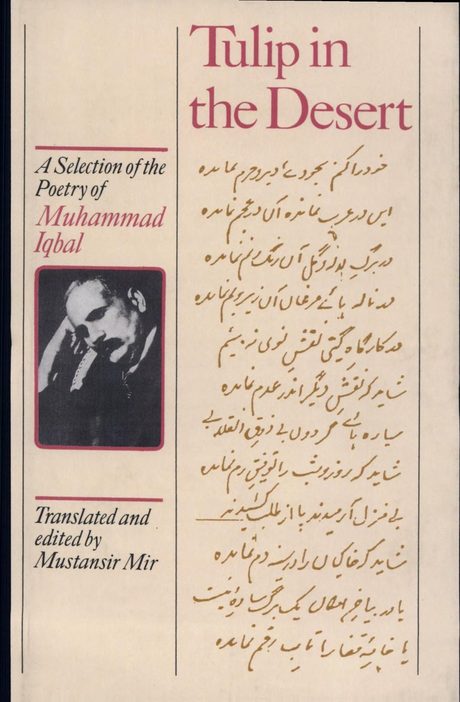
Urdu needed: none, philosophy tolerance needed: high
Tulip in the Desert: A Selection of the Poetry of Muhammad Iqbal
Muhammad Iqbaltranslated by Mustansir Mir2000about 184 pages
The poet who wrote Sare Jahan Se Achha and then spent his life arguing with everyone, including himself.
Iqbal is claimed by India and Pakistan both, taught in schools on either side of the border, and read properly by fewer people than either country pretends. Mustansir Mir's selection gives you the range: the early patriotic poems, the long arguments with God, the poems about selfhood and will that made Iqbal a philosopher who happened to write in verse. Mir translates for meaning rather than music and explains what he is doing, which is the honest approach with a poet this loaded with ideas.
Why it is at 12
Last on the ladder because Iqbal is the least immediately enjoyable poet here and the most argued over. He rewards a reader who already has the taste, and he frustrates one who does not. There is a further catch: a large part of his major work is in Persian, so an Urdu route to Iqbal will always be partial. Come here twelfth and you will get far more from him.
Read it ifyou want ideas and argument rather than mood and longing
Skip it ifyou read poetry to feel something rather than to think something
grand, philosophical, demandingBest for: readers who like ideasiqbalphilosophyclassical
Worth knowing
The script question, answered honestly
Urdu is written in the Nastaliq script, right to left, and almost nobody arriving at this list from Google can read it. That leaves three ways a book can help you. It can print the Urdu text alongside the English, which is useful if you read the script or want to learn it. It can give you a Roman transliteration, so you can pronounce the line without knowing the alphabet, which for most readers here is the genuinely useful option. Or it can give you English alone, which is cheapest to print and leaves you with the meaning and none of the music.
Editions change between printings, so check the sample pages before you pay. What I can say from the copies and the publisher descriptions I checked: Raza Mir gives you the Roman transliteration with the English, the Columbia Ghalib includes the Urdu text of the poems, the Murty Mir prints the original facing the translation, and the Penguin Gulzar is described by its publisher as a bilingual edition.
If your book turns out to be English only, keep Rekhta open on your phone while you read. The same poem is usually there in Urdu, Devanagari and Roman letters, and often with a recording of somebody reciting it. Reading the English, then saying the Roman aloud, then hearing it sung is the closest an outsider gets to the thing that happened in that room at my cousin's sangeet.
Worth knowing
The poets who are missing, and why
Jaun Elia and Ahmad Faraz are the two names I get asked about most, and neither made this list. Not because they are minor, they are the opposite, but because I could not find an English edition of either that a normal reader could buy with confidence: what turned up was scanned university volumes and print on demand books with blank covers. If a good Indian publisher fixes this, they belong at numbers four and five.
Amrita Pritam is missing for a different reason. She wrote in Punjabi, not Urdu, and putting her here would be flattering the list at the cost of the truth. Agha Shahid Ali's 1991 translations of Faiz, published as The Rebel's Silhouette, are real and worth hunting for if you like the poet after book number two, though the copy you find will probably be secondhand.
People also ask
Questions, answered
Which Urdu poetry book should I read first in English?
The Taste of Words by Raza Mir. It gives you each poem in Roman letters so you can hear it, the English so you understand it, and a paragraph of context so you know why the poet was upset. Most other books give you only the third of those, which is how readers end up believing Urdu poetry is nothing but roses, wine and sighing. Read it, work out which poets you liked, then buy their own collections.
Can Urdu poetry survive translation into English?
Partly, and it depends on the form. The nazm, a poem that follows one subject from start to finish, crosses over well: Faiz, Kaifi Azmi and Gulzar read almost as themselves in English. The ghazal loses much more, because its engine is a rhyme and a refrain returning at the end of every couplet, and English has no way to reproduce that without sounding like a birthday card. This is exactly why the better editions print the original next to the translation.
What is the difference between a ghazal and a nazm?
A ghazal is a run of independent couplets sharing a metre, a rhyme and a repeated refrain. Each couplet stands alone, so a single ghazal can move from a lover to God to a joke about the neighbours within six lines. A nazm is one poem about one thing, developed from beginning to end the way most English poems are. Beginners usually find the nazm easier to enter and the ghazal harder to stop reading once it clicks.
Which Urdu poetry books include the Urdu script or a Roman transliteration?
It varies by edition, so check the sample pages before buying. On this list, Raza Mir prints Roman transliteration with the English, the Columbia edition of Ghalib includes the Urdu text of the original poems, the Murty Classical Library Mir prints the original facing the translation, and the Penguin Gulzar is described by its publisher as bilingual. If the book you own is English only, keep Rekhta open beside it for the script and the pronunciation.
Is there a good English translation of Jaun Elia?
Not one I can point you to with a clear conscience, which is why he is absent from this list. Jaun Elia is the poet young readers ask about most, largely thanks to the mushaira clips online, and the English editions I could verify were either scanned academic volumes or print on demand books with no real cover. Until a proper edition appears, read him on Rekhta with the Roman transliteration switched on and treat the English there as a crutch.
Do I need to know Urdu to enjoy Ghalib?
No, but you need help, and you need to come to him in the right order. Ghalib packs several turns into two lines, so a bare English translation often lands as a shrug and readers conclude he is overrated. Start with his letters, which are funny, gossipy and startlingly modern, then move to the ghazals in an edition that gives you notes and the original text. That is why the Columbia selection is on this list.
Before you go
What to read tonight
If you want to start tonight, buy The Taste of Words and read fifteen pages before bed, out loud, badly. The mispronunciation is part of the process and nobody is listening. If you are choosing between the two obvious names, take Faiz first and Ghalib second, because Faiz will make you want more Urdu and Ghalib will make you want a teacher.
Then, once a poet has hooked you, go and hear the poems sung. Faiz has been recorded by half the subcontinent, Ghalib was sung into a whole generation's memory by Jagjit Singh, and hearing a ghazal after reading it is the moment the form finally makes sense. The book hands you the meaning. The singer hands back the sound that the translation had to leave behind.
Keep going
Lists that pair with this one
Mood & Life
17 Best Poetry Books for Beginners, Including the Indian Ones
Ordered by the sequence I would actually hand them to you, with one poem named in each as your way in, because nobody reads poetry cover to cover.
Indian Fiction
The 20 Best Indian Books in Translation, Ranked by Where to Start
Twenty books from ten Indian languages, ordered from the easiest way in to the one that will fight you, with the translator named every time.
Authors
10 Saadat Hasan Manto Books in English (And Which Translation to Buy)
Ranked as a buying order, not a greatness order, so each book you add repeats the least of the one before it.
Indian Fiction
The 13 Best Hindi Novels, and Whether the English Version Works
Ranked, with every book's English translation named and judged, because most of us will read at least half of these in translation.
Indian Fiction
16 Best Books to Understand India, Ranked by What They Explain
Sixteen books, ten doors into the same country: history, caste, the mega city, the village, money, and where to start tonight.